

Registration is required, please email artepoderygenero@um.es
Please find the complete programme below:
Registration is required, please email artepoderygenero@um.es
Please find the complete programme below:
Our next Research Seminar will take place on 30 November at 18.00 on zoom:
Dr Francisco Montes, Female Power and Visual Culture in Viceregal America
Abstract: This paper presents an overview of the findings in current research focusing on how the influence exerted by certain women in Spanish colonial society can be measured from the visual field. For this purpose, an extensive iconographic repertoire of casta paintings and sumptuous portraits of aristocrats, chieftains and nuns have been the most eloquent tools to analyze this phenomenon. However, there were other symbolic representations of female power, embodied by distant sovereigns and absent vicereines, which still need to reveal a multiplicity of hidden meanings.
About the speaker: Francisco Montes is Associate Professor of Art History at the University of Seville, where he also obtained his Ph.D. in Colonial Latin American Art. His research is primarily focused om artistic patronage, ritual festivals and the exchange of images between Spain, Italy and the Iberian Americas during the viceregal period. Montes is author of the books Sevilla Guadalupana. Arte, historia y devoción (2015) and Mecenazgo virreinal y patrocinio artístico. El ducado de Alburquerque en la Nueva España (2016). He is editor of the volume Religiosidad andaluza en América. Repertorio iconográfico (2017). He is a member of the editorial board of Anuario de Estudios Americanos.
To join the event, please register here: https://forms.office.com/pages/responsepage.aspx?id=i9hQcmhLKUW-RNWaLYpvlGP-wSu2R1JFpVjsNyCAKKVUOERSMThWRlpIMzFTN0JLQ0xGUUVNMFA1OS4u
The seminar is organised by the Zurbarán Centre with the ARTES Iberian and Latin American Visual Culture Group. It will be chaired by Dr Piers Baker-Bates (The Open University / ARTES).
Investigating the Spanish Roots of Filipino Catholic Devotion through the Santo Niño de Cebú
Through the generous funding of the Artes-CEEH Travel Scholarship, I was able to conduct invaluable research not only for my Courtauld History of Art MA dissertation but also for a future publication. By visiting the cities of Barcelona and Madrid, I enriched my investigation into the material and devotional history of the Santo Niño de Cebú, a sixteenth-century statue of the Christ Child brought by the explorer Ferdinand Magellan to the Philippine islands in 1519. As a native Filipino, my inquiry stems from an interest in this object’s role in fueling the Spanish Empire’s colonization of the archipelago and its contemporary veneration by Filipino Catholics.
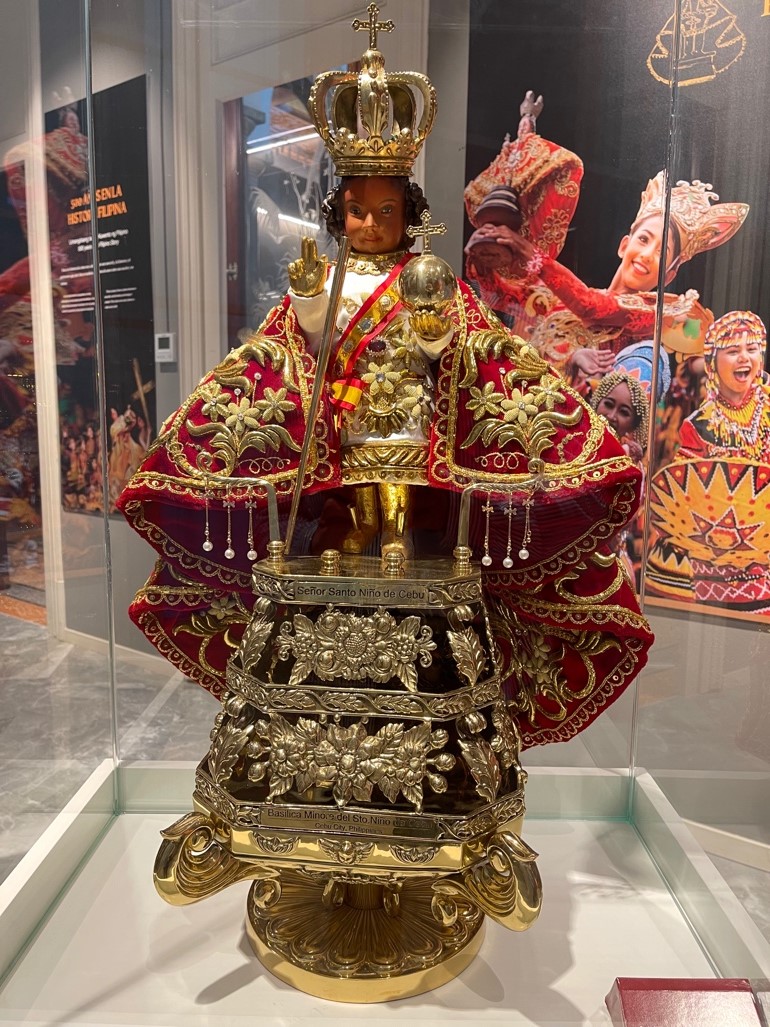
In April 2022, I travelled to Barcelona to visit the exhibition, Santo Niño de Cebú: An Icon of Philippine Culture and History. The show was staged in celebration of the quincentennial of Magellan’s, and, therefore, the Santo Niño’s, arrival in the Philippines. Organized by the Filipino Catholic church and the Consulate General of the Philippines in Barcelona, the jewel of the exhibition was an exact replica of the Santo Niño de Cebú statue. It was displayed in the eighteenth-century office spaces of the Philippine Consulate General along with paintings and informational texts explaining the Santo Niño’s history and the ways in which Filipinos celebrate the icon today. The island nation’s reverence for this statue is rooted in an idealized version of history that honors Magellan’s act of gifting the Santo Niño icon to the local rulers of Cebú Island. This positivist view overlooks the 333 years of colonization that ensued from the Spanish arrival. Today, Magellan’s act of gifting is remembered through two major festivals called Sinulog and Ati-atihan. Celebrated in Cebú in the month of January, Sinulog begins with a grandiose fluvial procession, during which the Santo Niño statue is sailed through Cebú’s coastline and then carried through the streets by the annual Sinulog queen, a role that commemorates the native Cebúano queen Humamay, who received the original statue from Magellan. The latter festival, Ati-atihan, commemorates the Santo Niño’s acceptance by the Aeta, a term for indigenous Filipinos. The festival’s name means ‘to be like the Aeta’ and is celebrated through street processions for which Filipinos paint themselves black to mimic the dark features of their indigenous ancestors.

I was led through the exhibition by Philippine Cultural Ambassador Bernardo Bagalay. He answered my questions regarding the Santo Niño’s history and confirmed my hypothesis that the statue was originally produced in Mechelen. Known as enfants des Malines, these statues were produced and sold for private devotional use, especially by nuns. Bagalay also informed me of a ceremonial mass that was held to commemorate the Santo Niño’s symbolic ‘return’ to Spain in the form of the exact replica. This mass was held in the renowned Basilica de la Sagrada Familia and Bagaly showed me images and videos of the event. I also learned from him that, after the exhibition, the replica statue would go on to be displayed at the San Agustin Church, which is frequented by the Filipino community of Barcelona. This move was based on making the statue more accessible. I thoroughly enjoyed listening to Bagalay stories of visitors who were moved by the exhibition. For example, the day before my visit, a group of Filipino women from Cebú stumbled upon the show and began singing local Cebúano canticles around the statue.
To further investigate the contemporary veneration of the Santo Niño de Cebú, I visited the San Agustin Church in Barcelona and listened to a Filipino mass. I also did the same in Madrid’s Paroquia del Santo Niño de Cebú, which has its own replica statue. These site visits and engagement with Filipinos abroad proved to be crucial fieldwork for my dissertation. In addition to the site visits that focused on Filipino Catholic devotion, my trip to Spain coincided with Semana Santa. It was insightful to witness the processions of pasos through the crowded streets of Madrid. I was able to tap into my childhood memories of participating in similar processions in the Philippines. Seeing these traditions in Spain allowed me to better understand just the influence of Spanish Catholicism on its Filipino counterpart. Overall, the Artes-CEEH Travel Scholarship made my dissertation possible and has laid the foundations for me to develop my project into a longer, future publication, which I will write after visiting the Philippines at the end of 2023.

Full Programme available here: bit.ly/3Xv2EQ8
To register please use the online form: https://agenart.org/seminarios/seminario-internacional-representar-la-reginalidad-en-la-monarquia-de-los-austrias-siglo-xvii/
The BritishSpanish Society is hosting an evening of music, wine and tapas at St James’s Church Picadilly this Friday 25 November 2022, doors open at 5:30 pm
The BSS is delighted to once again be holding their Autumn Concert in the impressive St James’s Church, Piccadilly. The church, which dates back to 1676, was designed by highly acclaimed British Architect Sir Christopher Wren. Wren’s aim for the church was to enable the largest number of people to hear the service and see the preacher. The acoustic qualities of the church have been consistently celebrated with the church hosting music greats across the ages from Haydn to Adele.
This year’s music director is former BritishSpanish Society scholarship winner Nicole Crespo O’Donoghue. Nicole describes the concert’s programme as a ‘celebration of Spanish composers’.
Programme (subject to change)
Julia Sanchez Merino (mezzo soprano) – A selection of songs by Falla & Lorca
Laura Peribañez (cello) – Allegro appassionat by T. Buxó
Lucia Veintimilla (violin) – Salve Regina by Jorge Muñiz & 3 ‘Hyperludes’ by F. Coll
Daisy Noton (flute) – Carmen Fantasy by F. Borne
Laura Peribañez & Nicole Crespo – Tango – I. Albeniz
Nicole Crespo (violin) – Playera and Zapateado by Sarasate
Ticket price includes a tapas and wine reception following the concert. The event is open to members and non-members.
Tickets available here: https://www.britishspanishsociety.org/events/talented-british-and-spanish-musicians/?currency=EUR

Please find the programme here: https://iemyrhd.usal.es/wp-content/uploads/2022/11/Triptico-.pdf
Thanks to the generous support of the ARTES-CEEH Travel Scholarship, I was able to carry out some research at the Biblioteca Nacional in Madrid, Spain, in June 2021. The topic of my dissertation, The Archangel Saint Michael in the Fifteenth-century Crown of Aragon: a different perspective, gives an idea of the period I needed to research and the language in which many sources were written. It was difficult to find many journals about 15th century Spanish art (specifically in the Crown of Aragon) in the main libraries in London, due to the fact that they are Spanish publications. I had to do most of my research online due to the restrictions imposed by the pandemic and online access to these types of journals was extremely difficult. A similar situation happened when I tried to access small museums online (diocesan museums in the regions of Cataluña, Valencia, Murcia). So, even if I knew there were some interesting examples of altarpieces in these cities, I couldn’t find or use any images.
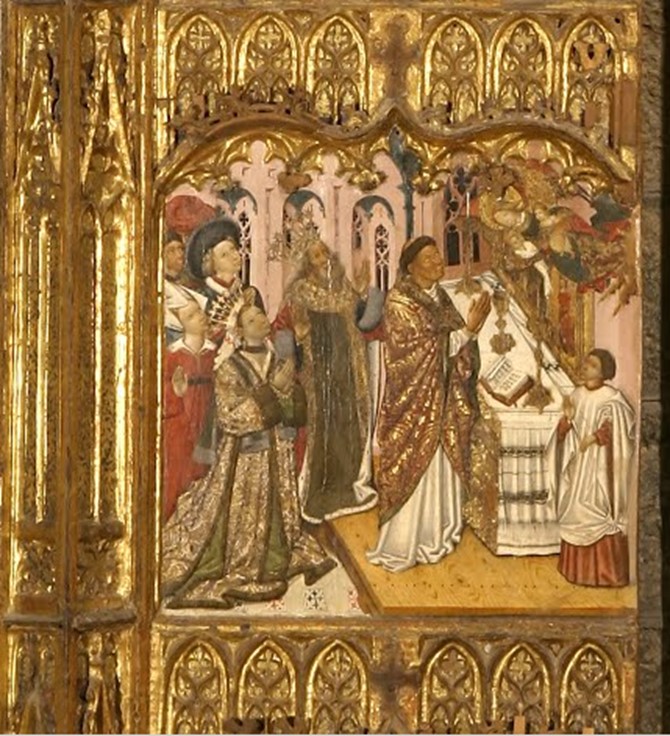
The Travel Scholarship allowed me to travel to Madrid and expand my research, but sadly, due to the Covid restrictions that were in place in Spain at that time, I couldn’t travel to other cities to visit these small museums. Nonetheless, I managed to spend some time checking publications that were not available in London. Hence, I am most grateful to ARTES and CEEH for helping me to expand the research for my final dissertation.
The Public Statues and Sculpture Association (PSSA) is hosting an online lecture on the seventeenth-century Seville sculptor Pedro Roldán and his legacy as a master, discussing the work of some of his pupils, including of course his daughter Luisa, to be given by Cathy Hall van den Elsen on Tuesday 22 November at 7.30 pm.
The talk is free for PSSA members, and only £3.50 for non-members. Register here: https://www.eventbrite.co.uk/e/sculptural-lineage-masters-and-pupils-tickets-430347028547
The talk forms part of the PSSA series, Sculpture Lineage. Masters and Pupils. For more information please see: https://pssauk.org/event/sculptural-lineage-masters-and-pupils-2/
In 2021 I was awarded an ARTES-CEEH Travel Scholarship for the project “My darling, fly thou: New iconography of the Song of Songs in Iberian medieval sculpture”. Unfortunately, Covid forced me to delay my research and I was unable to pursue my work until this Autumn. In fact, I am currently at the British Library writing this report, surrounded by books dedicated to the medieval exegesis of the Song of Songs while a 700-year-old Bible with exquisite illumination awaits me at the Manuscripts Room, only a few meters from where I am now.
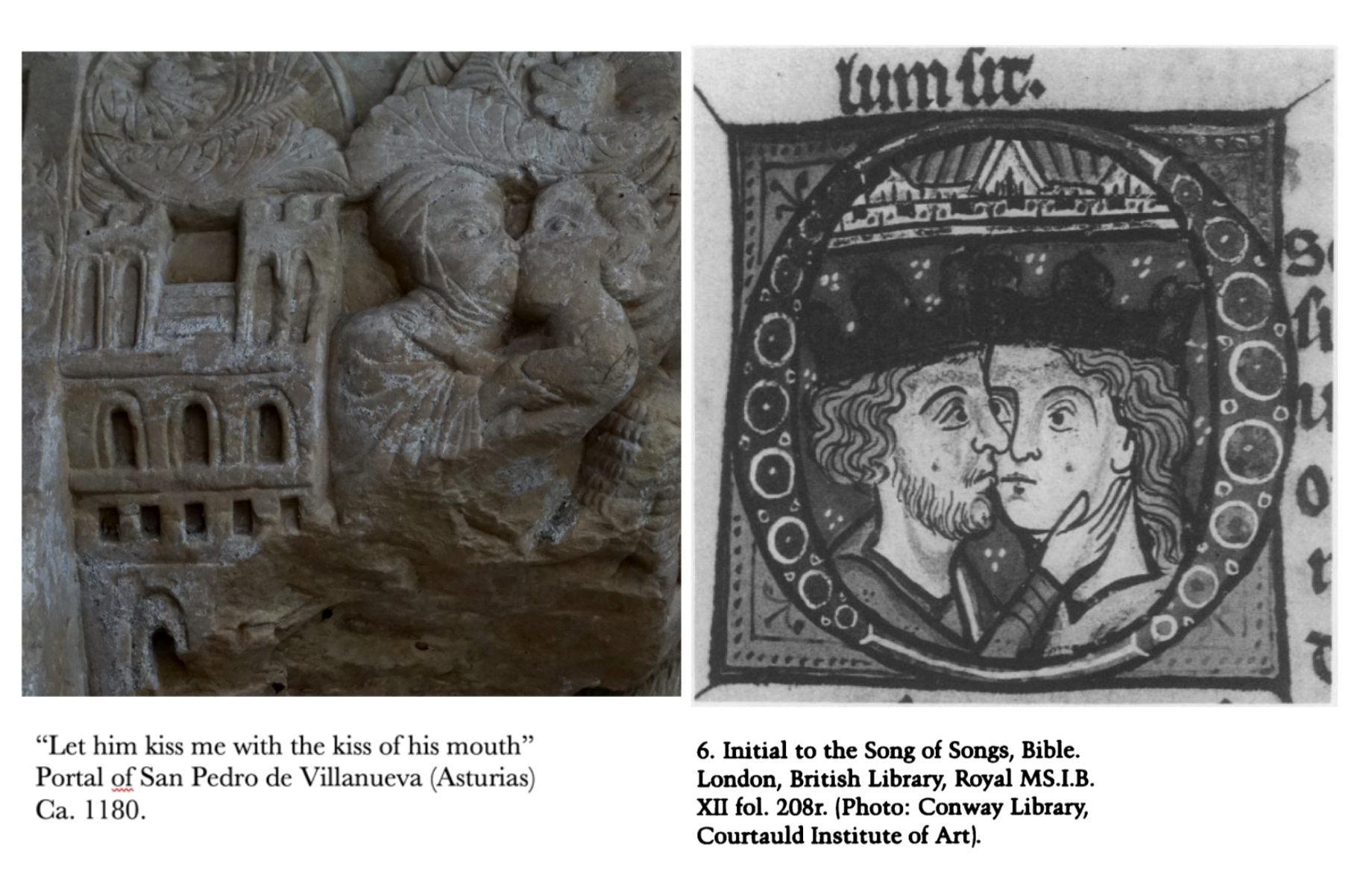
I came to London with a hypothesis that I wanted to tackle, that is, that a group of Romanesque sculptures in Asturias and Zamora (Spain) with embracing knights and ladies could be interpreted as a representation of the Song of Songs, one of the books of the Bible that was most heavily commented on during the Middle Ages. To strengthen this hypothesis, I had another group of sculptures of victorious knights being saluted by ladies that are believed to represent Psalm 45 (Vg.44), a passage deeply related to Solomon’s Song. Both the Song of Songs, written by king Solomon, and Psalm 44, written by king David, were interpreted by medieval exegetes such as Saint Augustin or Venerable Bede as the marriage of Christ with his followers or the marriage of Christ and Church. The iconographical epitome of this symbolic wedding is the Coronation of the Virgin, a theme that would become very popular in 12th– and 13th-century Europe.

During my stay in London, I had access to the extensive collection of books held at the British Library, the Warburg Library, and the Senate House Library. Through research I was able to strengthen my hypothesis and find arguments to support my claim that the kiss carved in stone on the portal of San Pedro de Villanueva (Asturias) is a representation of the first verse of the Song of Songs “Let him kiss me with the kiss of his mouth” (Cant. 1:1). I was also able to study first-hand the Bible of William of Hales (MS. Royal 1 B XII), which has not yet been digitized by the British Library and has a representation of the Kiss between Christ and the Church. Furthermore, the Warburg Institute Iconographic Database allowed me to compare different representations of the Song of Songs in the history of art and I arrived at the conclusion that the carvings of knights and ladies embracing found in Villanueva, Narzana, Villamayor, Sograndio, Oviedo, Benavente, and Toro constitute an iconography partitcular to that part of Iberia. In the next days, I am planning to visit the Conway and Witt Image Libraries at the Courtauld hoping to deepen my research.
Finally, I look forward to next week, when I have been invited to present my work at the Courtauld Institute of Art where I will be giving the talk “So shall the king greatly desire thy beauty”: on the sculptures of knight and ladies at Santa María la Mayor de Toro (Zamora). I am hugely grateful to ARTES and the CEEH for making this opportunity possible!
With the generosity of the ARTES-CEEH PhD Scholarship, I have made significant progress on my research, writing, as well as additional skills training. I am a second-year PhD student in the History of Art department at the University of York working under the supervision of Dr Richard McClary. My thesis is titled ‘From Umayyad Madinat al-Zahra to Almohad Seville: The Reuse of Architectural Spolia in al-Andalus during the 12th century.’ My work considers the re-use of Umayyad spolia, particularly marble capitals of the Madinat al-Zahra-type, in later imperial Almohad architecture in Seville, primarily the Giralda and Alcázar.
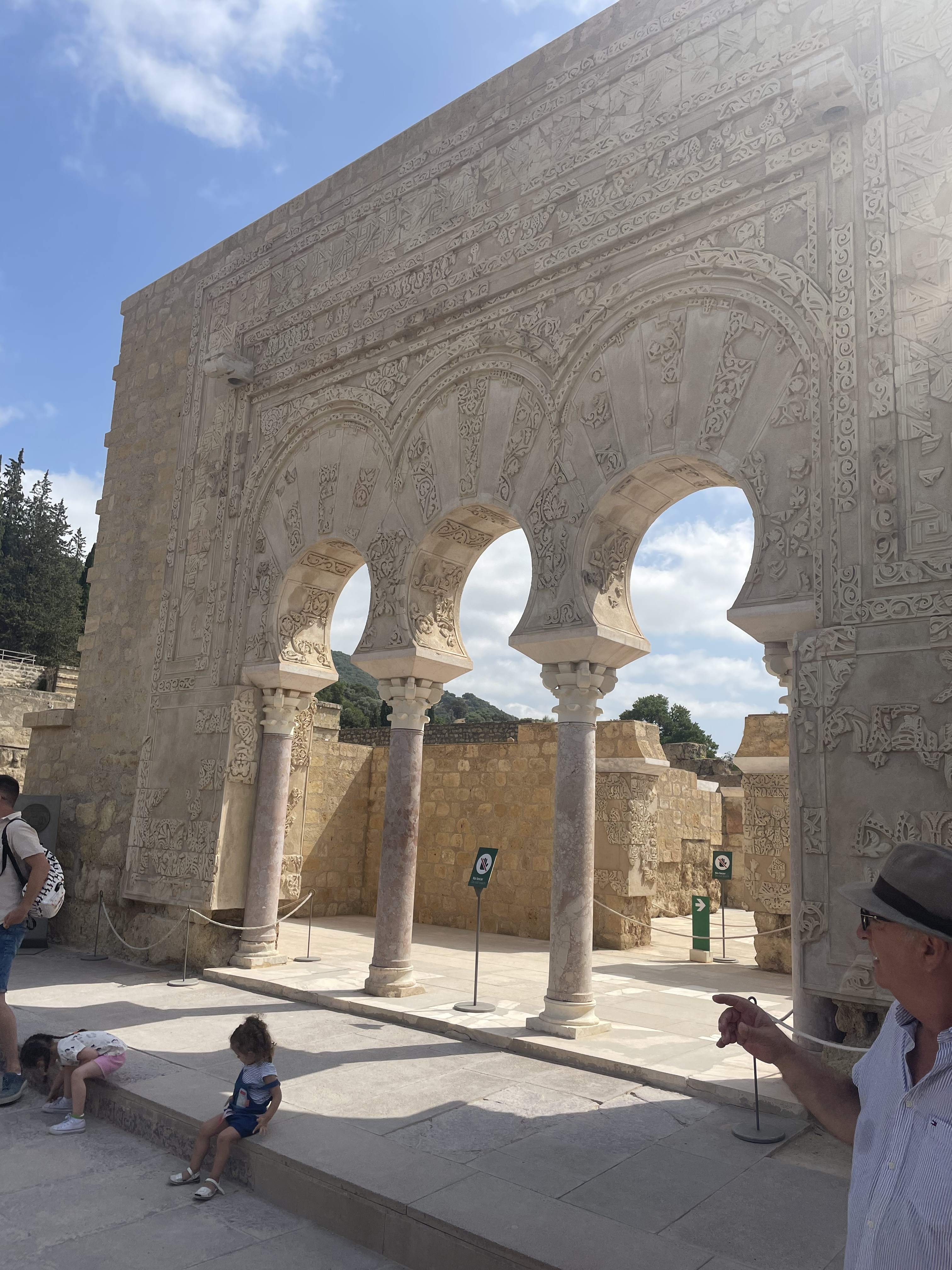
Since my last scholarship report, I have continued working towards compiling an annotated literature review, a digital database of the corpus of caliphal capitals, and significant portions of my thesis which have been submitted as conference papers. Thus far, I have been able to study the capitals in London (Victoria & Albert Museum and the British Museum), Paris (Louvre), Cordoba (Museo Arqueológico de Córdoba and the Madinat al-Zahra Museum), and in Malaga. This year, I plan to continue my field work in Madrid (Museo Arqueológico Nacional), Barcelona (Museu Nacional d’Art de Catalunya), and at the Almohad sites in Seville (Giralda and Alcázar, as well as the regional museums). The current chapter I am working on establishes the significance of Madinat al-Zahra, both as the imperial centre in the caliphal period and in its ruined afterlife, as a repository of architectural fragments. In this chapter, I trace the development of the Madinat al-Zahra-type capital, highlighting its iconography, inscriptions, and uses. The importance of history, first in the caliphal period but especially for the Almohads who later used Córdoba as a visual and material compass in claiming political legitimacy, will be at the forefront of this project. The attitudes towards the past, feelings of nostalgia, and memory will be significant in my research.

This past year, I had the opportunity to present my work at the Association for Art History’s annual conference and the Society for the Medieval Mediterranean’s biennial conference, “Interruptions & Disruptions in the Medieval Mediterranean,” in Crete. This year I hope to present my work at the International Medieval Congress in Leeds and the postgraduate students meeting of the Ernst Herzfeld Society For Studies in Islamic Art and Archaeology. Finally, I plan to present one of my chapters at the “Islamic Art Research in Progress Seminar” which has recently launched at the University of York.
When not in the field or in the library, I spend the rest of my time on professional and skills development. I am continuing with language training in Arabic and Spanish, which will help me in accessing relevant primary texts that are significant for my research. I am also working towards the York Learning and Teaching Award (YLTA) through my work as a Graduate Teaching Assistant on the course, ‘Transmissions and Connections’. Successful completion of YLTA will award me with Associate Fellow of the HEA (AFHEA). Finally, I have been selected to serve as a Yorkshire Consortium for Equity in Doctoral Education (YCEDE) Scholars Board Member.
In conclusion, I would like to express my gratitude to ARTES and CEEH for their continuing generous support, which has provided me with the means to continue my PhD work in all its research, writing, and training aspects.


