CALL FOR PAPERS: Movements and Transformations in the Making of Iberian and Latin American Art and Visual Cultures

Movements and Transformations in the Making of Iberian and Latin American Art and Visual Cultures
Emerging Researchers Symposium
Zurbarán Centre for Spanish and Latin American Art (Durham University, UK)

22-23 June 2023

Durham University’s Zurbarán Centre for Spanish and Latin American Art invites doctoral students and early career researchers to submit proposals for presentations at its annual Emerging Researchers Symposium, taking place in Durham between 22 and 23 June. This event aims to stimulate interdisciplinary conversations between international postgraduate students and early career researchers working on Iberian and Latin American art and visual cultures. It offers an opportunity for participants to discuss work-in-progress projects, to receive feedback, to learn about new research being carried out by colleagues, and to engage with leading keynotes given by established scholars and curators. The event will also offer opportunities to explore the significant holdings of Spanish art in County Durham.

We welcome proposals for 20-minute presentations focusing on the theme of ‘Movements and
Transformations in the Making of Iberian and Latin American Art and Visual Cultures’. Proposals may
relate to any aspects and periods of Iberian and Latin American art and visual cultures. Suggested
topics may include (but are not limited to):

➢ The physical movements or migration of artists, artworks, materials, theories between different
art worlds.
➢ The transformative power of art in political, religious and cultural debates and discourses.
➢ Polemics in artistic reception and thought, and the work of later generations in rethinking and
reimagining artistic cultures of the past.
➢ The appropriation and repurposing of images and motifs to create works for new audiences and
different communities.
➢ Innovation in artforms and techniques.

Organised by Durham University doctoral students, the symposium will be held as a hybrid event in Durham for in-person and remote attendees. We encourage speakers to attend in person as the event will include multiple opportunities for intellectual exchange and networking and visits to local collections, such as The Spanish Gallery in Bishop Auckland and the Bowes Museum. We are not however in a position to support travel or accommodation costs.


Please send a 250-word abstract and a brief biography as a word document to pg.zurbarancentre@durham.ac.uk by Thursday 13th April 2023, with the title Your Name-ERS2023-
Proposal
. Please also indicate whether you intend to attend the symposium in person or remotely. If you have any queries regarding the submission process, please do not hesitate to contact with us using the email provided.

2023 Jonathan Brown Award Winner – Romantic Spain: David Roberts and Genaro Pérez Villaamil

published by the Real Academia de Bellas Artes de San Fernando, the CEEH and the Instituto Ceán Bermúdez; 2021

ARTES would like to extend a warm congratulations to Dr. Claudia Hopkins, an active member and the inaugural winner of the 2023 Jonathan Brown Award for her work Romantic Spain: David Roberts and Genaro Pérez Villaamil, a richly illustrated catalogue that accompanied an exhibition of the same name at the Real Academia de Bellas Artes de San Fernando (2021 – 2022).

A comprehensive study on the relation between Roberts and Pérez Villaamil, the publication combines an impressive array of around 120 objects and critical scholarship by twelve contributors. At once a thorough and nuanced examination of artistic and archival material, the catalog offers an important critical revision of Iberian Orientalism.

Dr. Claudia Hopkins is Professor and Director of the Zurbarán Centre for Spanish and Latin American Art at Durham University. Before joining Durham in 2020, she was Senior Lecturer in History of Art at the University of Edinburgh and co-editor of the Getty-funded journal Art in Translation. Her research focuses on nineteenth- and twentieth-century Spanish art and Anglo-Spanish cultural relations. In 2009, she made substantial contributions to the exhibition The Discovery of Spain: British Artists and Collectors. Goya to Picasso, National Gallery of Scotland. She is author of articles, book chapters and edited volumes, a.o. Pascual de Gayangos: A Nineteenth-Century Spanish Arabist (2009, with C. Álvarez-Millán), Orientalism and Spain (with A. McSweeney, 2017), Hot Art, Cold War (2 vols., 2020, with I.B. Whyte). Her monograph The Orient Within: Spanish Art and Identity 1833-1956 is forthcoming.

The Ethiopian at the Door: Fantasy, Literality, and Race in the Cantigas de Santa María

Wednesday, Feb. 22, 4:00–5:30pm (EST) / 9:00 – 10:30pm (GMT)
A Zoom Lecture by Dr. Pamela Patton, Princeton University
Zoom Hosted by by Montclair’s Medieval and Early Modern Studies Seminar.

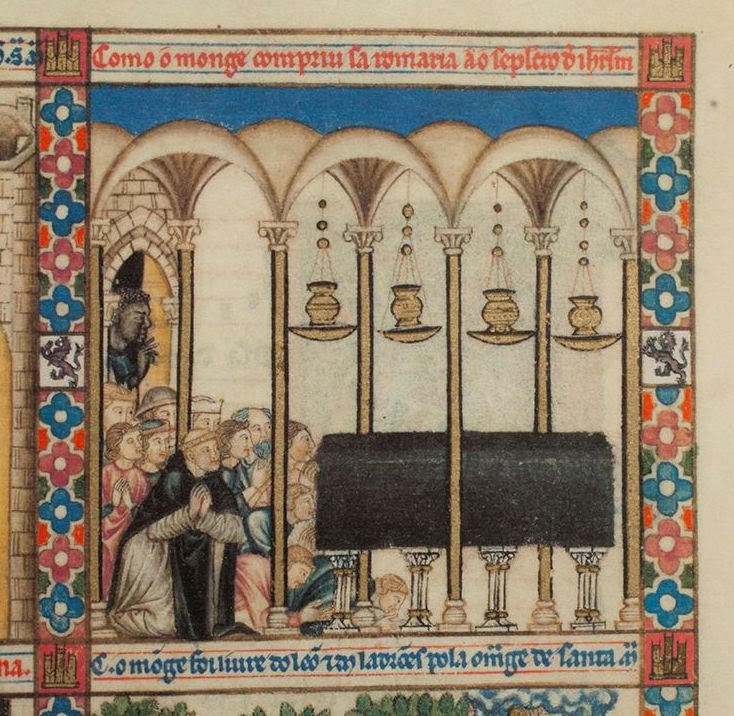
Pilgrims at the Holy Sepulcher
Detail of illustration for Cantiga 9, Cantigas de Santa María (RBME, MS T-I-1), fol. 17r.

A Lecture by Dr. Pamela Patton, Princeton University

Wednesday, Feb. 22, 4:00–5:30pm (EST) / 9:00 – 10:30pm (GMT) on Zoom Password: 807586

Dr. Patton is the director of The Index of Medieval Art at Princeton University.

An art historian of medieval Spain and its environs, Dr. Patton’s particular research interests focus on the role of the image in articulating cultural identity and social dynamics among the multiethnic communities of the Iberian Peninsula. Among Dr. Patton’s many publications are two monographs, Pictorial Narrative in the Romanesque Cloister (2004) and Art of Estrangement: Redefining Jews in Reconquest Spain (2012).

We are delighted to announce that the next Zurbarán Centre-ARTES Research Seminar will take place on 20 February at 18.00 (GMT), on zoom: 

Rosa M. Rodríguez Porto, “The library of the Marquis of Santillana (d. 1458) and the cultural networks of the European Renaissance”.

Don Iñigo López de Mendoza, Altarpiece of Buitrago, Jorge Ingles, c.1455

The talk relates to the exhibition El Marqués de Santillana: Imágenes y letras (Museo Nacional del Prado and the Biblioteca Nacional de España, Oct. 2022- Jan. 2023) and will focus on the books commissioned by Íñigo López de Mendoza, Marquis of Santillana, one of the most prominent figures of early Castilian Humanism. Although the relevance of his library was already acknowledged in a pioneering study by Mario Schiff (1905), art historians have tended to pay more attention to the manuscripts produced for Santillana in Castile. And yet, the books he acquired or commissioned in France and most notably in Italy, allow us to reconstruct the dense network of political, family and cultural connections behind his eclectic patronage, and to understand how his leading role in the introduction of new visual languages in Castile granted him a towering position among the other Castilian magnates.

About the speaker: 

Rosa M. Rodríguez Porto is Ramón y Cajal Fellow at the University of Santiago de Compostela and Adjunct Associate Professor at the Faculty of Humanities of the University of Southern Denmark. She has worked extensively on late medieval book illumination, medieval Iberian courtly art and the classical tradition in the Middle Ages. Her latest publication is “La biblioteca del Marqués de Santillana “, for the catalogue of the exhibition El Marqués de Santillana: Imágenes y letras, shown at the Museo Nacional del Prado and the Biblioteca Nacional de España, Oct. 2022-Jan.2023. 

To join the seminar, please click on this zoom link (or copy and paste it into your browser ) –  

https://durhamuniversity.zoom.us/j/93702971057?pwd=TW9raVNlM1pxaHFkdGFueURvaWVrZz09

Meeting ID: 937 0297 1057

Passcode: 612894

The seminar has been organised by the Zurbarán Centre and the ARTES Iberian and Latin American Visual Culture Group. 

Spain and the Hispanic World Symposium: cross-cultural exchanges

One-Day Symposium
Friday March 24th, 2023
10am – 6pm
Royal Academy of Arts, London, UK

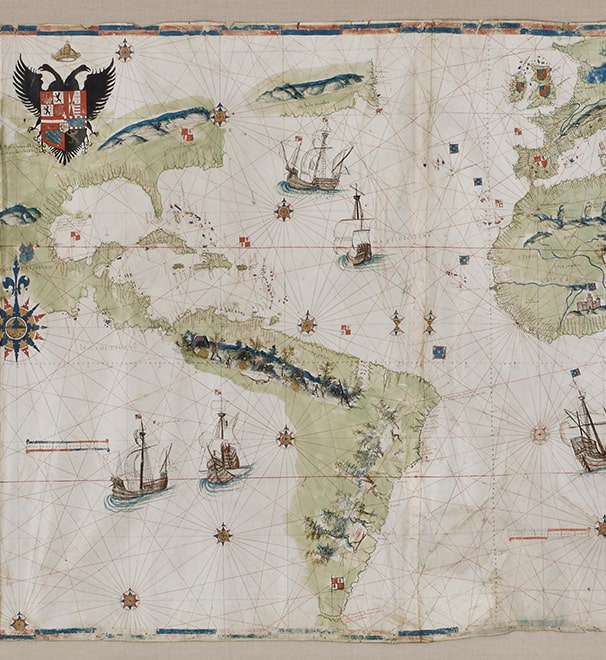
Giovanni Vespucci, World Map (detail), 1526.

In an opportunity to further elaborate ideas explored in their current exhibition, Spain and the Hispanic World a gathering of over 150 objects on loan from the Hispanic Society Museum and Library spanning time periods and continents – the Royal Academy of Arts invites the public to a one-day symposium: Spain and the Hispanic World Symposium: cross-cultural exchanges.

Based on an interdisciplinary approach, the Symposium offers the opportunity to engage in discussions in which global exchange, empire and colonialism, movement (of objects, peoples, ideas), and cross-confessional and -cultural issues take center stage. From Al-Andalus to Christian Iberia to colonial Latin America, the symposium looks beyond just the exportation of Spanish Culture to consider as well the influences and exchanges simultaneously brought back into Iberia.

To learn more about the symposium, speakers and to book your ticket, please click here.

ARTES-CEEH PhD Scholarship Report 2023

Thanks to the generous support of ARTES-CEEH PhD. Scholarship, I conducted my research in London last November and made significant advances in my PhD thesis’s archive work. My Thesis is titled Isidro Gálvez y los dibujos de la Flora peruviana et chilensis, supervised by Dr Ángel Justo Estebaranz at Universidad de Sevilla (Spain). My work studies the figure of Isidro Gálvez, a draughtsman of the Royal Botanic Expedition to Peru and Chile by Hipolito Ruiz and José Pavón (1777-1788). This Expedition produced more than 2.000 botanical drawings, over 700 signed by Gálvez.

At the beginning of 2022, I started my archival research in Madrid, studying Gálvez drawings at the Real Jardín Botánico of Madrid. To complete the work I was undertaking in Madrid, I needed to consult the materials in English institutions related to this Expedition. At the beginning of the 19th Century, José Pavón sold and exchanged part of the collection to botanists around Europe to obtain international recognition. As a result, manuscripts about the journey to Peru and Chile, letters regarding Pavon’s selling, and herbarium sheets ended up in the Natural History Museum, the Royal Botanical Gardens of Kew, the Linnean Society of London, and the Wellcome Collection.

Part of my research in London involved consulting the editions of the Flora peruviana et chilensis that the institutions I visited held. I was interested in the making of the books, the engraving process, and which paper they used. The publication of the Flora lacked funding and suffered some troubles due to the political situation of Spain at the beginning of the 19th Century. These affairs affected the quality of the books and the number of volumes published. The Flora was going to be a compound of 12 volumes, however, only the first three were published with their descriptions. Ruiz and Pavon sent the illustrations in the fourth tome to some international botanists. For the first time, I could see the fourth volume of the Flora, from which there are only four copies in the World. I could examine three of them at Kew, the Natural History Museum, and the Linnean Society and study how they arrived in London.

On this trip, I hoped to find drawings by Galvez or his colleagues among the letters and publications related to Ruiz and Pavón. And although I encountered some letters proving the exchange of illustrations between Pavón and several English botanists, I could not locate any of these drawings. Nevertheless, I am content with having actual proof of these exchanges. This would help me study the diffusion of knowledge through botanical images.

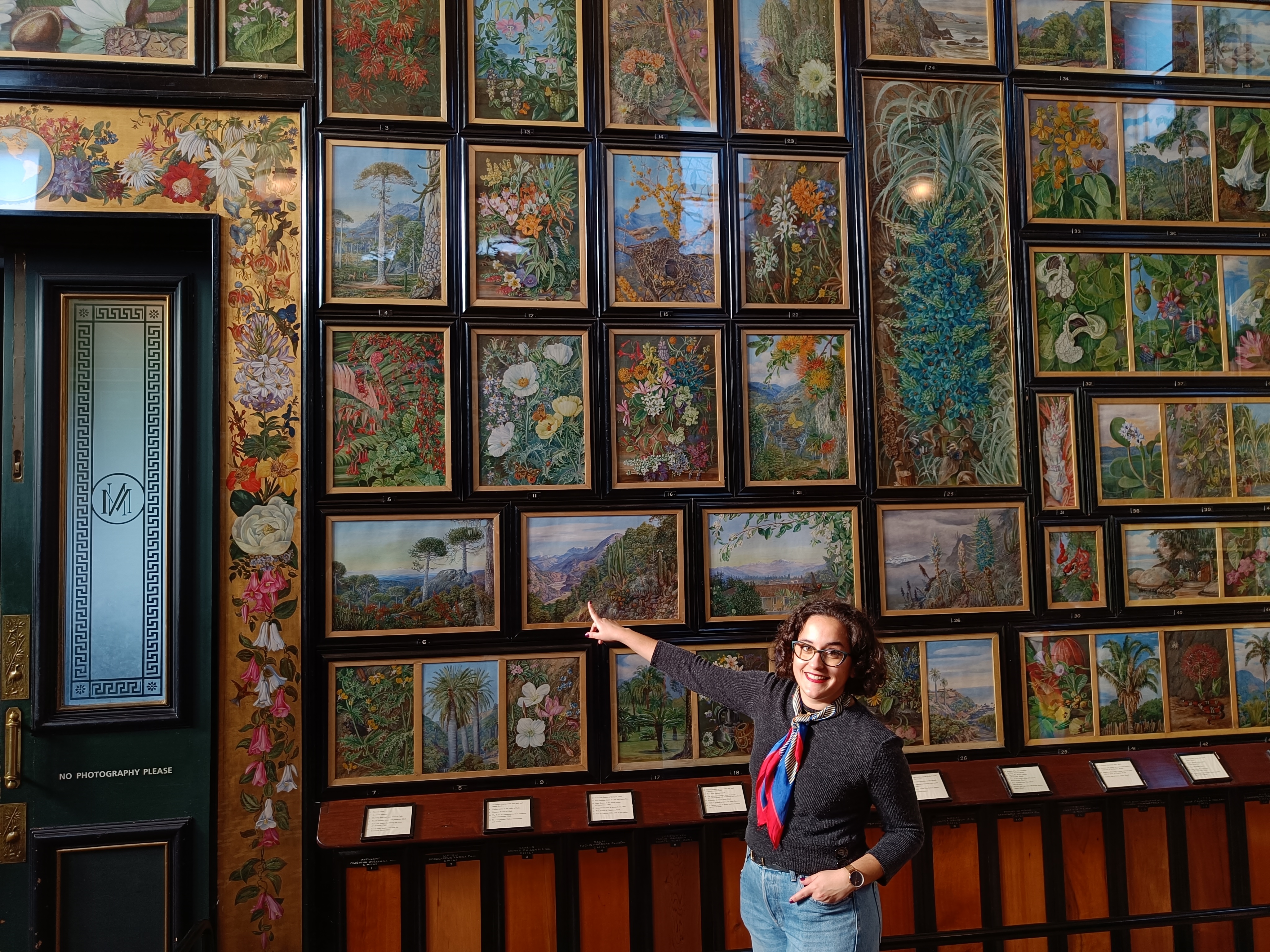
While in London, I decided to go to other places like the British Library or the University of London to consult the bibliography not available in Spain and some classic titles on Natural History. Furthermore, I used my free time in the city to also visit the Museums and institutions that held materials related to scientific expeditions and those that had artworks from botanical artists. I particularly enjoyed seeing the cinchonas from the Wellcome Collection displayed at the Science Museum, as Ruiz and Pavon collected these barks in their travel to Peru. Moreover, visiting Kew Gardens and seeing Marianne North Gallery was one of the highlights of my time in the UK. As a scientific illustrator myself, studying the artworks of North, Maria Sibylla Merian, Georg Dionysius Ehret and others inspired me to continue researching botanical art and drawing.

I am very grateful to ARTES and CEEH to give me the opportunity to conduct my research in some of the best Natural History institutions in the World. Their generous support has helped me to obtain a global vision of the materials from Ruiz and Pavon Expedition and had encouraged me to continue with my PhD work. 

New Publications Available Online

On Portraiture. Theory, Practice and Fiction. From Francisco de Holanda to Susan Sontag. (Published Conference Proceedings)

Edited by Annemarie Jordan Gschwend | Maria João Gamito | Fernando António Baptista Pereira, 2022

Faculdade de Belas-Artes, University of Lisbon

E-book available here

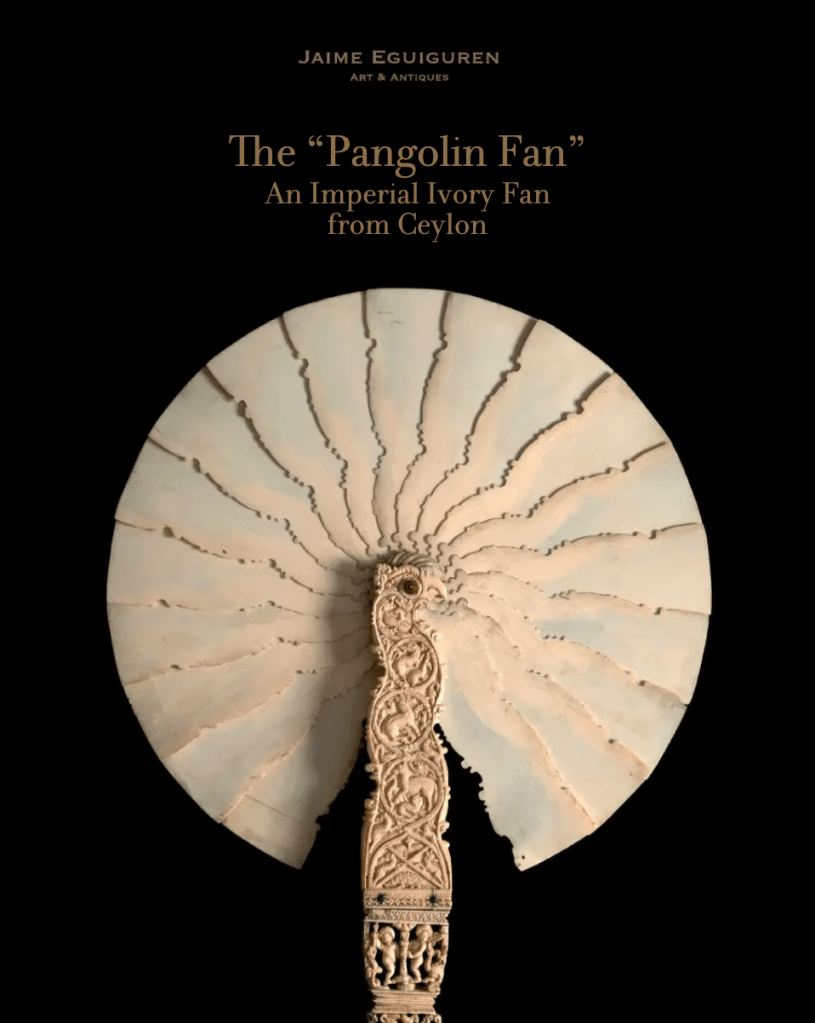
The “Pangolin Fan” An Imperial Ivory Fan from Ceylon

Annemarie Jordan Gschwend and Hugo Miguel Crespo, 2022

 Jaime Eguiguren Art & Antiques

PDF available here

ARTES-CEEH Travel Scholarship Report | Irini Picolou, Durham University

The generous scholarship provided by ARTES and the CEEH gave me the opportunity to conduct an exciting and productive research trip. My findings enabled me to address questions regarding the representation of the body in pain in the Altarpiece of Saint Engracia by Bartolomé Bermejo and to understand further the titular saint’s local significance in Zaragoza and Daroca. I was also able to examine, in detail, Bermejo’s portrayals of alterity in the panels of the altarpiece.

Irini capturing details

For the first two days of my trip, I stayed in Bilbao, where I visited the Museo de Bellas Artes and met the Head of the Department of Conservation and Restauration, María José Ruiz-Ozaita. She first conducted a guided in-situ examination of the Flagellation of Saint Engracia with a UV light to demonstrate the areas of restoration and remaining signs of damage. The conservation team then provided me with a microscopic lens and digital microscopic light to take close-up images of the whiplashes on Engracia’s back, blood spurts, and other minute details in the painting, such as inscriptions and skin pigmentation. This opportunity to gain a precise view of such details, as well as document these findings, enabled me to pinpoint the location of damage and wounds on the pictorial surface. The digital microscopic light also allowed me to detect the exact pigmentation of blood and skin colour which would not have been possible even by looking at a digital high-resolution image. The UV picture provided by the Museum also facilitated the identification of paint damage and uncovered novel conclusions regarding the depiction of the tortured body, thus demonstrating that it was more dramatic to fifteenth-century viewers than it currently appears. The stage micrometre was used to measure the sizes of lashes and blood drops, revealing Bermejo’s detailed and precise representation of torture. This research has opened a new series of questions in outlining the importance of blood and wounding as central elements of Engracia’s pained body.

Conservation Team in the Museo de Bellas Artes

The Conservation team also showed and sent me reflectographic images which demonstrated a possible hidden date referring to the production of the painting. They also revealed the definition of the bodily features and Islamic patterns on the floor tiles and clothing. This access to Bermejo’s drawings has enabled a clearer identification of the regional and religious references in the composition, thereby informing an understanding to Bermejo’s approach in representing alterity.

For the second part of the trip, I stayed in Zaragoza and visited the local museum, which held paintings of Christ’s Arrest, Crucifixion and Resurrection jointly produced by Martín Bernat and Miguel Ximénez, Bermejo’s collaborator and contemporary. Given that these paintings were produced around the same time that Bermejo was working with Bernat in Zaragoza, I was able to contextualize my observations on the portrayals of pain and alterity in the Altarpiece of Saint Engracia. More importantly, the in-situ examination of the Descent from the Cross by Bermejo and Bernat informed further insights concerning Bermejo’s specific depictions of blood, sacrifice, and alterity in comparison with the Flagellation of Saint Engracia.

Visit to the Palacio de la Aljafería in Zaragoza

I also visited the Basilica of Saint Engracia, which marks the location where Engracia was martyred. The building was previously a monastery church destroyed in the Siege of Zaragoza in 1809, and so it was reconstructed into the Basilica. By examining her shrine, I gained a better sense of her regional importance within Zaragoza, which informed the motives behind the commission of the altarpiece in Daroca. My final pursuit in Zaragoza was a visit to the Palacio de la Aljafería, where I observed and took photos of architectural inspirations for the portrayal of Dacian’s Palace in the Arrest of Saint Engracia, Imprisonment, and Flagellation. I was able to identify better some of the patterns and architectural elements depicted in the panels of the altarpiece.

From Zaragoza, I travelled to Daroca, where I visited the Museo de los Sagrados Corporales. I first conducted an in-situ examination of the remaining panels of the Engracia altarpiece held in Spain: the Crucifixion, Arrest, and Imprisonment. During this visit, I explored specific details in the panels constituting the portrayals of pain and alterity. I gained a better understanding of the devotional viewing context of the altarpiece since the panels were displayed in the Museum of the Church, which showed additional references to martyrdom and sacrifice, such as the famous sacred corporals. The ingrained visual and textual representations of medieval Jewish and Muslim people in the town of Daroca has also enriched insights on the propagandistic purposes of the altarpiece.  

Irini in Daroca

I am extremely grateful to ARTES and the CEEH for providing me with the opportunity to make an important contribution to scholarship on the Altarpiece of Saint Engracia and Bermejo. This research has also broadened theoretical insights on the importance of representing pain and female martyrdom in fifteenth-century devotional painting.  

 Instituto Cervantes / University College London International Seminar | The Education of a Christian Woman (1523) in the Construction of the Image of Female Power of Queen Mary I of England (1553-1558) | Hybrid (In person/ Zoom) | 24-25 January 2023

Registration is required, please email artepoderygenero@um.es

Please find the complete programme below: