REMINDER: Upcoming ARTES visit TO BISHOP AUCKLAND, COUNTY DURHAM – 18th August, 2023

Date: 18th August, 2023

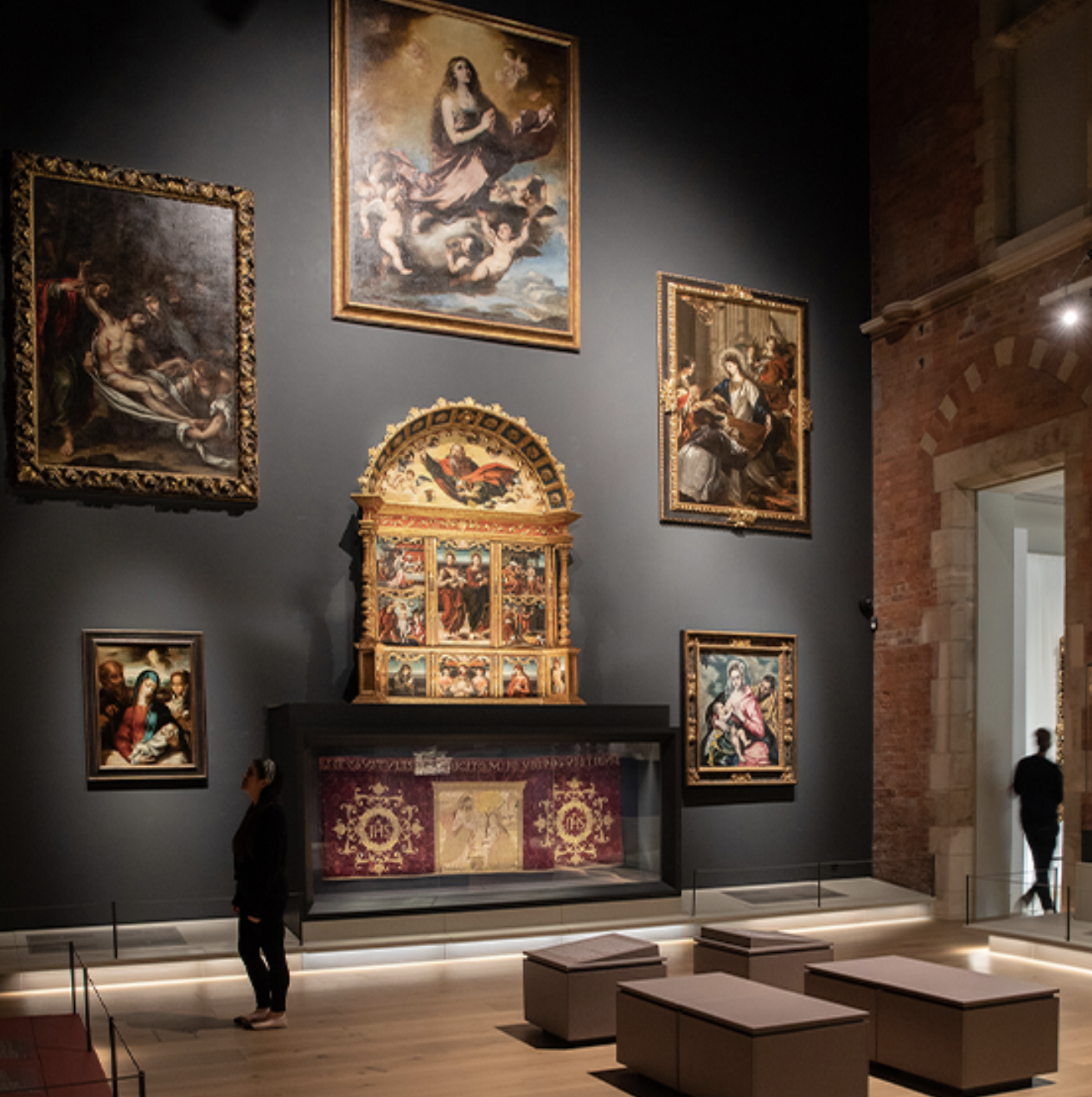
ARTES would like to share a reminder of our upcoming visit to Bishop Auckland. ARTES is organising a long-overdue visit to The Spanish Gallery and Bishop Auckland Castle on Friday 18th August. The visit will coincide with a lecture being given on the Spanish Gallery’s sculpture collection by ARTES President Dr Holly Trusted, who has been working on the collection for the last year as a Zurbarán Centre Fellow. The day will also provide opportunities to discuss the collection with the driving force behind the entire Auckland Project, Jonathan Ruffer, and, the curator of the Spanish Gallery, Morlin Ellis. Both of whom are longstanding ARTES members.

Schedule

10.30am – Highlights tour of the Spanish Gallery

11.30am – Holly Trusted lecture, “History, Feeling and Colour: Sculpture at Bishop Auckland

12.30pm – Further exploration of the Spanish Gallery, with Piers Baker Bates talking on the dialogue between Spanish and Italian art, which was the subject of his own Zurbarán Centre Fellowship in 2022.

1.30pm – Lunch

2.30pm – Zurbarán’s paintings of Jacob and his twelve sons, with Zurbarán Doctoral Scholar Richard Jacques, and the Sin Exhibition hosted in collaboration with the National Gallery, both at Auckland Castle.

4.00pm – Depart

For those who have yet to visit Bishop Auckland this will be an opportunity to explore one of the finest collections of Iberian art outside of Spain. For those who have already visited, it is envisaged that the talks by Holly Trusted, Piers Baker Bates and Richard Jacques will bring fresh perspectives to this remarkable resource.

Members will have to make their own travel arrangements to Bishop Auckland and pay for admission to the Gallery and Castle, although carers and ART Pass holders enter free of charge. Further information on Bishop Auckland, including opening times, ticket prices and travel information can be found here.

Would those interested in joining this event please let Richard Jacques (rpfjacques@gmail.com) as soon as possible. 

ARTES-CEEH Travel Scholarship Report | Megan Smith, Durham University

ARTES is delighted to share Megan Smith’s report of her research trip, funded by the CEEH/ARTES Travel Scholarship.

Thanks to the generous funding of the ARTES-CEEH Travel Scholarship, I was able to travel to several sites in Spain in late March-early April of this year to carry out research for my undergraduate dissertation, which focuses on the work of the Factum Foundation in Bishop Auckland’s Spanish Gallery.

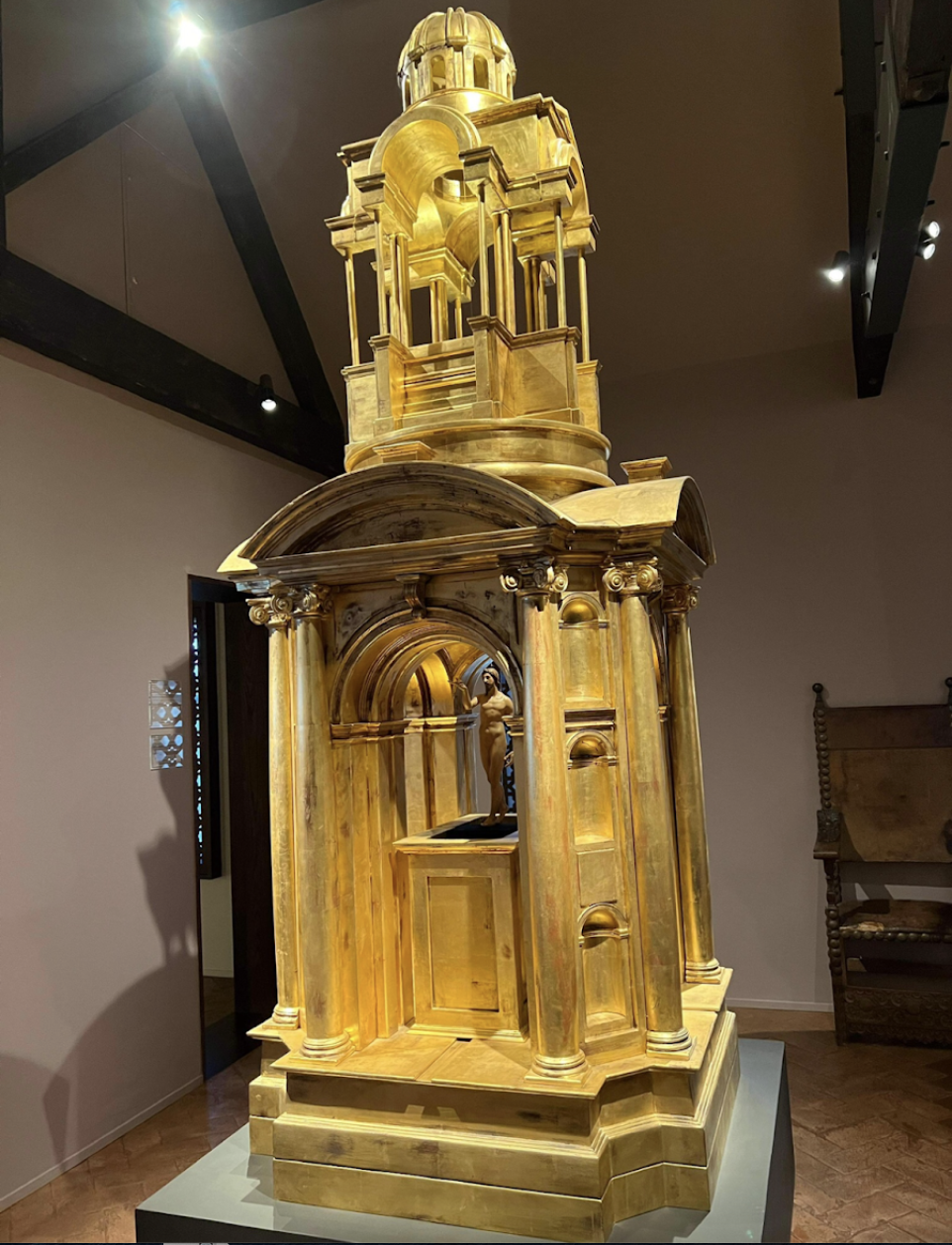
Facsimile of El Greco’s ‘Risen Christ’ Tabernacle on display at the Spanish Gallery, complete with restored top part of the structure.

The Factum Foundation uses non-contact scanning, modelling and printing technologies to produce facsimiles of artworks and artefacts across the globe, an invaluable resource in digital preservation and conservation. Since 2009, Factum have worked to digitally archive objects of significance in cultural heritage, and have produced high-spec facsimiles of a number of these objects for display in institutions on an international scale. For the Spanish Gallery, Factum have produced a full-facsimile exhibition of Spanish Baroque and Renaissance painting, sculpture and architectural elements, producing not only the artworks on immediately obvious display but also the floors, ceilings and wall mouldings, borrowed from several sites in Spain. The scholarship funding meant that I was able to visit the sites where the original works remain in their original contexts, to better understand the differences between them and their facsimile counterparts. In particular it was the display of these artworks which I wanted to investigate, which is very difficult to do without visiting the institutions in person to see how the original displays may differ from the gallery setting in which we find the facsimiles. 

El Greco’s original ‘Risen Christ’ Tabernacle on display at the Hospital de Tavera.

The tracing of these artworks began at the Hospital de San Juan Bautista (known as the Hospital de Tavera) in Toledo, where several works by El Greco and Alonso Berruguete recreated by Factum for the Spanish Gallery exhibition can be found. El Greco’s ‘Risen Christ’ tabernacle is perhaps one of the most interesting works from this collection, as Factum have rematerialised the missing top section of the structure by digitally modelling a new design based on a pre-Civil War photograph. In partnership with the Hospital, Factum also recreated the sepulchre and death mask of Cardinal Tavera, along with El Greco’s portrait of the Cardinal, and the much larger El Greco ‘Baptism of Christ’ painting from the side altarpiece. The display of this panel in the chapel of the Hospital is in great contrast with that of the Spanish Gallery facsimile, which opens up a discussion of how the use of facsimiles in this gallery space may offer visitors a new viewing experience.

From Toledo I travelled to Madrid, where I had the opportunity to visit the Factum Foundation workshop. This was without a doubt the highlight of my trip. I had the opportunity to speak to Carlos Bayod, who worked on the Spanish Gallery display, which helped me gain insight on how the curation of the exhibition developed and the importance of the digital preservation aspect. Each step of the facsimile process has a dedicated team and workshop, and it was particularly interesting to see precisely how an artwork goes from a collection of photographs and scans to a fully rematerialised object, identical to the original piece. I would like to specifically thank Larissa van Moorsel, who facilitated my tour of the workshop, for her wealth of knowledge on the detail of Factum’s work.

At the tiled patios of the Casa de Pilatos.

From Madrid I travelled to Seville, where I first visited the Casa de Pilatos. Like the Hospital de Tavera, the Casa de Pilatos is part of the Fundación Medinaceli. Factum scanned and reproduced ceramic tiles from the patios, alongside some of the surrounding plasterwork yeserías, and a fourth-century statuette of The Good Shepherd, the facsimiles of which are part of the Spanish Gallery exhibition. The facsimile tiles are a particularly noted visitor highlight of the Spanish Gallery display, and their recording and reproduction is especially significant as the original tiles are beginning to become damaged due to rising ground moisture causing the walls to curve outwards. As with the artworks in the Hospital de Tavera, it was interesting to consider the differences between the Casa de Pilatos and the display of its artworks and architectural elements in the Spanish Gallery exhibition. 

Gesso prototype of the facsimile tiles from the Casa de Pilatos patios, in an early stage of the facsimile creation process. 

My final stop was the church of the Hermandad de la Santa Caridad, also in Seville, where two works by Juan de Valdés Leal and two remaining works of an original series of six by Murillo can be found, all replicated for the Spanish Gallery. When seen in its intended compositional context in the chapel, a carefully designed iconographic program becomes clear which represents the Caridad’s philosophy of charity as salvation: the two vanitas paintings by Juan de Valdés Leal, In Ictu Oculi and Finis Gloriae Mundi, work in synthesis with the accompanying series of paintings by Murillo, which represents the Acts of Charity in the Catholic tradition. To understand this messaging, the paintings must be seen as they were originally commissioned; however in the Spanish Gallery, they are separated into different floors of the building, which naturally alters their iconographic significance in their new, isolated positions. This was the biggest difference between the original context and gallery display I noted whilst visiting these sites, and I found that it was this site which clarified the significance of this research the most. 

The funding from the ARTES-CEEH scholarship made this research – and my dissertation- possible, and I am hugely grateful to both organisations for this opportunity! I would also like to extend my gratitude to the team at Factum Foundation, who provided me with every resource possible to carry out this research. 

CALL FOR PAPERS – Moving Ideas in the Iberian Worlds (RSA Chicago, 2024)

Renaissance Society of America – Chicago, 2024 (March 21 – 23rd)

Organizers:
Marta Albalá Pelegrín, California State Polytechnic University, Pomona.
Maria Vittoria Spissu, Alma Mater Studiorum – University of Bologna

Submission Deadline: August 7th, 2023.

In the Early Modern period, the transmission of ideas and the movement of people, artworks, and commodities embraced diverse cultural worlds on a planetary scale. This panel seeks contributions exploring these phenomena from innovative perspectives that challenge and nuance concepts such as translation and circulation.

The exchange of ideas, iconographies, allegories, moral beliefs, and political projections reveals the role of writers and artists, clerics, diplomats, and merchants in connecting distant geographies and visualizing ideologies of power.

This panel welcomes case studies – with a transoceanic and global dimension – focusing on images (paintings and prints), literary and musical compositions, treatises, accounts, and maps, committed to redistributing targeted worldviews.

It examines how works represented moral superiority, political legitimacy, and economic prerogatives related to the salvation of the faithful or imperialistic aims and how they contested or reworked these ideas.

We encourage proposals from all fields of Early Modern studies.

Possible topics:
– Exchange of ideas and imageries concerning empire and evangelization
– Movements of objects and iconographies
– New paradigms of thinking about transmission, translation, and circulation
– Early capitalism and material culture
– Repurposing of ideas, transformation of models, and ‘distributed agency’
– Ideas of sovereignty through visual and literary representations
– Religious, political, and mercantile networks and patronage

The CMRS Center for Early Global Studies – UCLA will be sponsoring this panel.

To submit a paper proposal, please send a Word or PDF document to Maria Vittoria (Mavi) Spissu [mariavittoria.spissu@unibo.it] & Marta Albalá Pelegrín [martaa@cpp.edu].

Please ensure to include:
– Presenter’s first and last name
– Current academic affiliation (or “Independent Scholar”) and title
– Email address
– Paper Title (15-word maximum)
– Paper Abstract (150-word maximum)
– Short CV / Résumé (300-word maximum, expected)

Please also follow the RSA Guidelines.

CALL FOR PAPERS – The Construction of Identities from Material Culture in the Early Modern World (RSA 2024, Panel)

Renaissance Society of America – Chicago, 2024 (March 21 – 23rd)

Panel Organizers:
Rosario Nava Román. Instituto Mora (CONACYT), Escuela Nacional de Pintura, Escultura y
Grabado “la Esmeralda”

Vanessa A. Portugal. University of Lincoln

Submission Deadline: July 31st, 2023. 5pm (BST)

Considering the range of asymmetrical encounters (Subrahmanyam, 2012) that particulars
exercised during the early modern world, this panel seeks paper proposals that engage
critically with the representations of the otherness –and the construction of identities– from a
non-European discourse to examine the visual strategies employed by groups or individuals
(Indigenous peoples of the Americas, Africans, Asians) to understand unfamiliar peoples in
their interconnected world.

The aim of this panel is to deeply reflect on the diversity of creative processes brought in by
the new cultural interactions, shifting the focus on the paradigm of ‘the global world’ by
drawing on the diversity of diachronic negotiations, interpretations, and constructions of
identity of the self and of the otherness recognizing the agency of a diverse plurality of actors
with an emphasis in, but not limited to, the colonial Americas.

We welcome papers studying paintings, codices, artifacts, archaeological objects, dealing
with gender, racism, castes, identity, and the agency of the image.

Please submit your abstract (200 words maximum) with title (15 words maximum), your full
name, current affiliation and a one page CV to the organizers Rosario Nava Román
(rona.foto@gmail.com) and Vanessa A. Portugal (vaportugal@lincoln.ac.uk) by 5pm British
Summer Time on 31 July. Notifications will be sent by 10 August.

Zurbarán Center Summer Lectures 2023

Date: July 14th, 2023.
Time: 11:30am to 12:30pm

The Zurbarán Centre is looking forward to the first of four summer lectures at The Spanish Gallery in Bishop Auckland (in person and online).

The first lecture will be delivered on Friday 14 July, 11.30-12.30. Professor Andy Beresford (Durham University) will speak about  “El Greco, St Jerome and the Corporeality of Ascetic Piety”.

The lecture has been organised by the Zurbarán Centre.
It is free with an admission ticket to the Spanish Gallery.

If you would like to join via zoom, please register via Eventbrite.  

ARTES VISIT TO BISHOP AUCKLAND, COUNTY DURHAM – 18th August, 2023

Date: 18th August, 2023.

ARTES would like to share a reminder of our up-coming visit to Bishop Auckland. ARTES is organising a long-overdue visit to The Spanish Gallery and Bishop Auckland Castle on Friday 18th August. The visit will coincide with a lecture being given on the Spanish Gallery’s sculpture collection by ARTES President Dr Holly Trusted, who has been working on the collection for the last year as a Zurbarán Centre Fellow. The day will also provide opportunities to discuss the collection with the driving force behind the entire Auckland Project, Jonathan Ruffer, and, the curator of the Spanish Gallery, Morlin Ellis. Both of whom are longstanding ARTES members.

Proposed Schedule:

10.30am – Highlights tour of the Spanish Gallery

11.30am – Holly Trusted’s lecture on the sculpture collection

12.30pm – Further exploration of the Spanish Gallery, with Piers Baker Bates talking on the dialogue between Spanish and Italian art, which was the subject of his own Zurbarán Centre Fellowship in 2022.

1.30pm – Lunch

2.30pm – Zurbarán’s paintings of Jacob and his twelve sons, with Zurbarán Doctoral Scholar Richard Jacques, and the Sin Exhibition hosted in collaboration with the National Gallery, both at Auckland Castle.

4.00pm – Depart

For those who have yet to visit Bishop Auckland this will be an opportunity to explore one of the finest collections of Iberian art outside of Spain. For those who have already visited, it is envisaged that the talks by Holly Trusted, Piers Baker Bates and Richard Jacques will bring fresh perspectives to this remarkable resource.

Members will have to make their own travel arrangements to Bishop Auckland and pay for admission to the Gallery and Castle, although carers and ART Pass holders enter free of charge. Further information on Bishop Auckland, including opening times, ticket prices and travel information can be found here.

Would those interested in joining this event please let Richard Jacques (rpfjacques@gmail.com) as soon as possible. 

The ARTES Travel Scholarship for Artists

ARTES is delighted to announce a new annual scholarship of £1000 to enable artists to travel to Spain, Portugal or Hispano/Lusophone regions. Priority will be given to artists whose own work engages creatively with the rich and distinctive visual cultures of Iberia and Latin America, and we are looking especially for candidates who have curiosity, think widely and are prepared to explore. Artists should be based in the UK and may be at any stage of their career, but preference may be given to candidates who can show a track record of producing artworks in response to similar opportunities.

The deadline for all applications is 30th April, and winners are invited to attend a special awards ceremony at the ARTES AGM in the summer. Please read the guidelines below.

Scholarship application guidelines.

  1. Applications should be made in English as a single MS Word or PDF file and sent to artesscholarships@gmail.com. Applicants are requested to include ‘Travel Scholarship for Artists’ in the email subject, but should not expect acknowledgement of receipt.
  2. All applications should include: a) a max 600-word explanation of the project and how it engages with Iberian or Latin American visual culture; b) a portfolio of 3-6 illustrative artworks, with brief explanatory text (these may be completed works made in response to similar opportunities, or sketches/drafts in relation to the planned travel); c) a max 150-word proposal as to how the fruits of the travel might be shared within 18 months of its completion (this might be a brief illustrated talk to ARTES, an informal demonstration of sketchbooks/photos, or any other means deemed appropriate); d) a short breakdown of how the money will be spent,  together with details of any other funding received; e) a CV. Shortlisted artists will be invited to an interview and to show their portfolio in London.
  3. Candidates may apply for any other scholarship or award offered by ARTES, but are unlikely to be successful in more than one category in any one year.
  4. Applications are open to any artist based in the UK for more than 6 months in the year, other than ARTES Scholarship Committee members or their immediate families. Travel should be made within 9 months of the receipt of the scholarship.
  5. Applications will be assessed according to the following criteria: quality of artworks, depth of engagement with Iberian/Latin American visual culture, track-record of producing artworks in response to similar opportunities, value for money, necessity of travel.
  6. Successful scholarship winners are invited to attend a presentation at the ARTES AGM in the Summer. They are required to send an illustrated 600-word report on their travels to artesscholarships@gmail.com within 9 months of their travels, and invited to share the fruits of their travels within 18 months (see item 2, above).
  7. The scholarships come with no institutional affiliation or support for exhibitions, and ARTES cannot take responsibility for the support or welfare of scholarship holders.
  8. The decision of the Scholarship Committee shall be final. The Committee reserves the right to make no awards in cases where it deems that applications are not of satisfactory quality. ARTES accepts no legal responsibility to any applicant or third party arising from this notice, or the award or otherwise of a scholarship.  The Scholarship Committee will not enter into correspondence with unsuccessful applicants regarding its decisions.

Last Day to Register – Emerging Researchers Symposium

ARTES would like to remind all that today, June 15th, 2023, is the last day to register – both for online and in-person attendance – to the Emerging Researchers Symposium, at Durham University. This year’s theme is 

MOVEMENTS AND TRANSFORMATIONS IN THE MAKING OF IBERIAN AND LATIN AMERICAN ART AND VISUAL CULTURE

Join us as 20 speakers from 17 academic institutions explore the theme of movements and transformations in Iberian and Latin American art, architecture, and visual culture from the late middle ages to the present day. The topics are wide-ranging, from the physical movement of artists and artworks across different regions to the transformative power of art and architecture in the forging of identities. The papers address important questions relating to the circulation of art, art theory, and artefacts across time and space; changing constructs of identity (social, religious, political etc.); appropriations of traditions across different media and societies; artistic agency and innovation; and cultural translation. Opportunities for questions and answers will follow the presentations. The aim is to stimulate conversations and connections among emerging scholars engaged in the field ofIberian and Latin American art and visual culture.

The symposium begins with an opening address by José María Robles Fraga (Embassy of Spain) and features a keynote by Prof. Claudia Hopkins (Director of the Zurbarán Centre).

To Register, please click here

The event takes place June 22nd and 23rd, 2023. To see a full schedule, please see here

CONFIRMED SCHEDULE – Up-coming ARTES Visit to New York City, 2023

Dates: Sunday, 9th July – Thursday, 13th July, 2023

ARTES is pleased to share the confirmed schedule and visits during the upcoming trip, planned by our President, Dr. Holly Trusted. Join us!

Please find the confirmed timetable below.

Confirmed Schedule

Sunday 9th July – Visit at 11 am El Museo del Barrio.

Monday 10th July – Visit at 11 am to see Young Picasso in Paris exhibition at the Guggenheim Museum.

Tuesday 11th July – Visit Metropolitan Museum of Art: 11.30 am to see Senior Curator Ronda Kasl (Latin American collections); and 2 pm David Pullin (Curator of the Juan de Pareja exhibition).

Wednesday 12th July – Visit at 10 am Brooklyn Museum of Art with Nancy Rosoff to see Latin American and other collections.

Thursday 13th JulyVisit at 11 am The Hispanic Society of Art where Patrick Lenaghan will show us prints and photographs.

**Please note that the MET is closed on Wednesdays, while the Brooklyn Museum closes Mondays and Tuesdays.

We kindly ask that those interested in joining us, please let Dr. Holly Trusted (marjorie.h.trusted@gmail.com) know as soon as possible.

ARTES members will need to apply for an ESTA visa waiver, NOT a visa, which is much more expensive. You can find the link here.

MOVEMENTS AND TRANSFORMATIONS IN THE MAKING OF IBERIAN AND LATIN AMERICAN ART AND VISUAL CULTURES – Emerging Researchers Symposium

Durham University, June 22nd and 23rd, 2023.
Venue: Birley Room, Hatfield College, North Bailey, Durham, DH1 3RQ

On 22 and 23 June 2023, the Zurbarán Centre at Durham University will host its third student-led
symposium showcasing innovative doctoral and early career research in Iberian and Latin
American art and visual cultures.

20 speakers from 17 academic institutions explore the theme of movements and transformations in Iberian and Latin American art, architecture, and visual culture from the late middle ages to the present day. The topics are wide-ranging, from the physical movement of artists and artworks
across different regions to the transformative power of art and architecture in the forging of
identities.

The papers address important questions relating to the circulation of art, art theory, and
artefacts across time and space; changing constructs of identity (social, religious, political etc.);
appropriations of traditions across different media and societies; artistic agency and innovation;
and cultural translation. Opportunities for questions and answers will follow the presentations. The aims if to stimulate conversations and connections among emerging scholars engaged in the field of Iberian and Latin American art and visual culture.

The symposium begins with an opening address by José María Robles Fraga (Embassy of Spain)
and features a keynote by Prof. Claudia Hopkins (Director of the Zurbarán Centre).

Organised by Durham University doctoral students, the symposium is held as a hybrid event with
in-person attendance at Hatfield College at Durham University and virtual attendance via Zoom.

For those coming in person and able to spend more time in Durham, we will be arranging a visit to
the Spanish Gallery in Bishop Auckland on Wednesday, 21st June. Details will be provided closer
to the event.

Booking is essential by 15 June 2023. Register to event here

Please see below for the programme of the Emerging Researchers Symposium 2023 or click here

SCHEDULE


Thursday 22 June 2023

09.30-10:00 Registration

10:00-10:25 Welcome by Richard Jacques (PhD candidate, Zurbarán Centre, Durham University).

Opening Remarks by José María Robles Fraga, Minister-Counsellor for Cultural
and Scientific Affairs, Embassy of Spain.

10:20-12:30 Panel One – Art in Motion: Moving Artworks and Artistic Practices

10.25-10.45 Nora Guggenbühler (University of Zurich, Switzerland), The Travels of the
Madonna di Trapani: Records of a Miraculous Image’s Journey through the
Iberian World
(in person).

10.45-11.05 Stephanie Bernard (Durham University, UK), Juan Sánchez Cotán’s Adoration of the Magi. Between Tradition and Innovation (in person).

11.05-11.25 Q&A

11.25-11.45 Rafael Japón (Universidad Autónoma de Madrid, Spain), Flemish Paintings by an
Italian Painter: The Decoration of the Cloister of the Monastery of San Agustín in
Lima
(in person).

11.45-12.05 Annemarie Iker (Princeton University, USA), Secrecy in the Paris Paintings of
Santiago Rusiñol (1861-1931) and the Catalan Modernistes
(in person).

12.05-12.30 Q&A

12:30-1:30 Lunch Break

1:30-2:55 Panel Two – Art and the Transformation of Iberian Identities (Online)

1:30-1:50 Vega Torres Sastrús (Universitat de València, Spain), Transformations in and
through the Arts. Catholicism and Visual Culture in the Spanish Second Republic
(1931-1936)
(online).

1:50-2:10 Paola Setaro (Fondazione 1563 per l’Arte e la Cultura della Compagnia di San
Paolo, Italy), From Painter of Friars to Painter of the Soul. The Gaze on Zurbarán in
Francoist Spain
(online).

2:10-2:30 Andrea Garcés Galarreta (Universidad Complutense de Madrid, Spain), From Equipo
Realidad (1966) to Nueva Escuela Valenciana (circa 1980). De-sacralising Visual
Practices on the Post-Francoist Spanish Mediterranean Coast
(online).

2:30-2:55 Q&A

2:55-3:15 Break

3:15-4:40 Panel Three – Jewish Identity in the Hispanic World (In person)

3:15-3:35 Laura Feigen (The Courtauld Institute of Art, UK), Exodus and Expulsion: the
Barcelona Haggadah as a Material Witness to Sephardi Migration 1391-1459
(In-
person).

3:35-3:55 Jorge Oliaga Vázquez (University Autónoma of Madrid, Spain), The Old Testament
in Seventeenth-Century Spanish and Novo-Hispanic Painting: Circulation of Models
and Ideas in the Modern Age
(in person).

3:55-4.15 Drew Erin Becker Lash (University of California, USA), Jacob and Intertextuality: Old Testament Images in Seventeenth-Century Spain (in person).

4:15-4.40 Q&A

4:40-5:00 Break

5:00-5.50 Keynote : Professor Claudia Hopkins (Director of the Zurbarán Centre, Durham University,
UK), The Orient Within. Nostalgia for the Alhambra in Franco’s Spain around 1950 (in person).

Friday 23 June

10:00-12:10 Panel Four – Re-imagining the Artistic Cultures of the Past.

10.00-10.20 Montserrat Andrea Báez Hernández (University of Teramo, Italy) “Per metterlo in
venerazione nel lontano paese…” Translation, Reception and Devotion of Roman
Catacomb Martyrs in Latin America
(1830-1880) (online).

10.20-10.40 Richard Jacques (Durham University, UK), Zurbarán’s Image of Saint Serapion and the Transformation of a Body in Pain (in person).

10.40-11.00 Q&A

11.00-11.20 Pablo Sánchez Izquierdo (Universitat de València, Spain), The Vernacular Moroccan Construction and the Spanish Modern Architecture Theories (online).

11.20-11.40 Élodie Baillot (Sorbonne Université, France), From One Century to Another: French
Historiography and the Fortune of « Hispano-mauresque » Art
(in person).

11.40-12.00 Q&A

12.00-1.00 Lunch Break

1:00-2:25 Panel Five – Expressions of Power: Art and Politics in the Americas

1:00-1:20 Alexis Salas (University of Arkansas, USA), “¡Dále Gas! [Give It Gas!]: Art and Oil in The Petrochemical Americas (in person).

1:20-1:40 Francesca Romana Gregori (University of Padua, Italy), “Antimonumenta” Artistic Practice in Feminist Mexico (online).

1:40-2:00 Alessandra Simões Paiva (Federal University of Southern Bahia, Brazil), Revolution
from the Margins: The Decolonial Turn in the Brazilian Contemporary Art
(in person).

2:00-2:25 Q&A

2:25-2:45 Break

2:45-4:05 Panel Six – Innovative Artforms and Artistic Agency

2:45-3:05 Ana Plaza Roig (Universidad Nacional de Tres de Febrero AGENCIA
I+D+i/UNTREF, Argentina), A Saint Prince in Northwest Argentina: The Patronage of Juan José Fernández Campero de Herrera (online).

3:05-3:25 Julieta Pestarino (4A Laboratory: Art Histories, Archaeologies, Anthropologies,
Aesthetics, Berlin, Germany), Botanical Portraits: Anatole Saderman Native Plants Photographs, between Science and Art (online).

3:25-3:45 Lariana Olguín (University of Puerto Rico), The Female Figure in the Spanish and Puerto Rican Satirical Press from 1860-1900 (online).

3:45-4:05 Q&A

Closing Remarks (Stephanie Bernard, Daniela Castro-Ruiz, Richard Jacques).

To Register for this event either in-person or online, please click here