Venue: Room PCL054, The Palatine Centre, Stockton Road, Durham, DH1 3LE
On 7 and 8 July Durham University’s Zurbarán Centre will host its second student-led symposium showcasing innovative doctoral research in Iberian and Latin American art and visual culture.
The theme of this year’s symposium is transgression and liminality, with presentations exploring a wide variety of periods and geographies. The 19 papers, drawn from 14 academic institutions, range from the bounding of traditional artistic movements to the confronting of the borders of mind and body, of religion, and of societal norms. The presentations will address important questions relating to art and politics, the circulation of art and artefacts, visual traditions across different media and periods, identity issues, cultural heritage, and modernity. The symposium also features an invited keynote address by Dr Laura Fernández-González from the University of Lincoln.
The student presentations and the keynote lecture will be followed by opportunities for questions and answers. The aim is to stimulate interdisciplinary conversations and connections among emerging and established scholars engaged in the field of Iberian and Latin American art.
Organised by Durham University doctoral students, the symposium will be held as a hybrid event for in-person attendance in Durham or virtual attendance via Zoom.
The Zurbarán Centre for Spanish and Latin American Art at Durham University is seeking to recruit two research fellows to undertake research into the collection of the Spanish Gallery in Bishop Auckland, starting on 1 October 2022 and 30 June 2023.
The two fellowships are affiliated with the Zurbarán Centre and Durham University’s Residential Research Library Scheme. The appointed fellows will be part of Durham University’s research community and have privileged access to the Spanish Gallery. Generously funded by the Centro de Estudios Europa Hispánica (CEEH), each fellowship includes a monthly stipend of £2,100. An allowance for research-related travel will be available on request.
As in previous meetings, this workshop will feature short informal presentations followed by discussion. Questions will be accepted in English and Spanish.
Our line-up includes:
Isabel Escalera, ‘Creating a Feminine Identity Through Jewellery’. Isabel holds a degree in Art History from the University of Valladolid, Spain, and a Master’s degree in “Europe and the Atlantic World: Power, Culture and Society”. She is currently doing her PhD at the University of Valladolid and her research topic is jewellery in the Modern Age.
Mario Zamora, ‘Vicente Carducho: ¿Natural de Madrid?’. Mario is a PhD Candidate at the Universidad Autónoma de Madrid, where he is doing research on the painter and treatise writer Vicente Carducho. He is interested in early modern Spanish artistic literature and its relationship to painting.
Our sessions are open to all, and research in early stages of development is especially welcome.
ARTES is delighted to announce the winners of the 2022 Juan Facundo Riaño Essay Prize. With exceptionally strong submissions, this year we awarded the prize plus two runner-ups!
Winner of the 2022 Juan Facundo Riaño Prize 2022:Patricia Manzano Rodríguez, PhD candidate, University of Durham
The Upper half of Las Meninas
Diego Velázquez’s Las Meninas (1656) is one of the most iconic artworks in the Western world, and the literature on the painting is extensive. However, it was not until 1943 that the paintings depicted in the background were identified as copies by Juan Bautista Martínez del Mazo after Rubens’s Pallas and Arachne and Jordaen’s The Judgement of Midas for the Torre de la Parada. This essay offers a new interpretation of the presence of Mazo’s copies in Las Meninas. It will be argued that the copies were included to promote Velázquez’s art and—as an extension—his atelier, in particular Mazo as his son-in-law.
Diego Rodríguez de Silva y Velázquez, Las Meninas, 1656, oil on canvas. 320,5 x 281,5 cm, Madrid, Museo Nacional del Prado [P001174].
Joint runner-up: Mónica Lindsay-Pérez, PhD candidate, University of Edinburgh
Racism (or Anti-Racism?) in El negro que tenía el alma blanca?
El negro que tenía el alma blanca (“The black man with the white soul”) was a silent black and- white film produced in 1927 by the director Benito Perojo (1894-1974). It was an adaptation of the 1922 novel of the same name by Alberto Insúa (1883-1963), which told the story of a black, Cuban-born dancer, Peter Wald, who falls in love with his white Spanish dance partner, Emma. Due to her unshakeable racism, Emma cannot bring herself to reciprocate Peter’s feelings. The little scholarship that exists on this film has generated debate. Some scholars, such as Jo Labanyi, have asked whether Perojo was trying to expose the fictitiousness of race, making a subversive criticism of contemporary race relations in Spain. Others, such as Eva Woods Peiró, have labelled the film “shockingly racist”. This essay presents the first scholarly dissection of this debate. In order to get closer to the intention of the director, it enacts a thorough comparison of the original novel and the film adaptation. It thus exposes what is lost and what is gained when text is transformed into image; when literature becomes visual culture. But, more than that, it ultimately reveals the thin line between stories that criticise racism and stories that entrench it.
El negro que tenía el alma blanca film poster (1927)
Joint runner-up: Laura Feigen, PhD candidate, Courtauld Institute of Art
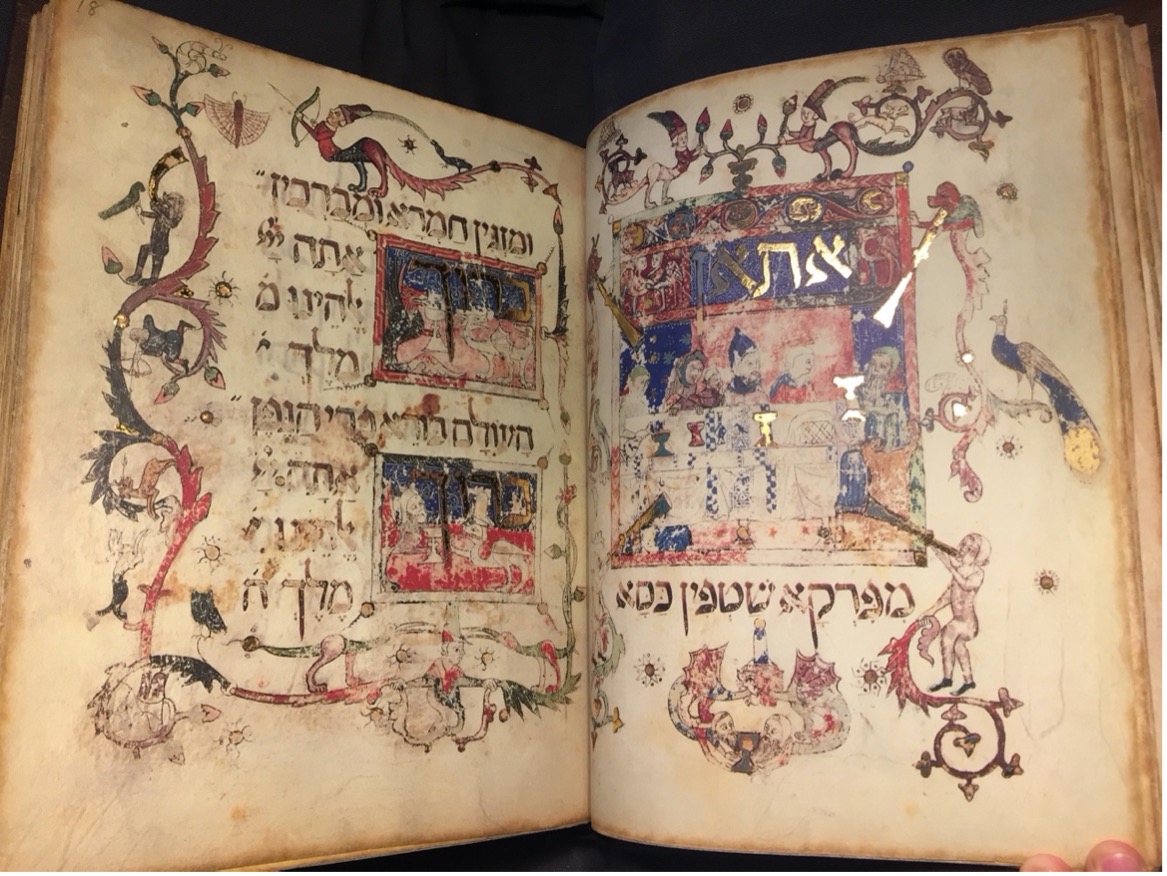
Meeting in the Margins of the Barcelona Haggadah: Marginalia as a Nexus for Ritual Tradition and Interreligious Tensions in Fourteenth-Century Catalonia
Crawling through the margins of the Barcelona Haggadah (British Library Add MS 14761) is a menagerie of animal, human, and hybrid drolleries whose open mouths and riotous actions interrupt and act out the liturgical text. While such drolleries are taken seriously as allegories or social criticism in medieval Christian art, they are usually dismissed by scholars of Jewish art as mere decoration or appropriations of Christian motifs. Though the marginal motifs in the Barcelona Haggadah do derive from the Christian pictorial tradition, the intimate dialectic they share with the text and central miniatures reflects a specifically Jewish understanding of the Passover narrative in which they are situated. Given the increase in Jewish persecution and interreligious tensions in fourteenth-century Catalonia, the marginalia’s liminal position between Jewish and Christian cultures prompts critical questions regarding their interpretation at the seder table and their function within the Barcelona Haggadah. Bringing to the fore four marginal motifs as yet unexamined in relation to the Barcelona Haggadah—the ape, hunter, knight, and goblet—this paper explores the marginalia as a nexus for Jewish ritual traditions and interreligious tensions between Jews and Christians in fourteenth-century Catalonia. In doing so, this paper presents a fresh method for examining Hebrew marginalia, arguing that they are multivalent, interreligious symbols that poignantly reflect the religious and socio-political landscape shaping the Jewish experience in this period.
ARTES is delighted to announce the winners of their 2022 scholarships, with tremendous gratitude to CEEH for their support. Reports of many previous scholars can be found here
TRAVEL SCHOLARSHIPS
Irini Picolou, Durham University: £877.52
Female Martyrdom in The Altarpiece of Saint Engracia by Bartolomé Bermejo
The Altarpiece of Saint Engracia by Bartolomé Bermejo, c. 1474. Isabella Stewart Gardner Museum, CC BY-NC-ND 4.0
Bartolomé Bermejo (active 1474–98), a painter in the Crown of Aragon, produced the Altarpiece of Saint Engracia (1472–74) in Daroca. The altarpiece has since been dispersed, with the central panel and Arrest of Saint Engracia displayed in the Isabella Stewart Gardner Museum and San Diego Museum of Fine Art, and the Flagellation in the Museum of Fine Arts in Bilbao. Only the predella, the Crucifixion, and the Imprisonment remain in the Museum of Daroca. The objective of my study is to trace the altarpiece’s production for a thesis chapter which examines female sanctity in relation to Engracia’s martyrdom.
Kirk Patrick Hilario Testa, Courtauld Institute of Art: £1000
Tracing the Spanish Roots of the Santo Niño de Cebu
The Santo Niño de Cebu. Photo: Kirk Patrick Hilario Testa
My Courtauld MA dissertation focuses on the contemporary articulations of a sacred object called the Santo Niño de Cebu. This Flemish-style statue was brought to the Philippines in 1521 by Ferdinand Magellan. Current scholarship on the Santo Niño de Cebu focuses on what happened after Spanish-Filipino contact. My goal for this research project is to trace the history of the object in the Spanish context before it was brought to the Philippines.
PHD SCHOLARSHIPS FOR UK PHD STUDENTS
Nausheen Hoosein, University of York: £3000
From Umayyad Madinat al-Zahra to Almohad Seville: The Reuse of Architectural Spoliain al-Andalus during the 12th century
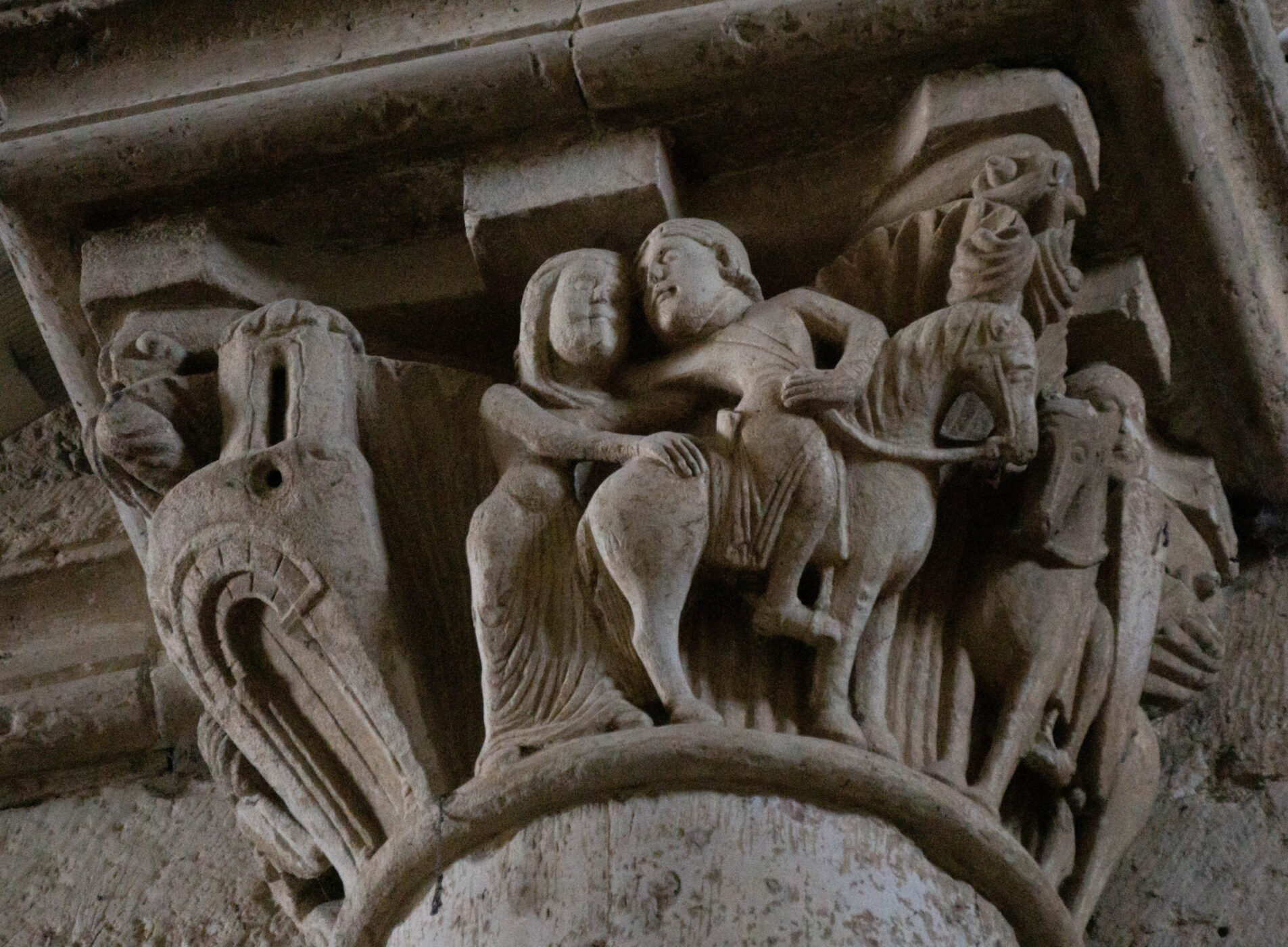
Capitals, 10th Century, Marble. La Giralda, Cathedral of Seville (formerly the minaret of the Almohad Mosque of Seville, completed 1198), Seville, Spain (Photo: Nausheen Hoosein)
The plunder and re-use of Umayyad spolia, particularly capitals, in Almohad architecture remains understudied- although much has been written about the re-use of antiquities in the West, the same cannot be said of Islamic Spain. This project deploys an integrated text- and material-based analysis to examine two significant Almohad sites, La Giralda and Alcázar, in Seville. The project situates the sites within the renewed field of medieval Islamic spolia studies and proposes that the Almohad reuse of Umayyad marble was not a practical or triumphant one, but instead a deliberate programme of religious and political assertion of Almohad rule.
ARTES CEEH SCHOLARSHIP FOR PHD STUDENTS OR POST-DOCTORAL STUDENTS IN SPAIN WHO WISH TO CONDUCT RESEARCH IN THE UK
Paula Martín Rodríguez, Universidad de Sevilla: £3000
Isidro Gálvez: a botanical artist from 18th-century Spain
Drawing of an Embothrium emarginatum by Isidro Gálvez (Photo: Archivo del Real Jardin Botanico, FONDO REAL EXPEDICION BOTANICA AL VIRREINATO DEL PERU)
My thesis examines the figure of Isidro Gálvez, a Spanish botanical artist who dedicated his life to illustrating the Flora peruviana et chilensis, one of several Spanish botanists and draughtsmen in the project. They produced a great number of botanical illustrations that are mainly kept in the Real Jardín Botánico de Madrid. To complete my research and achieve a holistic vision of the work of Gálvez and his colleagues in an expedition to Peru and Chile I need to conduct my research in several English archives.
British regional galleries are extraordinarily rich in holdings of Hispanic art. County Durham alone has the largest concentration of Spanish artworks anywhere in the world outside Spain. In addition to Francisco de Zurbarán’s cycle of Jacob and his Twelve Sons at Auckland Castle, significant holdings can be found at The Bowes Museum, Ushaw College, Durham Cathedral, Durham University, Raby Castle, and the recently established Spanish Gallery. The County’s collections, which cover nearly 500 years, are wide-ranging, from the Galilee Chapel Altarpiece in Durham Cathedral through to Dalí’s lithographs of the Bible at St John’s College. Further afield, Hispanic artworks can be found throughout the country in galleries, museums, and country houses.
Yet, the problem remains that majority of these works are largely unknown outside academia and so have been comparatively under-researched. This two-day conference seeks to raise them to greater public prominence by shifting attention away from collections in well-established locations in or around major cities such as London and Edinburgh and encouraging new research into Hispanic art in a regional context.
On the one hand, the aim is to explore the history and politics of collecting and displaying Hispanic art. It asks how collectors, patrons, and curators have, both historically and in recent years, shaped narratives of Hispanic art. How do we account for the motivations and strategies that underpin the acquisition and display of Hispanic art? What has been the impact of these collections on the regional, national, and international contexts?
On the other hand, the conference seeks to examine individual artworks and artefacts from regional collections, evaluating their significance and trajectory from the original context of artistic production up to their relevance for audiences today. Beyond a possible focus on familiar artworks, such as Zurbarán’s Jacob and his Twelve Sons, how might the study of less explored artists and iconographies advance a more complex understanding of artistic production and cultures of display? How might we work collectively to develop and share knowledge of Hispanic art?
Presentations may relate to (but are not limited to) the following themes:
The politics of collecting and displaying Hispanic art
Curatorial practices
Faith and devotion
Pain and suffering
Rituals, ceremonies, pilgrimage
Empire, colonialism, race
Gender and sexuality
Cultural relations and transfer
Centre and periphery
Decolonization agendas
Attribution
Materiality
The conference will offer delegates a unique insight into two of County Durham’s most important collections, with the first day held in the Spanish Gallery in Bishop Auckland, and the second, at Ushaw College, Durham. The conference is organised by Andy Beresford and Claudia Hopkins (Zurbarán Centre for Spanish and Latin American Art, Durham University). Please send titles and 250-word abstracts to the conference administrator, Barbara Jackson (zurbaran.centre@durham.ac.uk) by 27 May 2022.
Thanks to the generosity of the ARTES-CEEH PhD Scholarship, I have made significant progress in the first year of my PhD at the University of York’s History of Art department. My thesis is titled “From Umayyad Madinat al-Zahra to Almohad Seville: The Reuse of Architectural Spolia in al-Andalus during the 12th century” and is supervised by Dr Richard McClary. My work explores the plunder and re-use of Umayyad spolia, particularly marble capitals, in later Almohad architecture through an integrated text- and material-based analysis to examine two significant Almohad sites, the Giralda and Alcázar, in Seville.
Nausheen Hoosein presenting at the “Works in Progress” Postgraduate Research Conference hosted by the Department of History of Art at the University of York (March 2022)
Since beginning the PhD, I have completed numerous tutorials required of research students, including Research Integrity, Research Data Management, and Information Security Awareness, as well as created a Professional Development Plan. These trainings have ensured that I am equipped with the necessary skills to conduct effective and ethical research in my field. I have also successfully completed the Arabic for Medievalists language course, offered through the Centre for Medieval Studies. This course, along with an advanced Spanish course I will take in the summer term, will help me in better accessing relevant primary texts that are significant for my research. I have also completed several formal supervisions with my supervisor, as well as with my Thesis Advisory Panel Member, Professor Tim Ayers. These discussions have been instrumental in shaping my research questions and strengthening my bibliography.
Column capital, 936-976 CE, Madinat al-Zahra. On display at the British Museum. On loan from the Victoria and Albert Museum, London, A. 145-1920.
Throughout the past year, I worked towards compiling a literature review, as well as a digital database of the corpus of caliphal capitals that are dispersed in various international collections as well as in situ at various sites in Spain. Thus far, I have been able to study the examples in London, at the Victoria & Albert Museum and the British Museum. This short research trip was instrumental in studying the capitals closely and the material observation and visual analysis will serve as an integral component of the thesis. I am already looking forward to the second year of my PhD which will hopefully include field research in various archaeological sites, museums and archives in Cordoba, Seville and Madrid. Findings from these field visits will be recorded in a digital database. This database will serve as an integral component of the research process, allowing me to compile relevant information on each object and site.
Top: Capital, late 14th century, Granada, On display at the Victoria & Albert Museum, London, 341-1866. Bottom: Capital, 960-980 CE, Madinat al-Zahra, On display at the Victoria & Albert Museum, London, A.10-1922.
In addition, I have had the opportunity to present my research at the recent “Works in Progress” Postgraduate Research Conference hosted by the Department of History of Art at York. I am also looking forward to presenting my work and collaborating with colleagues at upcoming conferences in the spring and summer including the Association for Art History (virtual), International Medieval Congress in Leeds, and Society for the Medieval Mediterranean in Crete.
In conclusion, I would like to express my sincere gratitude to ARTES and CEEH for their generous support, without which this progress would not have been possible.
Thanks to the generous support of the ARTES-CEEH Travel Scholarship, I was able to carry out archival research at the Archivo General de Indias (AGI) in Seville, Spain, during the month of August, 2021. I was searching for lists of illustrated books and images that were sent to America before 1615, when Guaman Poma’s illustrated Nueva Corónica would have been completed. Before arriving at AGI, I got in touch with Prof. Pedro J. Rueda Ramírez, who knows the documents I wanted to read backwards and forwards, so my task in relation to my doctoral research was pretty straightforward. Now come the fascinating hours of systematizing the information I gathered. I also took advantage of being in Seville to visit the Biblioteca Americanista and read Spanish-language publications regarding the book trade in America that are difficult to find in the UK. One day, I visited nearby Cordoba and walked the streets that Inca Garcilaso de la Vega would have walked on that side of the Atlantic. I’m including a photo from that day, as I escaped the heat in a forest of columns!
In addition to successfully completing the research I set out to do, the ARTES-CEEH Travel Scholarship made possible two other deeply enriching moments during my month at AGI. First, due to covid restrictions, only a reduced number of researchers were allotted desks in the archive. In order to secure a spot for the day, we had to place our names on a list as early as possible and then wait an hour or so for the archive doors to open. This meant that, during this hour each morning, researchers could get a coffee and chat about their topics. This is incredibly beneficial to, not only each of us personally, but to the field as a whole, as we can get input and feedback in a more relaxed way. Usually, getting the chance to share with researchers in a silent archive requires some effort and planning. This time, however, the space was made for us, and I’d like to thank Stephanie, Marlis, Viviana, Kate, Scott, Grant, Cody, Jesús and José for the powerful and passionate conversations we had each day. Much success to all of you and I hope we meet again.
Yeidy in Cordoba
The second special moment took place on my third day at the archive. On that day, I read a document that, from the very first line, I knew was very special. It was filled with art-historical information regarding a sixteenth century Indigenous gold and silversmith, active in both Mexico and Peru, that I had never read before. I was so sure that what I had read was special that I reached out to Prof. Tom Cummins, who agreed that it was indeed very exciting! The document provides points of entry into discussions around artistic transfer (between Mexico and Peru, as well as transatlantic), circulation and mobility, pre-guild hierarchies and structures, surveillance, authorship, Indigenous and European artistic practices and iconography, mining and materiality, imperial power and artistic tastes, and the visual cultures of colonial contact zones. I have written a note regarding the document that will hopefully be published soon in order to make it accessible to researchers. Thanks to the ARTES-CEEH Travel Scholarship, this once-known silversmith is brought back into view, generating questions around artistic practice as a result of, and in spite of, colonial invasion. Thank you so very much. Support like yours has an even more valuable role now that we are again able to travel and meet our peers face-to-face. Thank you.
Date: Thursday 21 April 2022 Time: 13.00-14.00 BST Location: Zoom and YouTube (Online)
Speakers: Dr Akemi Luisa Herráez Vossbrink, Enriqueta Harris Frankfort Curatorial Fellow, The Wallace Collection, and Professor Claudia Hopkins, Director of Durham University’s Zurbarán Centre for Spanish and Latin American Art
Description: Victorian artist-adventurer David Roberts (1796-1864) travelled extensively in Europe, North Africa and the Middle East, creating countless images of sites and people in drawings, paintings, and prints. Join Dr Akemi Luisa Herráez Vossbrink and Professor Claudia Hopkins, who will discuss Roberts’s works in the Wallace Collection and those recently featured in the exhibition Romantic Spain: David Roberts and Genaro Pérez Villaamil (7 October 2021-16 January 2022) at Madrid’s Real Academia de Bellas Artes de San Fernando.