Take a VIRTUAL TOUR of ‘Funk Fiction’, a video Installation by Brazilian Artist Henrique Fagundes, showing at the Casa de las Conchas Palace in Salamanca, Spain.
To learn more about Henrique Fagundes’ art practice and its relationship to the broader context of Brazilian art join the following didactic initiatives:
SEMINAR (in Spanish)
‘Not Only Carnival: Brazilian Culture between the Symbols of the Nation, Cultural Hybridisation and the Struggle Against Stereotypes’
THURSDAY 24TH FEBRUARY 2021
HISPANIC BRAZILIAN CULTURAL FOUNDATION – SALAMANCA – (online from 11 am UK time)
Speakers: Natalia Muñoz-Rojas (Enrique Harris Frankford Curatorial Assistant, The Wallace Collection) and Patricia Manzano Rodríguez (PhD Candidate, Zurbarán Centre for Spanish and Latin American Art, Durham University)
The Wallace Collection has eight paintings attributed to Velázquez and his school. Yet, few of them have a firm attribution. This is partly due to how little is known about Velázquez’s school, studio and assistants. Juan Bautista del Mazo is the only assistant about whom more is known.
Patricia Manzano Rodríguez is currently working on the first monograph on Del Mazo, which aims to unravel his oeuvre from that of his master. Natalia Muñoz-Rojas will ask her about her research and findings, and their conversation may even cause us to reassess the figure of Mazo and our perception of his work.
Registration and Location: This talk will be hosted online through Zoom and YouTube.
This post, supported by the CEEH (Centro de Estudios Europa Hispánica), is a 22 month traineeship for someone who has a good scholarly art historical background in European paintings and a special interest in Spanish paintings, who wishes to pursue a museum career. The Curatorial Fellow will have the opportunity to be involved in a full range of curatorial activities, including special projects, with a particular focus on Spanish paintings in the period 1450 to post-1800.
The Christian conquest of Granada (1492) triggered the conversion and acculturation of Muslims living in the Iberian Peninsula, who were henceforth known as “Moriscos”. As this process did not unfold in a uniform fashion, Christian doctrine was unevenly assimilated across the territory. Records of material culture in Morisco homes can shed light on the extent of religious conversion in the different geographical areas.
Inventories of New Christian homes were traditionally compiled without reference to their counterparts among Old Christians who were subjecting and converting the Moriscos to Christianity. It is therefore important to study Old and New Christian inventories in parallel to identify any points of contact between them. On the one hand, this research will reveal how Moriscos projected their identity onto personal possessions, including devotional figures which would in fact have represented very unusual choices among Old Christians. On the other, it will show a clear hybridization of customs, as evidenced by the many objects associated to Medieval Islamic tradition found in Old Christian homes, such as adargas (shields), almalafas (robes), ‘Morisco style’ furniture, etc. The aim of this presentation is, firstly, to explore the defining features that set these two communities apart as revealed by both Old and New Christian material culture; and secondly, to learn how such objects were perceived, based on extant descriptions. Taken in combination, these sources can shed light on aspects of daily life among these coexisting communities, the way they made their different identities visible, and their emotional practices.
Borja Franco Llopis is a Professor at the Department of Art History in the UNED (Spain). His research is devoted to the visual and literary representation of the otherness in Southern Europe. He has been a visiting scholar in several prestigious institutions such as the School of History and Archaeology in Rome, the Instituto Storico per el Medievo (Rome), the Warburg Institute (London), Johns Hopkins University, University of California (Berkeley), Harvard University, Columbia University, Universidade Nova of Lisbon and NYU; and Visiting Professor at the University of Genoa. He is Associate Professor at the Department of Art History in the UNED (Spain), the PI of the research group “Before Orientalism. Images of the Muslim Other in Iberia (15-17th Centuries) and their Mediterranean connections” and working Group Leader of the Cost Action 18129: Islamic Legacy: Narratives East, West, South, North of the Mediterranean. He has recently published the monographs titled: Pintando al converso: la imagen del morisco en la peninsula ibérica (1492-1614) (Cátedra, 2019), and Etnicità e conversione. Immagini di moriscos nella cultural visuale dell’età moderna (Affinità Elettive, 2020). He has also co-edited the book: Muslim and Jews made Visible in Christian Iberia and beyond (14-18th centuries) (Brill 2019).
Recording of a talk delivered online on January 27th, 2021 as part of the research seminar series organized by Durham University’s Zurbarán Centre For Spanish and Latin American Art with ARTES Iberian & Visual Culture Group, with the collaboration of Instituto Cervantes in the UK
This talk was delivered as part of a series of 12 research seminars, many of which will also be recorded and available on the ARTES site.
The weekly sessions usually take place on Wednesdays, 6.00-7.00pm, except the fourth session scheduled for Tuesday, 2 February. The talks last ca. 40 minutes and are followed by Q&A.
The series is free and open to all with an interest in the visual arts. Booking is essential. Please email the Zurbarán Centre (Zurbaran.centre@durham.ac.uk) to register and to receive a zoom link. Please note registration closes 24 hours before the seminar.
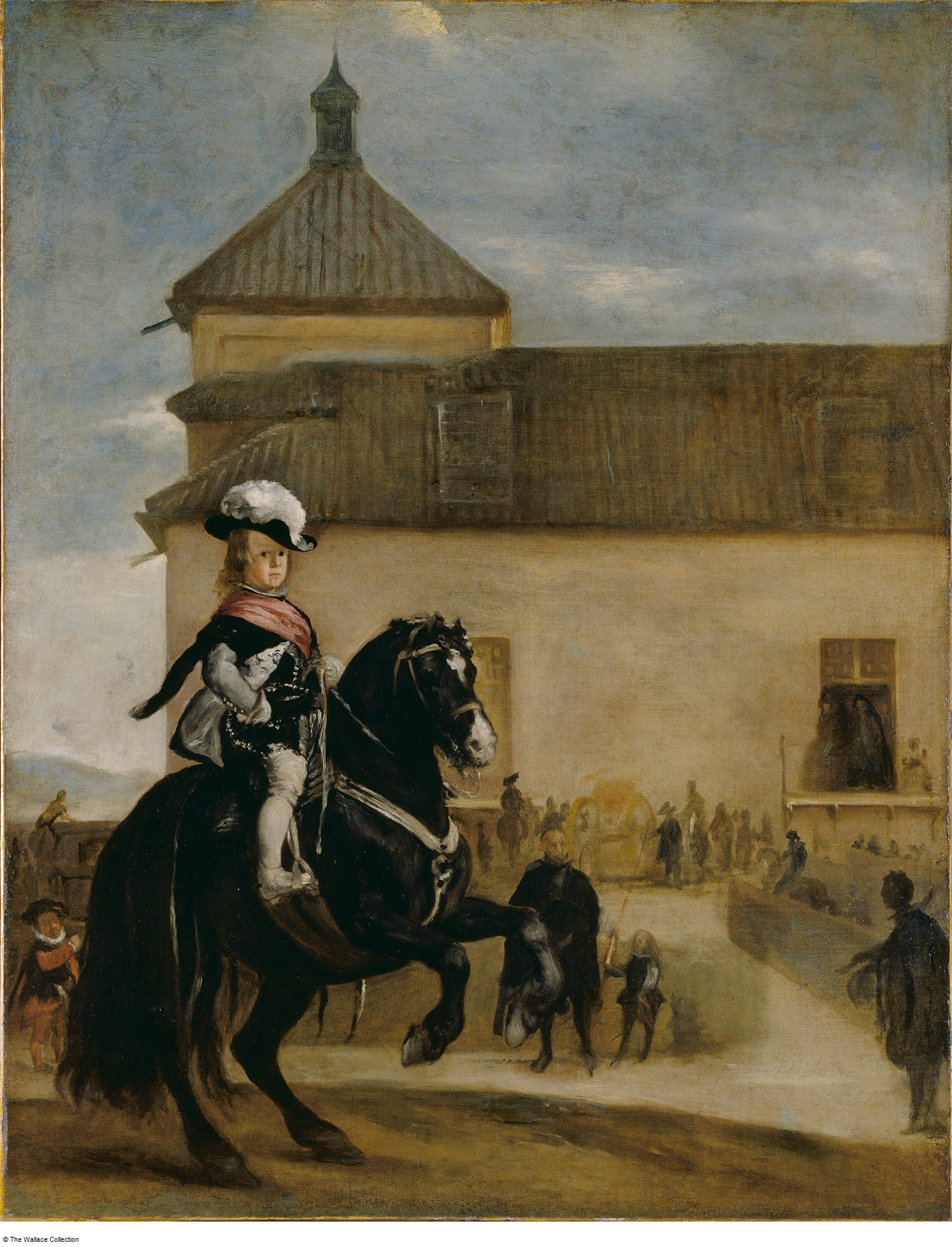
Prince Baltasar Carlos in the Riding School, c. 1640 – c. 1645, Wallace Collection
Date: Thursday 4 and Friday 5 March 2021 Times: 15.00-18.00 each day Location: Zoom (online)
Drawing together an international panel of eminent scholars working on the Spanish Habsburg Court and Spanish art, this two-session conference focuses on one of the best-loved paintings at the Wallace Collection, Prince Baltasar Carlos in the Riding School.
The lectures are free to members of the PSSA. A nominal charge of £3.50 is made for non-members for each lecture.
Abstract: The daughter of a well-known Sevillian sculptor, Luisa Roldán trained in her father’s circle, sculpting both over-life sized wooden sculptures for churches and intimate terracotta sculptures for domestic, devotional spaces. After her marriage in 1671 Roldán established an identity independent of her father and subsequently attracted commissions from churches and religious brotherhoods. Leaving southern Spain with her young family in 1688, she travelled to Madrid where she soon established her reputation as an able interpreter of Madrid’s religious and political environment. In 1692 she was named Sculptor to the Royal Chamber of Carlos II retaining the title upon his death and the arrival of Felipe V, and working until her death in 1706.
Biography: Cathy Hall-van den Elsen studied Spanish art at La Trobe University in Melbourne, Australia, completing her PhD (1992) on the life and work of Luisa Roldán. After a period working outside art history Cathy returned to scholarship in 2005, contributing the introductory chapter to the exhibition catalogue Roldana published by the Consejeria de Cultura in Seville in 2007. In 2018 Cathy published a monograph in Spanish:Fuerza e Intimismo: Luisa Roldán, escultora (1652-1706), (Madrid, CSIC). In August 2020 her annotated bibliography on Luisa Roldán was published by Oxford Bibliographies Online, and in 2021 Lund Humphries will publish her monograph in English: Luisa Roldán. Cathy’s next project is a study of creative women from Spain and Portugal in early modern period.


 ARTES
ARTES 