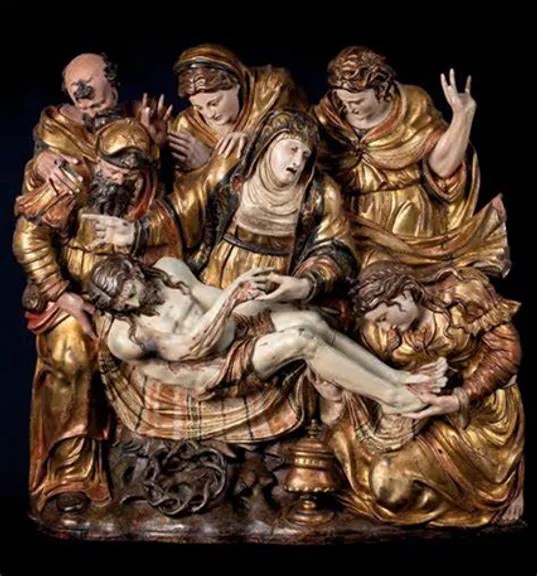
Please join us as Dr. Xavier Bray and Dr. Holly Trusted will be discussing Spanish polychromed sculptures, how they relate to easel paintings, some of the techniques involved, attitudes to such sculptures outside Spain, and why they are so central to the history of art.
Biographies
Dr Holly Trusted (formerly known as Marjorie Trusted) was a founder member and is now Honorary President of ARTES. She was Senior Curator of Sculpture at the Victoria and Albert Museum for over 30 years, and has lectured and published extensively on Spanish sculpture. She is currently working on a catalogue raisonné of Luisa Roldán with Catherine Hall-van den Elsen.
Dr Xavier Bray is an art historian specialising in Spanish art and Director of The Wallace Collection, London. He completed his PhD in 1999 at Trinity College, Dublin, on Goya as a painter of religious imagery. He was Chief Curator at Dulwich Picture Gallery, London and the Museum of Fine Arts, Bilbao, as well as Assistant Curator at the National Gallery. He has curated a wide range of exhibitions including El Greco, Velazquez, The Sacred Made Real: Spanish Painting and Sculpture 1600-1700, Murillo & Justino de Neve: The Art of Friendship, Goya: The Portraits and Ribera: The Art of Violence. Since joining the Wallace Collection he has overseen and co-curated several exhibitions including Richard Wallace: The Collector, Henry Moore: The Helmet Heads and Forgotten Masters: Indian Painting for the East India Company with the writer William Dalrymple. He most recently curated an exhibition at the Wallace Collection entitled Portraits of Dogs: From Gainsborough to Hockney, which ran from 29th March to 15th October 2023.
The event is part of the Research Seminar Series organised by Durham University’s Zurbarán Centre with the ARTES Iberian and Latin American Visual Culture Group in collaboration with the Instituto Cervantes and the Embassy of Spain in London.
The series provides an open forum for engaging with innovative research and exhibition projects relating to the visual arts in the Hispanic world.
An interdisciplinary conference on Islamic Art, Architecture, History and Archaeology
Deadline: December 31st, 2023 All abstracts should be sent as pdf attachments to hist592@york.ac.uk
Conference dates: 14th and 15th March, 2024
With keynote addresses by Professor Robert Hillenbrand and Professor Marcus Milwright
Islamic time begins with the Hijra; the integral responsibilities of every Muslim include the Hajj; and studies of Islamic history have traditionally followed military marches and commercial/cultural corridors that enabled the creation of the great gunpowder empires. More recently, mobility has also been manifested in the Islamic world in the fall of these empires, movement of their materials through loots and repatriations, and voluntary and forced migrations. Until recently, these themes have been predominantly researched divorced from Islam through incongruous positivist lenses and euro-centric canons, and often with underlying colonial agendas.
It is with the aim to intervene within and disrupt this context that the Department of History of Art and the Department of Archaeology at the University of York present Production, Transmission, & Interpretation, a conference on Islamic Art, Architecture, History, and Archaeology. Foregrounding the voices of the historically marginalised, founded in material cultural narratives, and focussed on new sources and methodologies, this conference will bring together the latest research from scholars ² doctoral to emeriti ² and draw upon a range of cognate disciplines across the arts, humanities, and social sciences, to consider 1400 years of the Islamic world and society.
Submission Guidelines
We welcome abstract submissions intended to culminate into the standard format of 20-minute in-person academic paper presentations and invite applications from across disciplines, including art and architectural history, archaeology, conservation, heritage management, curation, museum studies and cultural studies, on themes that may include
Islamic heartlands, hinterlands, and frontiers
Art and architecture of mobility, routes, travels, and transfers
Patronage – imperial, sub-imperial, male, female, and non-binary
Agency of architects, artists, and craftspersons
Sources, oral histories, local archives, epigraphy, calligraphy, endangered languages
Archaeological material, bioarchaeological approaches, and conservation
Islamic approaches past and present to nature, culture, environment and sustainability Conflicts, occupations, appropriations and adaptations
Islamic art markets ² auctions, ethics, legislations
Abstracts should be limited to 250 words, indicate the target thematic cluster, and be accompanied by the researcher’s name, institutional affiliation and stage of study, location, and a brief biography not exceeding 100 words.
Deadline for proposal submission is 31 December, 2023.
All abstracts should be sent as pdf attachments to hist592@york.ac.uk
If you have any questions, please email Parshati Dutta (parshati.dutta@york.ac.uk) or Nausheen Hoosein (nausheen.hoosein@york.ac.uk).
Conversations are underway with leading university presses to publish a thematic edited volume of papers presented, therefore please declare if the material has been used before, and if not, whether you would be interested in publishing with us.
A limited number of travel bursaries may be provided. Please indicate if you would like to be considered for the same.
By Isabelle Kent, PhD candidate at University of Cambridge and winner of the ARTES 2023 Juan Facundo Riaño Essay Prize.
When: Monday, 4th December 2023 18:00GMT Where: Instituto Cervantes London (15-19 Devereux Court London WC2R 3JJ) and zoom
In the background of Diego Velázquez’s enigmatic masterpiece, Las Hilanderas, the artist summarises with a few bravura strokes a treasure of the Spanish crown, Titian’s Rape of Europa. This citation, first identified in 1903, has underpinned many subsequent interpretations of the work, yet a second pivotal allusion to Titian’s poesie has passed unnoticed until now, that of Diana and Actaeon.
Taking these two citations as a starting point, this paper argues that Velázquez designed his painting within the intellectual framework of Conceptismo, with these quotations acting as ‘correspondencias’, mechanisms of interconnecting wit that weave art, metaphor and Ovidian myth. Combining this mode of intellectual thought as it applies to the poesie, with an embodied approach to how Velázquez as the curator of the King’s collection interacted with Titian’s paintings, this lecture (literally) pulls back the curtain on a new understanding the work, one that, as in Las Meninas, centres our ambiguous gaze.
To book your tickets – both in-person or zoom – please click here.
Isabelle Kent is a PhD candidate at Trinity College, University of Cambridge researching the heroic body in early modern Spanish art. She has been a visiting scholar at Universidad Autónoma de Madrid and El Consejo Superior de Investigaciones Científicas, and from 2017-19 she was the inaugural Enriqueta Harris Frankfort Curatorial Assistant at the Wallace Collection. Her work has been published in the Burlington Magazine, Apollo Magazine and the Hispanic Research Journal, and she is also editor ofCollecting Murillo in Britain and Ireland (CEEH, 2020).
This event is organized by ARTES, in conjunction with the Instituto Cervantes London and with the support of the Spanish Embassy to London.
The talk will discuss the research for the exhibition Murillo. From Heaven to Earth curated by Guillaume Kientz at the Kimbell Art Museum in Forth Worth, 18 September 2022 – 29 January 2023. Inspired by the Kimbell’s mysterious Four Figures on a Step, the exhibition focused on Murillo’s earthly depictions of secular subjects and everyday life in seventeenth-century Seville. The show and its accompanying catalogue shed new light on Murillo’s innovative portrayals of beggars, street urchins and flower girls in the artist’s culturally rich narratives of youth and age, romance and seduction, faith and charity.
Guillaume Kientz is the Director and CEO of the Hispanic Society Museum and Library, New York. He previously served as Curator of European Art at the Kimbell Art Museum and as Curator of Spanish and Latin American Art at the Musée du Louvre.
To join the seminar, click on the link below, or copy and paste it into your browser:
The seminar has been organised by the Zurbarán Centre and the ARTES Iberian and Latin American Visual Culture Group in association with the Cervantes Institute, UK.
The permanent Seminar “Iberian Worlds and Early Globalization” resumes its activities the coming Thursday, September 21st, starting with an inaugural session focused on the figure of J.H. Elliott, titled “J.H Elliott y su Mundo / J. H. Elliott and his World”.
In this session, Dr. Richard L. Kagan (Johns Hopkins University) and Dr. Geoffrey Parker (Ohio State University) will consider the legacy of Professor Elliot based on the text recently published in The British Academy, which can be downloaded here:
The Seminar will be composed by introductory remarks by Dr. Bethany Aram (Área de Historia Moderna, UPO), the dialogue between Professor Kagan and Professor Parker, and the mediation of Dr. Bartolomé Yun (Área de Historia Moderna, UPO), which will only be transmitted online through the following Zoom link:
Rome, Bibliotheca Herztiana – Max Planck Institute for Art History
8–10 May 2024
Submission Deadline: December 15, 2023
A category of objects that exists entirely as a function of violence, the term ‘loot’ describes a relationship of possession, if not more specifically of dispossession. Neither an historically nor materially specific typology of artifacts, loot is instead primarily a legal category that cuts across place and time. And while it is also not an art- historical classification, it is one with which the discipline of art history must constantly contend, given its repercussions for what is accessible, where, and in what condition. This international, interdisciplinary conference invites papers addressing the ways in which conflict and its resolution have historically moved, modified, and reclassified art objects in the long early modern period. We invite contributions on the material, ethical, legal, political, and narrative implications of the claiming and reclaiming of objects in times of war and peace, as well as the ongoing resonance of these issues today, particularly for institutions that are their present-day repositories.
Studies on looting have a tendency to focus on canonical episodes, most often drawn from Roman, Napoleonic, and Nazi-era plunder. But the early modern period saw the steady transfer of booties, trophies, and spoils over the European continent and across the Atlantic and the Pacific. In Europe, this transfer triggered a moral, theological, and legal debate around property rights, as well as the development of codified criteria governing correct modes of wartime conduct, regulating who was permitted to plunder, what, when, and from whom. The act of looting was itself a strategy of violence, especially in the colonial context; but looted objects themselves were also particularly susceptible to damage, neglect, and even deliberate melting down. Moreover, although often thought of as an entirely modern phenomenon, the return of seized objects was also first theorized in this period as a tool of diplomacy and cultivated alongside a nascent legislation for the protection of art against damage, destruction, or unlawful export.
This conference revisits the early modern origins of the discourse around cultural property with an eye to the challenges facing museums today. Recently, scholarly meetings including “Plunder: An Alternative History of Art” (panel, Annual Meeting of the Association for Art History, 2022), and “The Material Cultures of War and Emergency” (conference, University College London and Oxford University, 2023) have brought attention to the long history of the taking away of things as a result of conflict. We hope to continue this conversation, expanding its purview beyond the object’s capture, to its framing, display, and possible restitution, while spotlighting medieval and Renaissance loot and its contemporary stakes.
This conference is organized by Julia Vázquez and Francesca Borgo. Following “Wastework” in 2023, this is the second yearly conference convened by the Lise Meitner Research Group “Decay, Loss, and Conservation in Art History” at the Bibliotheca Hertziana – Max Planck Institute for Art History, furthering the Research Group’s ongoing inquiry into the consequences that different forms of loss, disappearance, and degradation bear for the discipline. For more information see our webpage: https://www.biblhertz.it/research-group-borgo. A series of special presentations and pre-conference visits to local collections will launch the event. Travel and accommodation costs will be covered for speakers. Proposals will be considered for inclusion in an edited volume on loot and its recovery in the early modern period. To submit a proposal, please send your CV (including current position and affiliation), a 250-word abstract and paper title to john.rattray@biblhertz.it by December 15, 2023.
The Meadows Museum (Dallas, Texas) is currently looking for a museum curator. The Meadows Museum is a thriving university art museum and a leading institution for the study and presentation of the art of Spain in the U.S. In 1962, Dallas businessman and philanthropist Algur H. Meadows donated his private collection of Spanish paintings, as well as funds to start a museum, to Southern Methodist University. The museum opened to the public in 1965, marking the first step in fulfilling Meadows’s vision to create “a small Prado for Texas.” Today, the Meadows is home to a comprehensive and high-quality collection of peninsular Spanish art. The collection spans from the 10th to the 21st centuries with a particular strength in painting, sculpture, and works on paper from the late medieval to modern periods.
ARTES would like to bring to the readers’ attention that the current staff strike will affect the Museo Picasso Málaga’s work. Consequently, this might affect the opening on the coming exhibition, The Echo of Picasso, prospectively planned Oct. 3, 2023 – March 31, 2024.
ARTES would like to share a reminder of our upcoming visit to Bishop Auckland. ARTES is organising a long-overdue visit to The Spanish Gallery and Bishop Auckland Castle on Friday 18th August. The visit will coincide with a lecture being given on the Spanish Gallery’s sculpture collection by ARTES President Dr Holly Trusted, who has been working on the collection for the last year as a Zurbarán Centre Fellow. The day will also provide opportunities to discuss the collection with the driving force behind the entire Auckland Project, Jonathan Ruffer, and, the curator of the Spanish Gallery, MorlinEllis. Both of whom are longstanding ARTES members.
Schedule
10.30am – Highlights tour of the Spanish Gallery
11.30am – Holly Trusted lecture, “History, Feeling and Colour: Sculpture at Bishop Auckland“
12.30pm – Further exploration of the Spanish Gallery, with Piers Baker Bates talking on the dialogue between Spanish and Italian art, which was the subject of his own Zurbarán Centre Fellowship in 2022.
1.30pm – Lunch
2.30pm – Zurbarán’s paintings of Jacob and his twelve sons, with Zurbarán Doctoral Scholar Richard Jacques, and the Sin Exhibition hosted in collaboration with the National Gallery, both at Auckland Castle.
4.00pm – Depart
For those who have yet to visit Bishop Auckland this will be an opportunity to explore one of the finest collections of Iberian art outside of Spain. For those who have already visited, it is envisaged that the talks by Holly Trusted, Piers Baker Bates and Richard Jacques will bring fresh perspectives to this remarkable resource.
Members will have to make their own travel arrangements to Bishop Auckland and pay for admission to the Gallery and Castle, although carers and ART Pass holders enter free of charge. Further information on Bishop Auckland, including opening times, ticket prices and travel information can be found here.
Would those interested in joining this event please let Richard Jacques (rpfjacques@gmail.com) as soon as possible.
ARTES is delighted to share Megan Smith’s report of her research trip, funded by the CEEH/ARTES Travel Scholarship.
Thanks to the generous funding of the ARTES-CEEH Travel Scholarship, I was able to travel to several sites in Spain in late March-early April of this year to carry out research for my undergraduate dissertation, which focuses on the work of the Factum Foundation in Bishop Auckland’s Spanish Gallery.
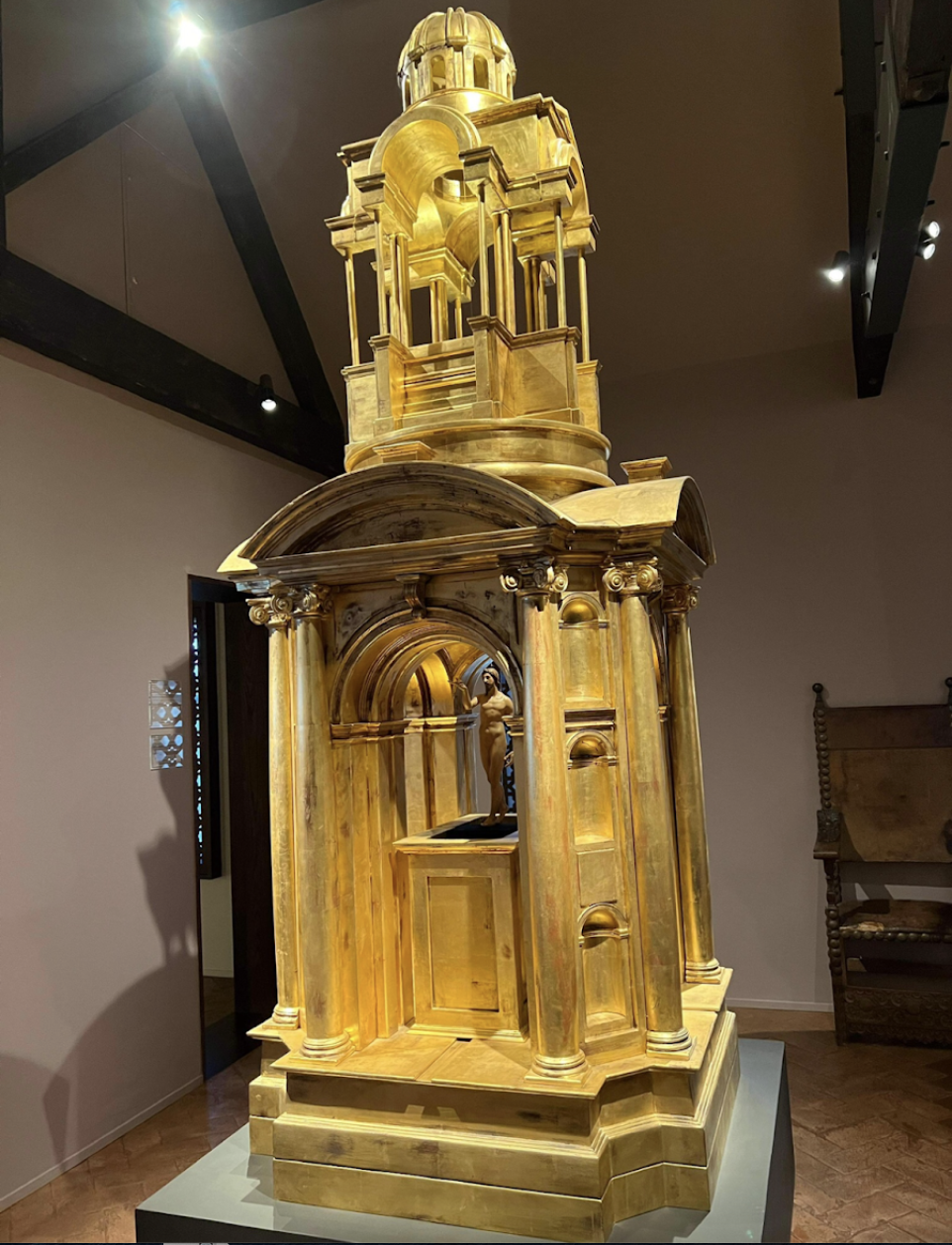
Facsimile of El Greco’s ‘Risen Christ’ Tabernacle on display at the Spanish Gallery, complete with restored top part of the structure.
The Factum Foundation uses non-contact scanning, modelling and printing technologies to produce facsimiles of artworks and artefacts across the globe, an invaluable resource in digital preservation and conservation. Since 2009, Factum have worked to digitally archive objects of significance in cultural heritage, and have produced high-spec facsimiles of a number of these objects for display in institutions on an international scale. For the Spanish Gallery, Factum have produced a full-facsimile exhibition of Spanish Baroque and Renaissance painting, sculpture and architectural elements, producing not only the artworks on immediately obvious display but also the floors, ceilings and wall mouldings, borrowed from several sites in Spain. The scholarship funding meant that I was able to visit the sites where the original works remain in their original contexts, to better understand the differences between them and their facsimile counterparts. In particular it was the display of these artworks which I wanted to investigate, which is very difficult to do without visiting the institutions in person to see how the original displays may differ from the gallery setting in which we find the facsimiles.
El Greco’s original ‘Risen Christ’ Tabernacle on display at the Hospital de Tavera.
The tracing of these artworks began at the Hospital de San Juan Bautista (known as the Hospital de Tavera) in Toledo, where several works by El Greco and Alonso Berruguete recreated by Factum for the Spanish Gallery exhibition can be found. El Greco’s ‘Risen Christ’ tabernacle is perhaps one of the most interesting works from this collection, as Factum have rematerialised the missing top section of the structure by digitally modelling a new design based on a pre-Civil War photograph. In partnership with the Hospital, Factum also recreated the sepulchre and death mask of Cardinal Tavera, along with El Greco’s portrait of the Cardinal, and the much larger El Greco ‘Baptism of Christ’ painting from the side altarpiece. The display of this panel in the chapel of the Hospital is in great contrast with that of the Spanish Gallery facsimile, which opens up a discussion of how the use of facsimiles in this gallery space may offer visitors a new viewing experience.
From Toledo I travelled to Madrid, where I had the opportunity to visit the Factum Foundation workshop. This was without a doubt the highlight of my trip. I had the opportunity to speak to Carlos Bayod, who worked on the Spanish Gallery display, which helped me gain insight on how the curation of the exhibition developed and the importance of the digital preservation aspect. Each step of the facsimile process has a dedicated team and workshop, and it was particularly interesting to see precisely how an artwork goes from a collection of photographs and scans to a fully rematerialised object, identical to the original piece. I would like to specifically thank Larissa van Moorsel, who facilitated my tour of the workshop, for her wealth of knowledge on the detail of Factum’s work.
At the tiled patios of the Casa de Pilatos.
From Madrid I travelled to Seville, where I first visited the Casa de Pilatos. Like the Hospital de Tavera, the Casa de Pilatos is part of the Fundación Medinaceli. Factum scanned and reproduced ceramic tiles from the patios, alongside some of the surrounding plasterwork yeserías, and a fourth-century statuette of The Good Shepherd, the facsimiles of which are part of the Spanish Gallery exhibition. The facsimile tiles are a particularly noted visitor highlight of the Spanish Gallery display, and their recording and reproduction is especially significant as the original tiles are beginning to become damaged due to rising ground moisture causing the walls to curve outwards. As with the artworks in the Hospital de Tavera, it was interesting to consider the differences between the Casa de Pilatos and the display of its artworks and architectural elements in the Spanish Gallery exhibition.
Gesso prototype of the facsimile tiles from the Casa de Pilatos patios, in an early stage of the facsimile creation process.
My final stop was the church of the Hermandad de la Santa Caridad, also in Seville, where two works by Juan de Valdés Leal and two remaining works of an original series of six by Murillo can be found, all replicated for the Spanish Gallery. When seen in its intended compositional context in the chapel, a carefully designed iconographic program becomes clear which represents the Caridad’s philosophy of charity as salvation: the two vanitas paintings by Juan de Valdés Leal, In Ictu Oculi and Finis Gloriae Mundi, work in synthesis with the accompanying series of paintings by Murillo, which represents the Acts of Charity in the Catholic tradition. To understand this messaging, the paintings must be seen as they were originally commissioned; however in the Spanish Gallery, they are separated into different floors of the building, which naturally alters their iconographic significance in their new, isolated positions. This was the biggest difference between the original context and gallery display I noted whilst visiting these sites, and I found that it was this site which clarified the significance of this research the most.
The funding from the ARTES-CEEH scholarship made this research – and my dissertation- possible, and I am hugely grateful to both organisations for this opportunity! I would also like to extend my gratitude to the team at Factum Foundation, who provided me with every resource possible to carry out this research.







 ARTES
ARTES 