One-Day Symposium Friday March 24th, 2023 10am – 6pm Royal Academy of Arts, London, UK
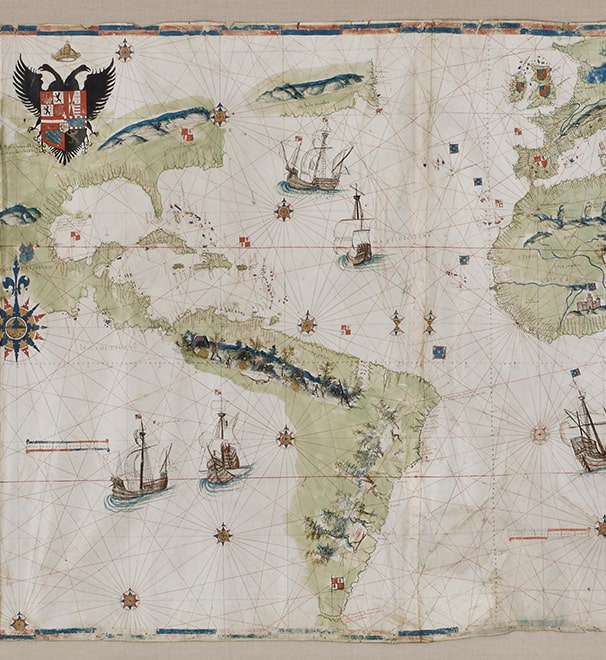
Giovanni Vespucci, World Map (detail), 1526.
In an opportunity to further elaborate ideas explored in their current exhibition, Spain and the Hispanic World– a gathering of over 150 objects on loan from the Hispanic Society Museum and Library spanning time periods and continents – the Royal Academy of Arts invites the public to a one-day symposium: Spain and the Hispanic World Symposium: cross-cultural exchanges.
Based on an interdisciplinary approach, the Symposium offers the opportunity to engage in discussions in which global exchange, empire and colonialism, movement (of objects, peoples, ideas), and cross-confessional and -cultural issues take center stage. From Al-Andalus to Christian Iberia to colonial Latin America, the symposium looks beyond just the exportation of Spanish Culture to consider as well the influences and exchanges simultaneously brought back into Iberia.
To learn more about the symposium, speakers and to book your ticket, please click here.
Thanks to the generous support of ARTES-CEEH PhD. Scholarship, I conducted my research in London last November and made significant advances in my PhD thesis’s archive work. My Thesis is titled Isidro Gálvez y los dibujos de la Flora peruviana et chilensis, supervised by Dr Ángel Justo Estebaranz at Universidad de Sevilla (Spain). My work studies the figure of Isidro Gálvez, a draughtsman of the Royal Botanic Expedition to Peru and Chile by Hipolito Ruiz and José Pavón (1777-1788). This Expedition produced more than 2.000 botanical drawings, over 700 signed by Gálvez.
At the beginning of 2022, I started my archival research in Madrid, studying Gálvez drawings at the Real Jardín Botánico of Madrid. To complete the work I was undertaking in Madrid, I needed to consult the materials in English institutions related to this Expedition. At the beginning of the 19th Century, José Pavón sold and exchanged part of the collection to botanists around Europe to obtain international recognition. As a result, manuscripts about the journey to Peru and Chile, letters regarding Pavon’s selling, and herbarium sheets ended up in the Natural History Museum, the Royal Botanical Gardens of Kew, the Linnean Society of London, and the Wellcome Collection.
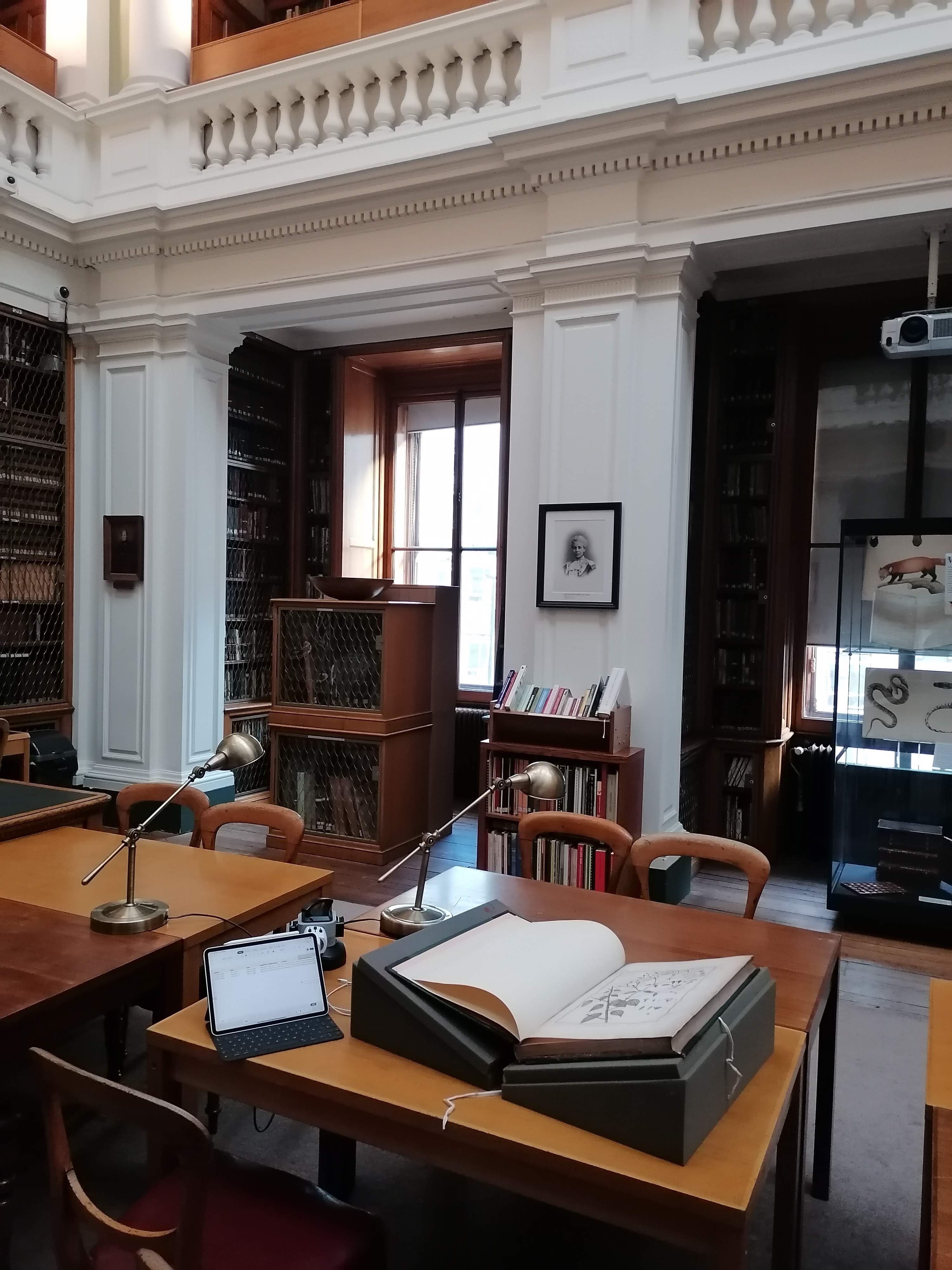
Part of my research in London involved consulting the editions of the Flora peruviana et chilensis that the institutions I visited held. I was interested in the making of the books, the engraving process, and which paper they used. The publication of the Flora lacked funding and suffered some troubles due to the political situation of Spain at the beginning of the 19th Century. These affairs affected the quality of the books and the number of volumes published. The Flora was going to be a compound of 12 volumes, however, only the first three were published with their descriptions. Ruiz and Pavon sent the illustrations in the fourth tome to some international botanists. For the first time, I could see the fourth volume of the Flora, from which there are only four copies in the World. I could examine three of them at Kew, the Natural History Museum, and the Linnean Society and study how they arrived in London.
On this trip, I hoped to find drawings by Galvez or his colleagues among the letters and publications related to Ruiz and Pavón. And although I encountered some letters proving the exchange of illustrations between Pavón and several English botanists, I could not locate any of these drawings. Nevertheless, I am content with having actual proof of these exchanges. This would help me study the diffusion of knowledge through botanical images.
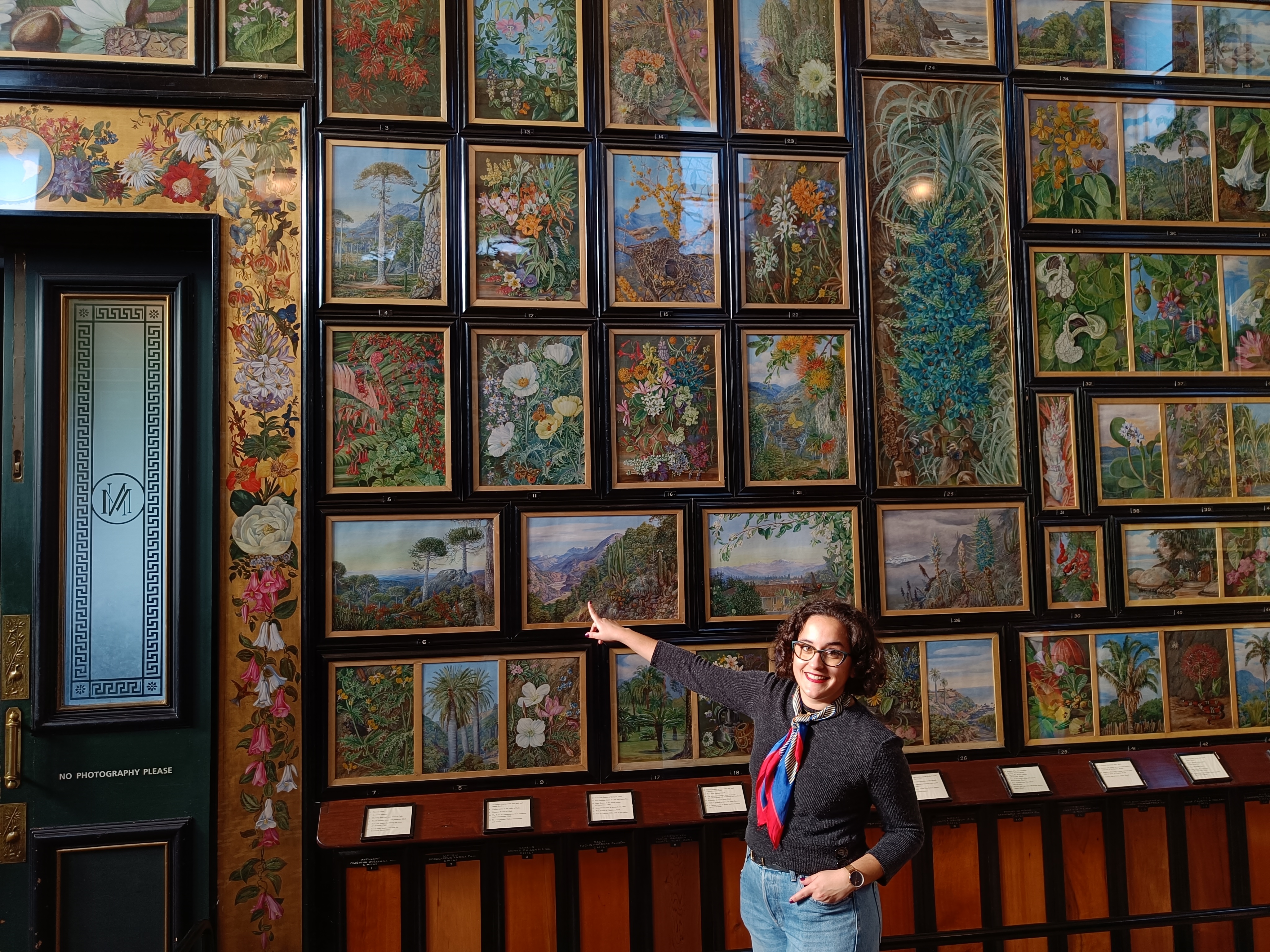
While in London, I decided to go to other places like the British Library or the University of London to consult the bibliography not available in Spain and some classic titles on Natural History. Furthermore, I used my free time in the city to also visit the Museums and institutions that held materials related to scientific expeditions and those that had artworks from botanical artists. I particularly enjoyed seeing the cinchonas from the Wellcome Collection displayed at the Science Museum, as Ruiz and Pavon collected these barks in their travel to Peru. Moreover, visiting Kew Gardens and seeing Marianne North Gallery was one of the highlights of my time in the UK. As a scientific illustrator myself, studying the artworks of North, Maria Sibylla Merian, Georg Dionysius Ehret and others inspired me to continue researching botanical art and drawing.
I am very grateful to ARTES and CEEH to give me the opportunity to conduct my research in some of the best Natural History institutions in the World. Their generous support has helped me to obtain a global vision of the materials from Ruiz and Pavon Expedition and had encouraged me to continue with my PhD work.
ARTES is delighted to share Irini Picolou’s report of her research trip, funded by the CEEH/ARTES Travel Scholarship. We are currently accepting applications for 2023, please click here for details (deadline 31st January).
The generous scholarship provided by ARTES and the CEEH gave me the opportunity to conduct an exciting and productive research trip. My findings enabled me to address questions regarding the representation of the body in pain in the Altarpiece of Saint Engracia by Bartolomé Bermejo and to understand further the titular saint’s local significance in Zaragoza and Daroca. I was also able to examine, in detail, Bermejo’s portrayals of alterity in the panels of the altarpiece.
Irini capturing details
For the first two days of my trip, I stayed in Bilbao, where I visited the Museo de Bellas Artes and met the Head of the Department of Conservation and Restauration, María José Ruiz-Ozaita. She first conducted a guided in-situ examination of the Flagellation of Saint Engracia with a UV light to demonstrate the areas of restoration and remaining signs of damage. The conservation team then provided me with a microscopic lens and digital microscopic light to take close-up images of the whiplashes on Engracia’s back, blood spurts, and other minute details in the painting, such as inscriptions and skin pigmentation. This opportunity to gain a precise view of such details, as well as document these findings, enabled me to pinpoint the location of damage and wounds on the pictorial surface. The digital microscopic light also allowed me to detect the exact pigmentation of blood and skin colour which would not have been possible even by looking at a digital high-resolution image. The UV picture provided by the Museum also facilitated the identification of paint damage and uncovered novel conclusions regarding the depiction of the tortured body, thus demonstrating that it was more dramatic to fifteenth-century viewers than it currently appears. The stage micrometre was used to measure the sizes of lashes and blood drops, revealing Bermejo’s detailed and precise representation of torture. This research has opened a new series of questions in outlining the importance of blood and wounding as central elements of Engracia’s pained body.
Conservation Team in the Museo de Bellas Artes
The Conservation team also showed and sent me reflectographic images which demonstrated a possible hidden date referring to the production of the painting. They also revealed the definition of the bodily features and Islamic patterns on the floor tiles and clothing. This access to Bermejo’s drawings has enabled a clearer identification of the regional and religious references in the composition, thereby informing an understanding to Bermejo’s approach in representing alterity.
For the second part of the trip, I stayed in Zaragoza and visited the local museum, which held paintings of Christ’s Arrest, Crucifixion and Resurrection jointly produced by Martín Bernat and Miguel Ximénez, Bermejo’s collaborator and contemporary. Given that these paintings were produced around the same time that Bermejo was working with Bernat in Zaragoza, I was able to contextualize my observations on the portrayals of pain and alterity in the Altarpiece ofSaint Engracia. More importantly, the in-situ examination of the Descent from the Cross by Bermejo and Bernat informed further insights concerning Bermejo’s specific depictions of blood, sacrifice, and alterity in comparison with the Flagellation of Saint Engracia.
Visit to the Palacio de la Aljafería in Zaragoza
I also visited the Basilica of Saint Engracia, which marks the location where Engracia was martyred. The building was previously a monastery church destroyed in the Siege of Zaragoza in 1809, and so it was reconstructed into the Basilica. By examining her shrine, I gained a better sense of her regional importance within Zaragoza, which informed the motives behind the commission of the altarpiece in Daroca. My final pursuit in Zaragoza was a visit to the Palacio de la Aljafería, where I observed and took photos of architectural inspirations for the portrayal of Dacian’s Palace in the Arrest of Saint Engracia, Imprisonment, and Flagellation. I was able to identify better some of the patterns and architectural elements depicted in the panels of the altarpiece.
From Zaragoza, I travelled to Daroca, where I visited the Museo de los Sagrados Corporales. I first conducted an in-situ examination of the remaining panels of the Engracia altarpiece held in Spain: the Crucifixion, Arrest, and Imprisonment. During this visit, I explored specific details in the panels constituting the portrayals of pain and alterity. I gained a better understanding of the devotional viewing context of the altarpiece since the panels were displayed in the Museum of the Church, which showed additional references to martyrdom and sacrifice, such as the famous sacred corporals. The ingrained visual and textual representations of medieval Jewish and Muslim people in the town of Daroca has also enriched insights on the propagandistic purposes of the altarpiece.
Irini in Daroca
I am extremely grateful to ARTES and the CEEH for providing me with the opportunity to make an important contribution to scholarship on the Altarpiece of Saint Engracia and Bermejo. This research has also broadened theoretical insights on the importance of representing pain and female martyrdom in fifteenth-century devotional painting.
Our next Research Seminar will take place on 30 November at 18.00 on zoom:
Dr Francisco Montes, Female Power and Visual Culture in Viceregal America
Abstract: This paper presents an overview of the findings in current research focusing on how the influence exerted by certain women in Spanish colonial society can be measured from the visual field. For this purpose, an extensive iconographic repertoire of casta paintings and sumptuous portraits of aristocrats, chieftains and nuns have been the most eloquent tools to analyze this phenomenon. However, there were other symbolic representations of female power, embodied by distant sovereigns and absent vicereines, which still need to reveal a multiplicity of hidden meanings.
About the speaker: Francisco Montes is Associate Professor of Art History at the University of Seville, where he also obtained his Ph.D. in Colonial Latin American Art. His research is primarily focused om artistic patronage, ritual festivals and the exchange of images between Spain, Italy and the Iberian Americas during the viceregal period. Montes is author of the books Sevilla Guadalupana. Arte, historia y devoción (2015) and Mecenazgo virreinal y patrocinio artístico. El ducado de Alburquerque en la Nueva España (2016). He is editor of the volume Religiosidad andaluza en América. Repertorio iconográfico (2017). He is a member of the editorial board of Anuario de Estudios Americanos.
The seminar is organised by the Zurbarán Centre with the ARTES Iberian and Latin American Visual Culture Group. It will be chaired by Dr Piers Baker-Bates (The Open University / ARTES).
Investigating the Spanish Roots of Filipino Catholic Devotion through the Santo Niño de Cebú
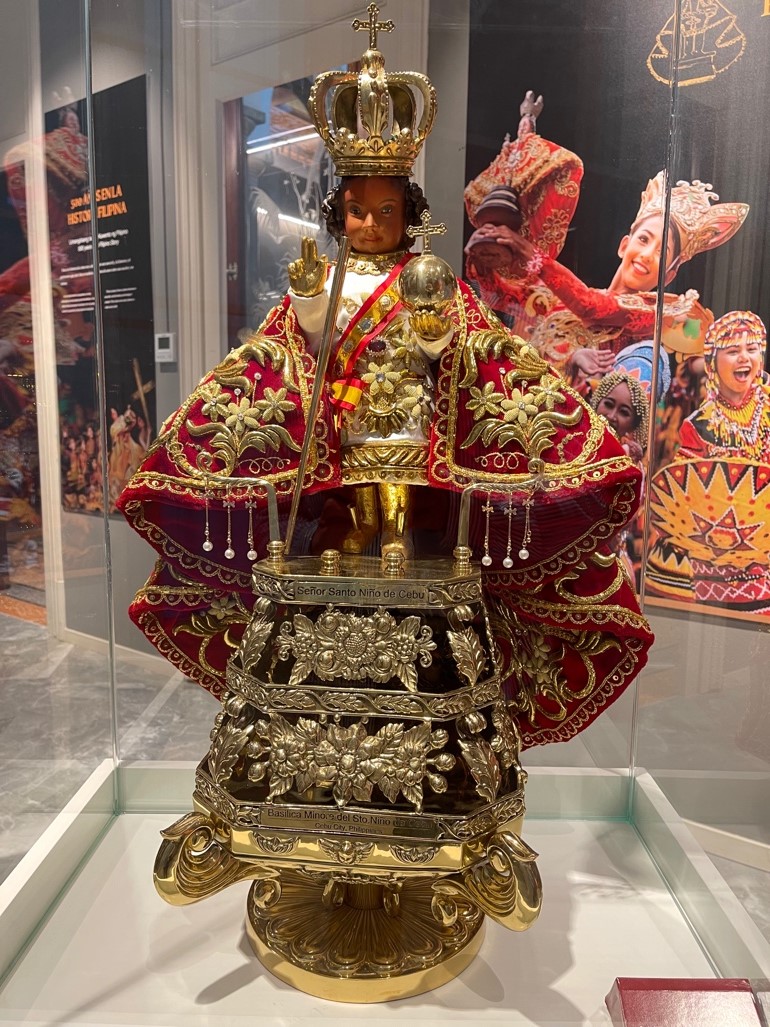
Through the generous funding of the Artes-CEEH Travel Scholarship, I was able to conduct invaluable research not only for my Courtauld History of Art MA dissertation but also for a future publication. By visiting the cities of Barcelona and Madrid, I enriched my investigation into the material and devotional history of the Santo Niño de Cebú, a sixteenth-century statue of the Christ Child brought by the explorer Ferdinand Magellan to the Philippine islands in 1519. As a native Filipino, my inquiry stems from an interest in this object’s role in fueling the Spanish Empire’s colonization of the archipelago and its contemporary veneration by Filipino Catholics.
The Santo Niño de Cebú replica
In April 2022, I travelled to Barcelona to visit the exhibition, Santo Niño de Cebú: An Icon of Philippine Culture and History. The show was staged in celebration of the quincentennial of Magellan’s, and, therefore, the Santo Niño’s, arrival in the Philippines. Organized by the Filipino Catholic church and the Consulate General of the Philippines in Barcelona, the jewel of the exhibition was an exact replica of the Santo Niño de Cebú statue. It was displayed in the eighteenth-century office spaces of the Philippine Consulate General along with paintings and informational texts explaining the Santo Niño’s history and the ways in which Filipinos celebrate the icon today. The island nation’s reverence for this statue is rooted in an idealized version of history that honors Magellan’s act of gifting the Santo Niño icon to the local rulers of Cebú Island. This positivist view overlooks the 333 years of colonization that ensued from the Spanish arrival. Today, Magellan’s act of gifting is remembered through two major festivals called Sinulog and Ati-atihan. Celebrated in Cebú in the month of January, Sinulog begins with a grandiose fluvial procession, during which the Santo Niño statue is sailed through Cebú’s coastline and then carried through the streets by the annual Sinulog queen, a role that commemorates the native Cebúano queen Humamay, who received the original statue from Magellan. The latter festival, Ati-atihan, commemorates the Santo Niño’s acceptance by the Aeta, a term for indigenous Filipinos. The festival’s name means ‘to be like the Aeta’ and is celebrated through street processions for which Filipinos paint themselves black to mimic the dark features of their indigenous ancestors.
Me standing at the entrance of the Philippine Consulate in Barcelona
I was led through the exhibition by Philippine Cultural Ambassador Bernardo Bagalay. He answered my questions regarding the Santo Niño’s history and confirmed my hypothesis that the statue was originally produced in Mechelen. Known as enfants des Malines, these statues were produced and sold for private devotional use, especially by nuns. Bagalay also informed me of a ceremonial mass that was held to commemorate the Santo Niño’s symbolic ‘return’ to Spain in the form of the exact replica. This mass was held in the renowned Basilica de la Sagrada Familia and Bagaly showed me images and videos of the event. I also learned from him that, after the exhibition, the replica statue would go on to be displayed at the San Agustin Church, which is frequented by the Filipino community of Barcelona. This move was based on making the statue more accessible. I thoroughly enjoyed listening to Bagalay stories of visitors who were moved by the exhibition. For example, the day before my visit, a group of Filipino women from Cebú stumbled upon the show and began singing local Cebúano canticles around the statue.
To further investigate the contemporary veneration of the Santo Niño de Cebú, I visited the San Agustin Church in Barcelona and listened to a Filipino mass. I also did the same in Madrid’s Paroquia del Santo Niño de Cebú, which has its own replica statue. These site visits and engagement with Filipinos abroad proved to be crucial fieldwork for my dissertation. In addition to the site visits that focused on Filipino Catholic devotion, my trip to Spain coincided with Semana Santa. It was insightful to witness the processions of pasos through the crowded streets of Madrid. I was able to tap into my childhood memories of participating in similar processions in the Philippines. Seeing these traditions in Spain allowed me to better understand just the influence of Spanish Catholicism on its Filipino counterpart. Overall, the Artes-CEEH Travel Scholarship made my dissertation possible and has laid the foundations for me to develop my project into a longer, future publication, which I will write after visiting the Philippines at the end of 2023.
The BritishSpanish Society is hosting an evening of music, wine and tapas at St James’s Church Picadilly this Friday 25 November 2022, doors open at 5:30 pm
The BSS is delighted to once again be holding their Autumn Concert in the impressive St James’s Church, Piccadilly. The church, which dates back to 1676, was designed by highly acclaimed British Architect Sir Christopher Wren. Wren’s aim for the church was to enable the largest number of people to hear the service and see the preacher. The acoustic qualities of the church have been consistently celebrated with the church hosting music greats across the ages from Haydn to Adele.
This year’s music director is former BritishSpanish Society scholarship winner Nicole Crespo O’Donoghue. Nicole describes the concert’s programme as a ‘celebration of Spanish composers’.
Programme(subject to change) Julia Sanchez Merino (mezzo soprano) – A selection of songs by Falla & Lorca LauraPeribañez (cello) – Allegro appassionat by T. Buxó Lucia Veintimilla (violin) – Salve Regina by Jorge Muñiz & 3 ‘Hyperludes’ by F. Coll Daisy Noton (flute) – Carmen Fantasy by F. Borne LauraPeribañez & Nicole Crespo – Tango – I. Albeniz Nicole Crespo (violin) – Playera and Zapateado by Sarasate
Ticket price includes a tapas and wine reception following the concert. The event is open to members and non-members.









 ARTES
ARTES 