Organised by:
The Centre for Image Research and Diffusion (CRDI) of the Girona City Council and the Association of Archivists of Catalonia, with the support of the Department of Culture of the Generalitat of Catalonia – Sub-Directorate General of Archives, and the Spanish Ministry of Culture – Sub Directorate-General of State Archives, the promotion of the International Council on Archives (CIA/ICA) and the collaboration of Digital Meets Culture, Michael Culture Association, Photographic Studies Institute of Catalonia (IEFC), Sindicat de la Imatge UPIFC and ANABAD.
Subsequently on show at other locations around Spain.
Display celebrating Spain’s cultural and natural heritage via the 191 Spanish projects that have been awarded Europa Nostra prizes over the last 40 years. The exhibition is divided into 13 sections including: Roman monuments; Arab buildings; religious institutions; palaces, houses and towers; civic buildings; other urban structures; and industrial heritage.
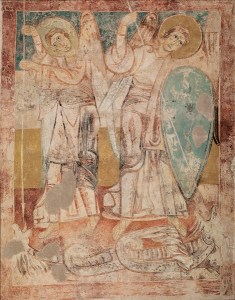
Display of 17 Romanesque and Gothic paintings and mural fragments selected from artworks presented to the Museum in recent years by the collector Antonio Gallardo Ballart. These acquisitions constitute the most outstanding contribution to the medieval collection over the past few years. In the near future, these pieces will come to form part of the permanent itinerary through the Museum’s room displays. The selection includes examples of Romanesque mural painting and Gothic panel painting, from the twelfth to the sixteenth centuries. Most of the pieces are of Catalan origin, by artists such as the Serra brothers, Lluís Borrassà and Bernat Martorell. The rest come from other Hispanic regions, such as the fragment from the Abbey of San Pedro de Arlanza and a panel associated with Nicolás Francés.
Research Forum Seminar Room, The Courtauld Institute of Art, Somerset House, Strand, London, WC2R 0RN
Speakers include
Dr Glaire D. Anderson: University of North Carolina
Organised by
Dr Sussan Babaie: The Courtauld Institute of Art
Open to all, free admission
There is a symbiotic relationship between design, art and visual culture, and the exact sciences, which is attested in early scientific objects from al-Andalus and in medieval Arabic texts. In this talk I explore the objects, spaces, and figures that illuminate this relationship, focusing on ‘Abbas Ibn Firnas (d. ca. 887), the celebrated polymath of the Cordoban Umayyad court, and on al-Andalus and its contemporaries between the 9th-11th centuries.
Glaire D. Anderson is a historian of Islamic art of the caliphal period, with a focus on the art and court culture of Umayyad Cordoba. She is the author of The Villa in Early Islamic Iberia (Ashgate, 2013), co-editor with Mariam Rosser-Owen of Revisiting al-Andalus (Brill, 2007), and recent articles on the Islamic west in architectural history, women and the arts of Cordoba, and material culture and caliphal sovereignty.
A comprehensive retrospective of the Spanish artist includes 120 works from the artist’s entire career, from his early paintings in Paris, in which the influence of the French Impressionists is clearly evident, through to the distinctive pictures that reflect the maturing of his art into his own style. The exhibition focuses in particular on the large-format paintings that attracted such attention in the Paris Salon. Accompanied by a 248-page catalogue in German with 118 colour images priced at €29.
Gonzalo Chillida Kuba-Kutxa Fondazioa San Sebastián
22 April – 3 July 2016
First major retrospective of the San Sebastián-born artist displaying some 130 paintings, drawings, prints and photographs from five decades of his career: Landscapes and still lives through his abstract images of the 1950s and 1960s, culminating with his sea and cloudscapes.
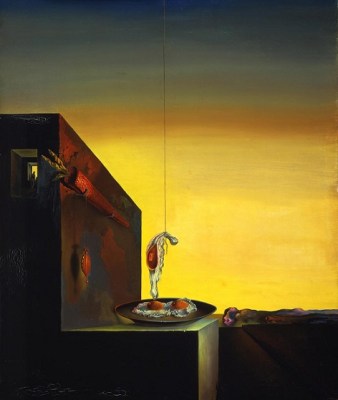
The Menil has borrowed from the Dali Museum, St Petersburg, Florida Dalí’s Eggs on a Plate without the Plate and displayed it alongside its own Surrealist collection including artists with whom he collaborated in Paris.
The paper proposes revisions to the chronology of the chapel’s construction, its layout, the identities of the effigies and the place of production of its carved retable.
Call for Papers: The Matter of Sculpture in Southern Italy, Spain and the New World
The history of sculpture has, particularly with regard to the early modern period, been dominated by studies on marble and bronze, materials that are at the core of traditional art literature. Yet, as Michael Baxandall has shown in his Limewood Sculptors of Renaissance Germany, different materials might be related to different geographies and very different discourses. This session aims to explore the material richness of early modern sculpture, focusing in particular on the axis between the Kingdom of Naples, Sicily, Spain and the New World. More specifically, we are interested in the ways in which different materials might tell different stories about artistic developments, patronage, artists and local traditions, uncover different sources, and create new connections between various geographical areas. The wooden sculptures of Spain are a well-known example; one may also think, among others, of Sicilian wax sculptures, the silver sculptures of Naples, Lecce’s sculptures in the local pietra leccese, or the cornstalk-paste sculptures of Latin America.
As per RSA guidelines, proposals must include the following: paper title (15-word maximum), abstract (150-word maximum), keywords, and a very brief curriculum vitae (300-word maximum).