

El Greco’s Library, Museo del Prado,1 April – 29 June 2014.
Reconstructs the literary and theoretical roots of El Greco’s art via the books he owned according to the inventories produced by his son in 1614 and 1621. Of the 130 books owned by the artist the Prado has brought together about 40 books from its own holdings and those of the Biblioteca Nacional and other Madrid libraries. The exhibition includes the two editions of Vasari and Vitruvius annotated by El Greco with his comments on painting and architecture, a rare letter from the archives of the Italian city of Parma and nine prints, which provided the artist with compositional inspiration.
Rubens, Madrid and Los Angeles
 Rubens: The Triumph of the Eucharist, 25 March – 29 June 2014, Prado; and travelling to the Getty, Los Angeles in 14 October 2014 – 4 January 2015.
Display of six recently conserved panel paintings which Rubens painted as modelli for The Triumph of the Eucharist part of the series of 20 tapestries commissioned by Philip III’s sister the Infanta Clara Eugenia in 1625 to decorate the convent of Las Descalzas Reales in Madrid, to which the Infanta intended to retire. Four of the tapestries will also form part of the exhibition to illustrate the artistic process from Rubens’ initial painted designs to the finished tapestries woven in 1628 by the Geubels’ family workshop. Other tapestries from the series will remain on display in the convent, which is also open to the public as part of the Patrimonio Nacional.
1st ARTES Coll & Cortés Scholars announced
ARTES is delighted to announce the winners of the 2014 ARTES Coll & Cortés scholarships. Out of a very strong field the following awards were made:
 ARTES Coll & Cortés PhD Scholarship for students at a UK University
This was awarded to Kathryn Santner, a PhD candidate at the University of Cambridge, to support her study of the paintings in the Convent of Santa Catalina de Sena, in Arequipa, Peru.
ARTES Coll & Cortés Scholarships for PhD or post-doc students in Spain, Portugal or Latin America
This was awarded to Ana Hernández Ferreirós, a doctoral student at the Universidad Complutense de Madrid, for her research on the twelfth-century bibles of San Isidoro de Leon and San Millan de la Cogolla.
ARTES Coll & Cortés Travel Scholarships
These were awarded to Costanza Beltrami, a 3rd-year undergraduate student at the Courtauld Institute, for a research trip to Spain to visit buildings associated with the fifteenth-century architect Juan Guas. Another scholarship was awarded to Matilde Grimaldi, a PhD student at the Courtauld Institute, for a research trip to Tortosa to study the city’s twelfth-century cathedral (now largely destroyed), and its treasury.
ARTES extends its warmest congratulations to the 2014 scholars, and thanks Coll & Cortés once again for their generous support.
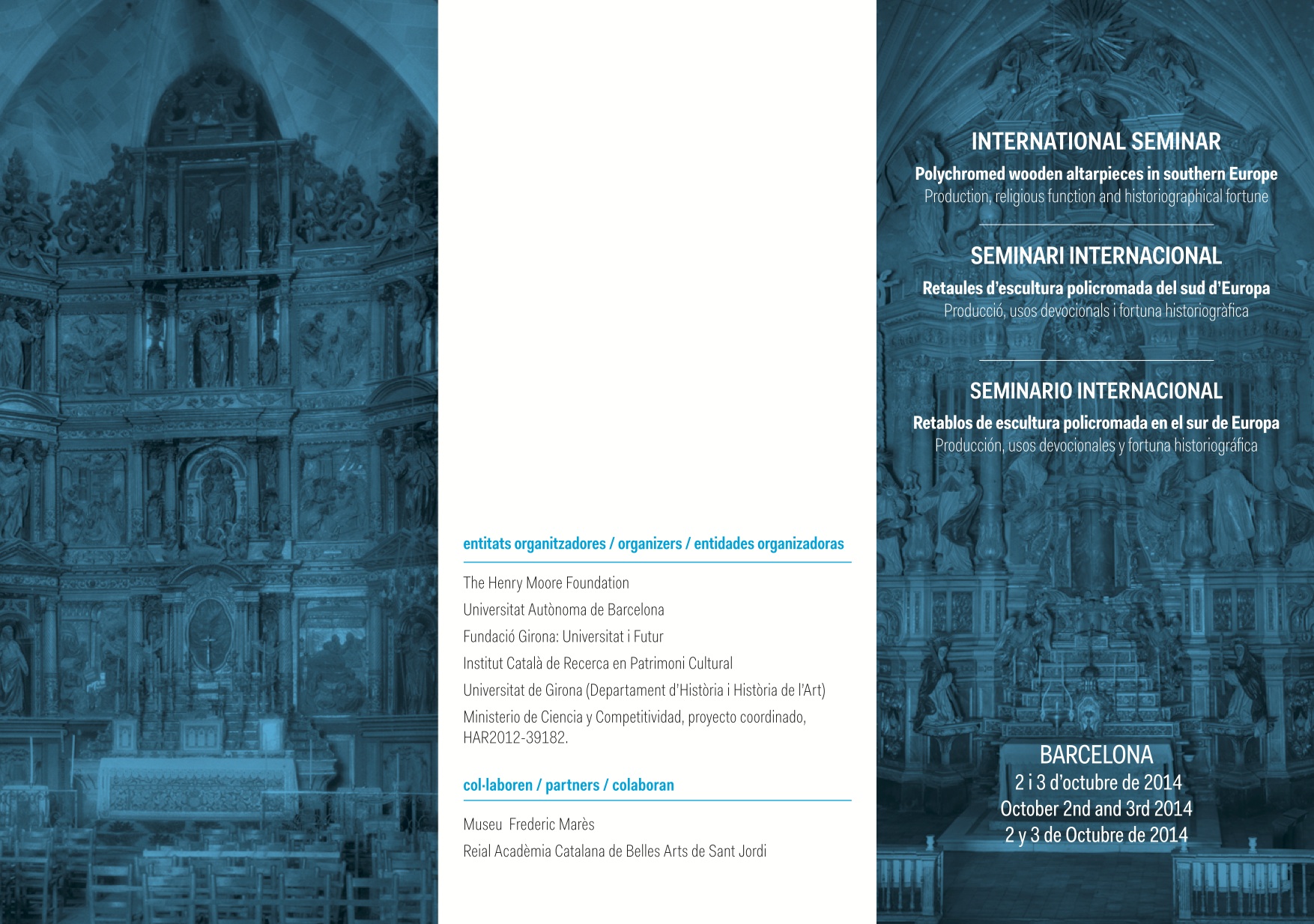
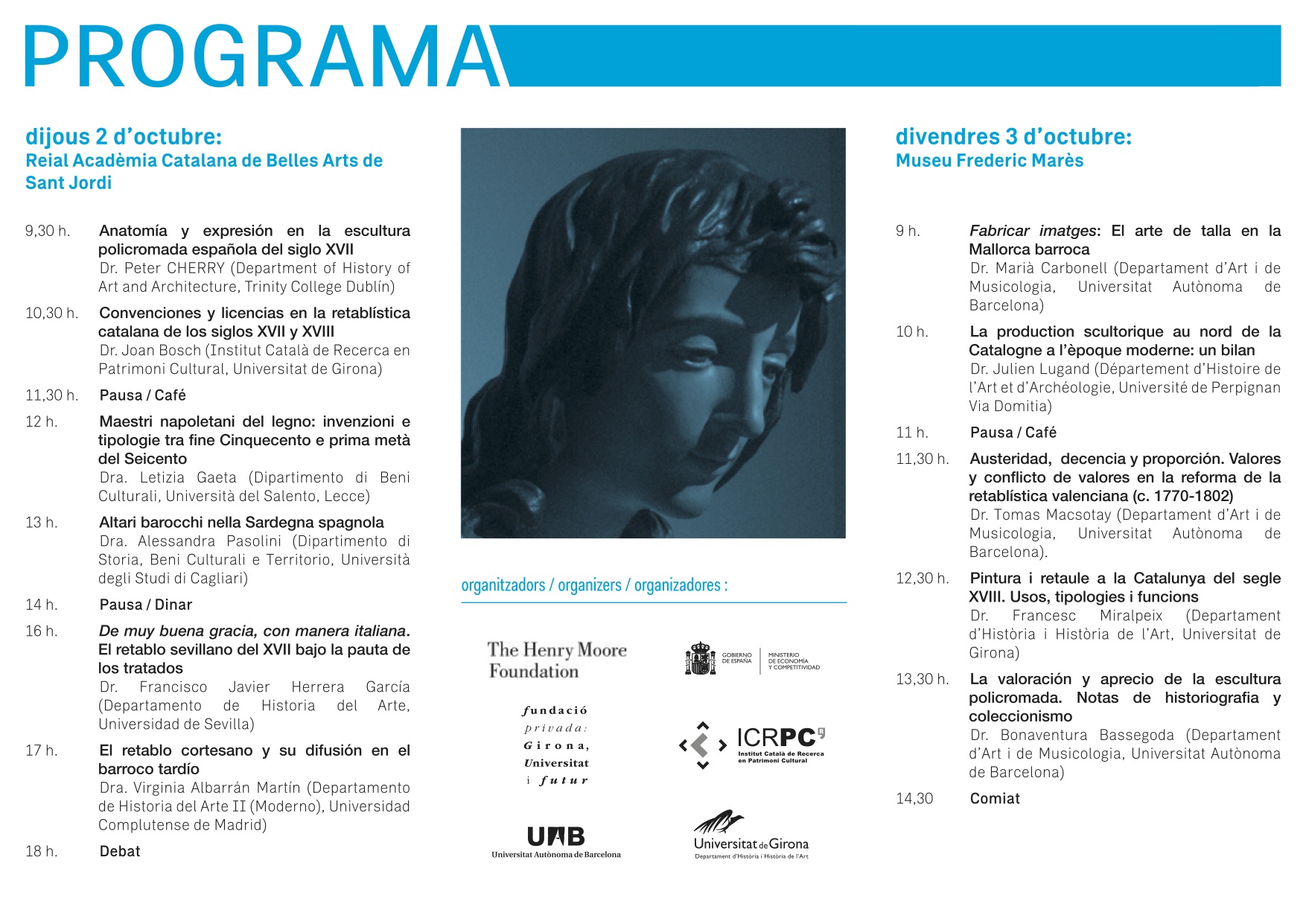
International Seminar on Polychromed Wooden Altarpieces in Southern Europe 2 & 3 October 2014/ Seminario internacional – retablos de escultura policromada en el sur de europa – 2 & 3 octubre de 2014
Internships at Coll & Cortés, dealers in fine arts
 Coll & Cortés Fine Arts, dealers in Hispanic, Latin American and Italian art, are offering internship opportunities at their London offices. These internships are unpaid, but interns will have opportunities to gain valuable experience with major London dealers, with picture research likely to be a significant part of the role.
Internships will be offered on a competitive basis. Applicants are expected to hold a degree in Art History (or be in their final year of a BA) and will need at least a reading knowledge of Spanish. Internships are offered throughout the year (except July and August), for a minimum of 4 consecutive weeks. Coll and Cortés regrets that it cannot assist in funding transport or accommodation costs for interns.
Applications should be sent to CollCortesinternships@gmail.com by 2nd April 2015. Applicants should not expect notice of receipt; successful candidates will normally be notified by the end of May. Applications should include the following:
1) a covering letter (max 2 pages), including a description of suitability and dates of availability over the next 12 months; and a CV (max 2 pages), emphasising educational or professional experience of particular relevance. These should be sent in a single MS Word document. Applicants are strongly encouraged to research on the Coll and Cortés website in order to tailor their application, paying particular attention to Coll and Cortés’ highly respected catalogues.
2) An academic or professional reference, sent directly to CollCortesinternships@gmail.com by the referee.
Please note that ARTES assists only in recruiting candidates for these internships and accepts no legal responsibility to any applicant or third party arising from this notice, or the award or otherwise of a internship. Coll & Cortés and ARTES reserve the right to make no awards in cases where they deem that applications are not of satisfactory quality. Coll & Cortés and ARTES will not enter into correspondence with unsuccessful applicants or their academic advisors regarding its decisions.
Sorolla and America, Meadows Museum, Southern Methodist Museum, Dallas, 13 December 2013 – 19 April 2014

Sorolla and America, Meadows Museum, Southern Methodist Museum, Dallas, 13 December 2013 – 19 April 2014; touring to San Diego Museum of Art, 30 May – 26 August and finally Fundación MAPFRE, Madrid, 23 September 2014 – 11 January 2015. Exhibition curated by the artist’s great-grandaughter Blanca Pons-Sorolla , presenting over 100 paintings, oil sketches and drawings, by Joaquín Sorolla y Bastida (1863-1923) covering his early socially realistic themes as well as his better known landscapes and beach scenes. Exhibition focuses on key American collectors Archer Huntington and Thomas Fortune Ryan and the impact on the artist and American cultural society of the exhibitions he held in the States in 1909 and 1911. Accompanied by bilingual English/Spanish editions of the catalogue.
Last chance to see ‘America Latina: Photographs 1960-2013’
 ‘America Latina: Photographs 1960-2013’ at the Fondation Cartier pour l’Art Contemporain, Paris, closes on 6 April 2014 before moving to the Museo Amparo, Puebla, Mexico (14 June – 29 September 2014). This exhibition, co-produced with the Museo Amparo in Puebla Mexico, brings together works by 70 artists from eleven countries, ranging from documentary photographers to contemporary artists who manipulate/modify the photographic image.
Lecture: Kirstin Kennedy, ‘What Alfonso X’s works tell us about the dissemination of his manuscripts’
 On Wednesday 28th May, at 5.30pm, Dr Kirstin Kennedy (V&A) will give the Medieval Work in Progress Seminar in the Research Forum South Room of the Courtauld Institute of Art. Open to all.
Dr Kennedy’s talk is entitled ‘What Alfonso X’s works tell us about the dissemination of his manuscripts’
Conference: Sculpture and Sculptors in Spain – New Orleans – 16-19 Oct 2014 – Request for Papers
Sixteenth Century Society & Conference (SCSC)
Sculpture and Sculptors in Spain
New Orleans, 16-19 Oct 2014
Sculpture and Sculptors in Spain, 1450-1660 Panel
Panel Chairs
- Ilenia Colón Mendoza, University of CentralFlorida (icm2@hotmail.com)
- Kelley Helmstutler Di Dio, University of Vermont (kelley.didio@uvm.edu)
The goal of this panel is to highlight recent research on sculpture in Spain during the long sixteenth century. Please submit papers dealing with the varied methodological approaches to the production, creation and interpretation of sculpture and its place within the art historical canon and the history of Spanish art. Studies on context, iconography, manufacture, transportation, and patronage are welcome. We are particularly interested in the roles of sculpture in diplomacy and politics, the organization of sculpture workshops, the specific use of materials and their meaning, the culture of display and collecting practices, the status of sculptors and sculpture in Spanish society, production and exportation of works in an out of Spain by native-born and immigrant sculptors as well as sculptors who worked for Spanish clients outside of Spain.
Please send 250-word abstract to both chairs by March 25, 2014.
Great British Hispanists in conversation at the Instituto Cervantes: ARTES Hon President Sir John Elliott – Tues 25 March 2014 – 6.30pm
As part of a series on Great British Hispanists taking place at the Instituto Cervantes in London, Director Dr Julio Crespo MacLennan will be talking to Sir John Elliott this Tuesday 25 March at 6.30 pm.
Sir John (who publishes as J.H.Elliott) is an eminent historian of Spain and the Spanish Empire in the Early Modern Period and is Regius Professor Emeritus of the University of Oxford. Sir John has been a stalwart supporter of ARTES over the years and is now our Hon President.

Please do come along and support this event if you can. There is no charge for entry and although booking is preferred, time is short and Morlin will be there to vouch for ARTES members. It will be in English and will surely be very interesting.
 ARTES
ARTES 