

Exhibition:
Joan Miró: Painting Walls, Painting Worlds
Schirn Kunsthalle, Frankfurt
26 February – 12 June 2016
A little known aspect of Miró’s oeuvre: Approximately 50 large-format works.
Exhibition:
Joan Miró: Painting Walls, Painting Worlds
Schirn Kunsthalle, Frankfurt
26 February – 12 June 2016
A little known aspect of Miró’s oeuvre: Approximately 50 large-format works.
Exhibition:
Sorolla tierra adentro
Museo Sorolla, Madrid
9 February – 5 June 2016
Final month of an exhibition reuniting 35 landscape paintings belonging to the Sorolla Museum. Focuses on views of Spain’s interior, especially Castille’s central meseta, Asturian mountains and a series of cathedrals and Andalucian monuments, patios and gardens. Painted by Sorolla in 1902, alongside the landscape artist Aureliano de Beruete.

Prado Museum, Madrid
18 May 2016 – 04 September 2016
The result of a collaborative project between the National Media Museum in Bradford and the Centro de Estudios Europa Hispánica, the Museo del Prado has assembled for the first time the material used by the Scottish collector and Hispanist William Stirling Maxwell for the preparation of his book The Annals of the Artists of Spain, the first art historical publication to include photographic images. With the Annals, Spanish art became widely known abroad through its reproductions of works by 16th – 17th century Spanish artists, as well as Goya. On display are the proofs from the Henneman photographic studio, showing how the book was produced and the problems encountered.
Curated by founding ARTES member Hilary Macartney, University of Glasgow; and José Manuel Matilla, Head of the Department of Prints and Drawings at the Museo Nacional del Prado.

Mesoamerican Manuscripts: New Scientific Approaches and Interpretations
Conference, exhibition and workshop
31 May – 2 June
Weston Library, University of Oxford
Display and discussion of the Bodleian Library’s five pre-Colonial and early Colonial Mexican manuscripts: Codex Selden, Codex Bodley, Codex Mendoza, Codex Laud and The Roll of the New Fire (or Selden Roll).
Presents recent findings on the making and historical significance of the Bodleian’s and other early, pictorial Mesoamerican manuscripts, situating them in the context of the pre-Columbian and colonial societies that produced them, describing the world they depict, and reflecting upon their meaning in contemporary Mexico and beyond.
More information (including Programme and Registration): Click here.

Museo del Prado and Fundación Gondra Barandiarán Research Scholarships (Madrid)
APPLICATION DEADLINE: 7 May 2016
CALL FOR APPLICATIONS FOR TWO FUNDACIÓN GONDRA BARANDIARÁN-MUSEO DEL PRADO RESEARCH SCHOLARSHIPS
Centro de Estudios, Museo del Prado, Madrid, Spain, September 01, 2016
Application deadline: May 7, 2016
The Fundación Gondra Barandiarán and the Museo Nacional del Prado have signed an agreement allowing the two institutions to jointly sponsor a program consisting of two remunerated scholarships for researchers involved with any aspect of art history related to the Museo del Prado’s collections.
This agreement stipulates the awarding of two scholarships: a senior scholarship for researchers over the age of 40, and a junior scholarship for those beneath that age. These scholarships will be funded by the Fundación Gondra Barandiarán and will have a maximum duration of three months each. The two scholarships will be carried out at the Museo del Prado’s Centro de Estudios (Research Center) in the Casón del Buen Retiro, beginning in September 2016.
The scholarships will be awarded following a competition based on the principles of objectivity, transparency, equality, non-discrimination and public access.
Provision
The senior scholarship is endowed with 9,000€ (nine thousand Euros), consisting of 3,000€ (three thousand Euros) per month for a maximum of three months. The junior scholarship is endowed with 6,000€ (six thousand Euros), consisting of 2,000€ (two thousand Euros) per month for a maximum of three months.
Further information via H-ARTHIST: Please click here.

Just opened: Bête Noire
Exhibition, MUSART-BERLIN
29 Apr 2016 – 27 May 2016
Curated by SCAN Spanish COntemporary Art Network
Bête Noire is an art exhibition that reflects on conceptual positions and creative opportunities of the colour black (and de-saturation) in the context of contemporary art practices. Includes the work of nine multidisciplinary emerging artists from Spain: Ruben Guerrero, Alain Urrutia, Maria Leon, Ubay Murillo, Anna Talens, Inma Femenia, Alex Marco, Maria Tinaut and Fernando Martin Godoy.
27 April 2016
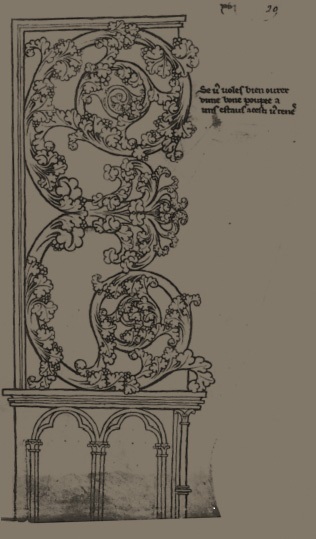
Universitat Autònoma de Barcelona. Facultat de Filosofia i Lletres. Aula 602.
Programme:
2016-04-II IMMC Art and Ceremony
.
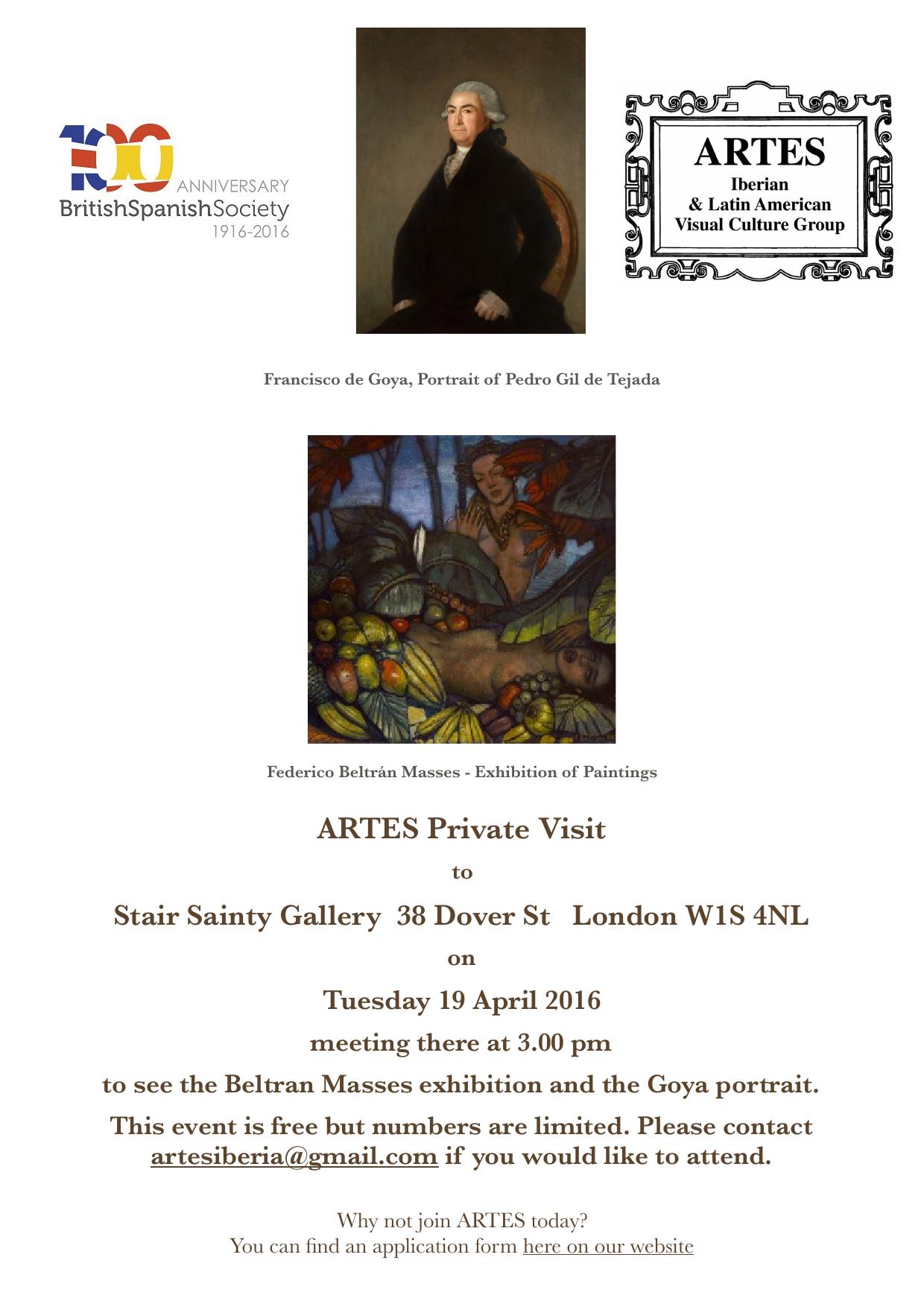
Here follows a report by Dr Encarna Montero Tortajada, a post-doctoral researcher from Valencia, who in 2015 was awarded a £3000 scholarship to conduct research in the UK.
From the 7th of January 2016, I spent forty days in London conducting research on Spanish art in the United Kingdom, thanks to an ARTES scholarship granted last year. The first week was almost entirely consecrated to preparing the talk “Architectural Practice in Spain, 1370-1450: Documents, Drawings and Historiography”, delivered on the 18th of January at the Courtauld Institute. After that, I conducted my research in the Warburg Library and in the Courtauld Library, where I found new and very useful papers about several historiographical problems within my field of academic interests. Moreover, the stay was a superb opportunity to attend lectures and seminars related to medieval art, for example Mary Carruthers’ seminar on the Art of Invention in Cambridge (“Vividness, Evidence, Proof: the Role of Visions”), and Lina Bolzoni’s talk about Memory Palaces in the Renaissance at the Courtauld Institute. Besides, I was kindly invited by Nicola Jennings and Tom Nickson to join their lessons in the V&A about Spanish Medieval Art and Gothic architectural drawings, respectively. I could visit, too, the medieval collections of the British Museum and the National Gallery, and prominent architectural monuments such as Ely Cathedral and Saint Alban’s Abbey. Furthermore, in addition to the aforementioned scholars, I met researchers as Susie Nash, Barry Taylor, Rose Walker and Kirstin Kennedy, who all gave me sound advice about my work.
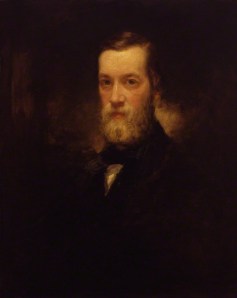
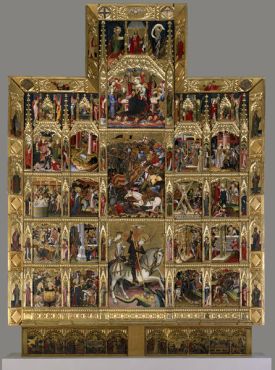
The main focus of my research in London was the altarpiece of Saint George (Victoria and Albert Museum, 1217-1864), an exceptional work of art and very well preserved. The piece was bought in Paris art market in 1864, and was said to have been removed from a church of Valencia. Little more is known about its original context. In order to discover more about the circumstances of its purchase, I reviewed the files referring to Saint George’s Altarpiece in the Prints and Drawings Study Room of the V&A, as well as other documents lent by the Conservation Department of the Museum. Key information was provided by Blythe House Archives, particularly the files of Sir John Charles Robinson, John Webb and Juan Facundo Riaño. Robinson’s words on the altarpiece put its acquisition into context: Spanish medieval art had begun to be greatly appreciated in France and Britain ca. 1864, partly because of the influence of the French Empress, and partly because of the 19th century’s love affair with the exoticism of Southern Europe. Robinson’s voyages to Spain testify to this allure (exemplified by the V&A’s cast of El Pórtico de la Gloria ). Webb was summoned
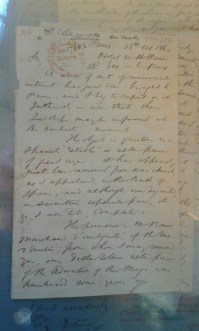
by Robinson to examine the Altarpiece of Saint George, and his diagnosis was key: the piece was deemed worthy of its asking price. The reports of Juan Facundo Riaño, who wasn’t directly involved in the issue, reveal also a whole world of antique dealers, painters, diplomats and connoisseurs operating in Spain. The reading of bibliography related to the art market in mid 19th-century Europe completed this survey of the vicissitudes of the Saint George Altarpiece. I hope that the outcome of this research will be published soon in a forthcoming paper.

 ARTES
ARTES 