Summer course: “Romanization and Islamization in the Western Mediterranean”, Casa Árabe, Córdoba, Monday 23– Saturday 28 July 2020

Specialists from different academic institutions will guide a select group of students in a series of seminar-style intensive classes throughout a week-long course.

INTRODUCTION AND OBJECTIVES
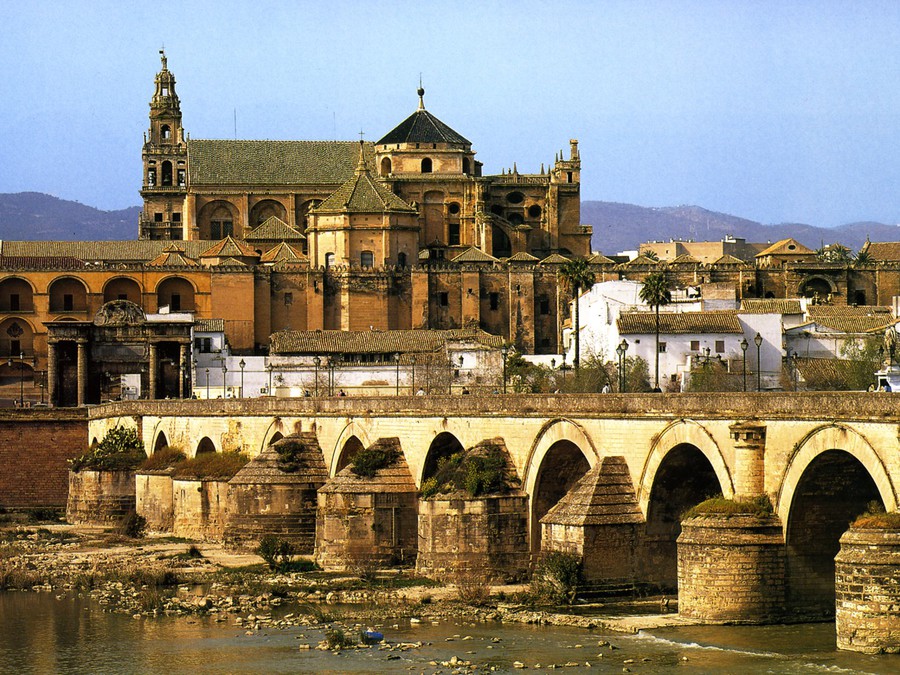
The image above speaks for itself: in the background, built as the Friday Mosque of Cordoba, an extraordinary example of medieval Arab architecture and a popular tourist destination, which is at the same time the embodiment of the civilization of al-Andalus itself; in the foreground, the Roman bridge crossing the Guadalquivir since 2000 years reminds that Cordoba was the capital of one of the richest provinces of the Roman Empire.

This IV Intensive Summer Course held in Casa Árabe Cordoba will introduce English speakers to the fascinating history of two empires: the Roman and the Islamic one. Specialists from different academic institutions will guide a select group of students in a series of seminar-style intensive classes throughout a week-long course.
This year, the course will focus on the processes of Romanization and Islamization that led to the formation of the Western Mediterranean first as a Roman and later on as an Islamic society. Together we will explore issues related to the sources at our disposal to reconstruct such processes (including literary sources and archaeological evidence) as well as the debates regarding their interpretation.

VENUE
The choice of the Casa Árabe in Córdoba as the venue for the course hardly needs any explanation. It is housed in the beautiful Casa Mudéjar, a 14-16th century building whose restoration received the World Heritage City Award 2011 from the Spanish Ministry of Education, Culture and Sports. The Casa is located at a three-minute walk from the Mosque-Cathedral.

THE STUDENTS AND COURSE STRUCTURE
The course is directed at university students and scholars who – regardless of their specialization – want to become familiar with the most relevant issues related to the history of al-Andalus. Taught in English, it aims at guiding the participants to the wide range of scholarly research on al-Andalus. Thirty students will be selected from among the applicants (for the application procedure see below).
Students are not required to have knowledge of Arabic or any other language except English; for those who are proficient in Arabic, guidance in the Arabic sources will be provided as a complement.
A basic bibliography of studies in English will be provided once the selection of students has been made and registration has been finalized. The students selected are expected to become familiar with that bibliography before the beginning of the course. A more comprehensive bibliography, including the most relevant studies in a variety of languages, will be provided during the course.
As the course is intensive and text-oriented, students are required to be present at each class. An attendance certificate will correspondingly be provided. For those interested in producing a research paper, assignments will be given and upon submission (within six months) an examination certificate can be obtained.

SCHEDULE
The course will take place during the fourth week of July, from Monday 23 to Saturday 28, with a total of 34 hours. On Friday, class will be held in the Umayyad palatine town of Madinat al-Zahra’. The course will be completed with two Archeological Workshops on Tuesday and Thursday morning.

LODGING AND MEALS
Coffee will be provided in the morning breaks and the fee includes as well a welcome reception and a dinner on Thursday. Students should arrange for the rest of their meals and lodging. Córdoba has many hotels and restaurants. A selection of the different options available around Casa Árabe will be provided upon registration.

APPLICATION AND FEE
Those interested are requested to send an e-mail message to infocordoba@casaarabe.es, indicating in the message subject line: Intensive Summer Course Al-Andalus IV. They need to provide a brief introduction about the candidate’s profile, including first and last names (maximum 300 words), and a letter expressing their interest in the course. The deadline is July 1th 2020. Those 30 selected will be contacted by July 3rd 2020. 

Once confirmation of admittance is received, registration must be completed using the application form that will be sent. The fee for the course is 300 €.

Further information: Calle Samuel de los Santos Gener, 9.
From Monday-Friday, 9:30 a.m. to 14:00 p.m. (infocordoba@casaarabe.es).

Web Resource: Prestapágina: Early Modern Spanish History and History of Art Bookshare

https://www.facebook.com/groups/prestapagina/

ARTES members are invited to join this Facebook group, to request and share scans (insofar as they do not violate U.S. or international copyright laws) of scholarly texts and primary sources in aid of remote research by independent and affiliated scholars of early modern Spain. The focus of this group is history and history of art, but all scholars of early modern Spain are welcome.

Open Access Publication: Gothic Architecture in Spain: Invention and Imitation, eds Tom Nickson and Nicola Jennings

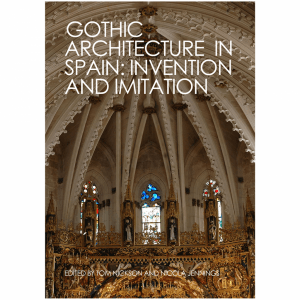
Click here to read Gothic Architecture in Spain: Invention and Imitation, eds Tom Nickson and Nicola Jennings (London, 2020)

From the dazzling spectacle of Burgos Cathedral to the cavernous nave of Palma Cathedral or the lacy splendour of San Juan de los Reyes, Spain preserves a remarkable variety of inventive but little understood Gothic buildings. Yet Gothic architecture in Spain and the Spanish kingdoms has traditionally been assessed in terms of its imitation of northern European architecture, dismissed for its ‘old-fashioned’ or provincial quality, and condemned for its passive receptivity to ‘Islamic influence’. But did imitation really triumph over invention in the architecture of medieval Iberia? Are the two incompatible? Can inventio and imitatio offer useful or valid analytical tools for understanding Gothic architecture? And to what extent are invention or imitation determined by patrons, architects, materials or technologies? This essay collection brings together leading scholars to examine Gothic architecture from across Iberia from the thirteenth to the sixteenth century, and provides the first significant account of Spanish Gothic architecture to be published in English since 1865.

CANCELLED: ARTES Event: Self-Guided Tours of the National Gallery Exhibitions: Artemisia and Titian, Thursday 23 April 2020, 9:00 – 11:30 am

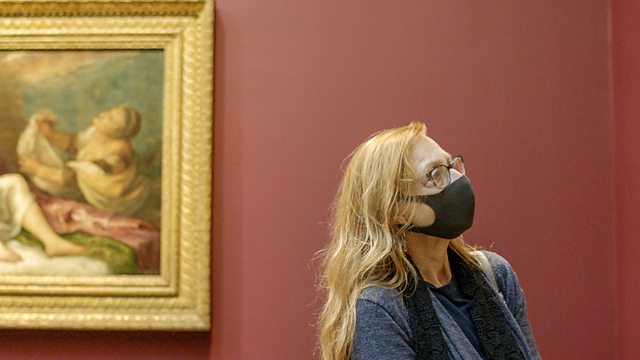
Artemisia Gentileschi, ‘Self Portrait as Saint Catherine of Alexandria’, about 1615–17, National Gallery, London

Thursday 23 April 2020, 9:00 – 11:30 am

The National Gallery, London

You are cordially invited to self-guided tours of Artemisia and Titian. ARTES members will be able to access both exhibitions free of charge during the event (7 spaces are available).

9:00 am           

Entry via the Sainsbury Wing to the Artemisia exhibition (accessible via the Sainsbury Wing Entrance, to the far left of the main portico on Trafalgar Square, and descend to level -2). Names will be checked off a security list.

10:00 – 10:30 am

Coffee break at the National Gallery café.

10:30 – 11:30 am

Meet at the Titian exhibition entrance (via room 5) where exhibition curator Matthias Wivel will provide a brief introduction before the members’ self-guided tour.

Attendees may check their belongings into one of the Gallery’s cloakrooms. Large bags and suitcases may not be brought into the Gallery. Please note that this event is by invitation only. Places will be allocated on a first-come, first-served basis.

We kindly ask you to RSVP to akemi.herraezvossbrink@ng-london.org.uk by Friday 17 April 2020.

New Funding Opportunity: John Phillip PhD Scholarship in Spanish art and visual culture at the School of Art History, University of St Andrews

Deadline: Monday 25 May 2020

The School of Art History at the University of St Andrews is delighted to invite applications for the John Phillip Doctoral Scholarship in Spanish Art and Visual Culture, to start in September 2020.

Generously funded by the Centro de Estudios Europa Hispánica (CEEH), the doctoral scholarship is named after the nineteenth-century Scottish artist John Phillip (1817-1867), who travelled extensively in Spain, and whose work was strongly inspired by the art of Velázquez and Murillo.

The scholarship is available to both Home/EU and Overseas candidates, and is tenable for three years (full-time). It is a full scholarship, covering tuition fees, plus an annual stipend of £15,285 for living expenses, and an annual research allowance of £5,000.

The scholarship will fund a doctoral research project that focuses on the history of Spanish art and visual culture between ca. 1600 and 1700. We will also consider research projects devoted to the reception of seventeenth-century Spanish art in later periods, up to ca. 1900.

Applicants should apply via the University of St Andrews application process: https://www.st-andrews.ac.uk/study/pg/apply/research/

The deadline for applications is Monday 25 May 2020.

For informal queries, intending applicants may contact Dr José Ramón Marcaida (jrm32@st-andrews.ac.uk).

Click here for more information.

Featured Exhibition: Murillo: The Prodigal Son Restored, Hugh Lane Room, National Gallery of Ireland, Dublin, until 30 August 2020

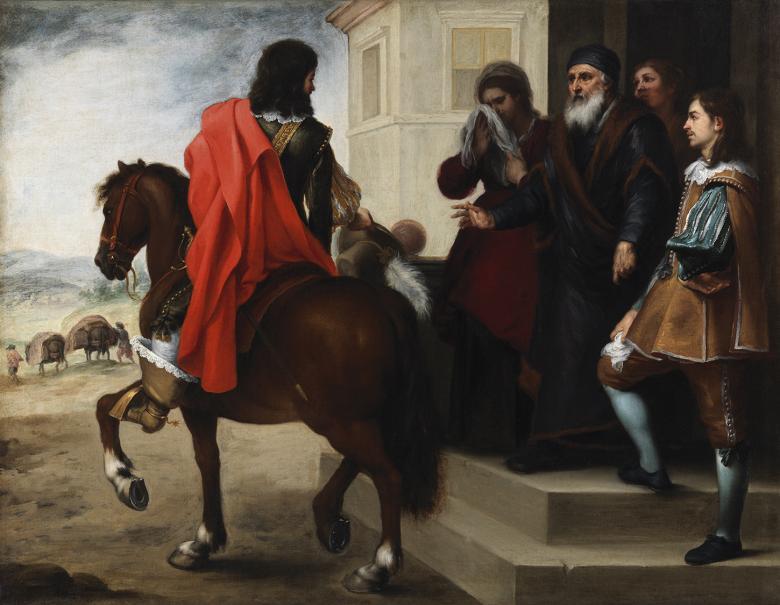
Six remarkable paintings by one of the most celebrated painters of the Spanish Golden Age, Bartolomé Esteban Murillo (1617–1682), have been conserved and researched at the National Gallery of Ireland. They depict the parable of the Prodigal Son. Fascinating details uncovered during the conservation project and a number of related prints will be displayed alongside the series, revealing the secrets of the artistic process of this master storyteller.

Click here for more information.

Generously supported by the Blavatnik Family Foundation

Curators| Muirne Lydon and Dr Aoife Brady

CFP: ICDAD-ICOM Annual Conference: ‘Revivals’, Lisbon, 14-16 October 2020

Deadline: April 15th

The 2020 Annual Conference and General Assembly of ICOM International Committee for Museums and Collections of Decorative Arts and Design will take place at the National Palace of Ajuda in Lisbon, Portugal, from October 14th to 16th (plus two days—October 17th and 18th—for the post conference tour to Coimbra and Porto).

 Theme: ‘Revivals’

 The good men of every age are those who dig the old ideas deep down and bear fruit with them – the farmers of the spirit. Friedrich Nietzsche, in The Gay Science

Revivals as the socio-cultural phenomenon that has occurred many times throughout universal history and that seeks to rescue principles and traditions of times gone by. In this conference we approach the term Revivals with regard to Decorative Arts and Design.

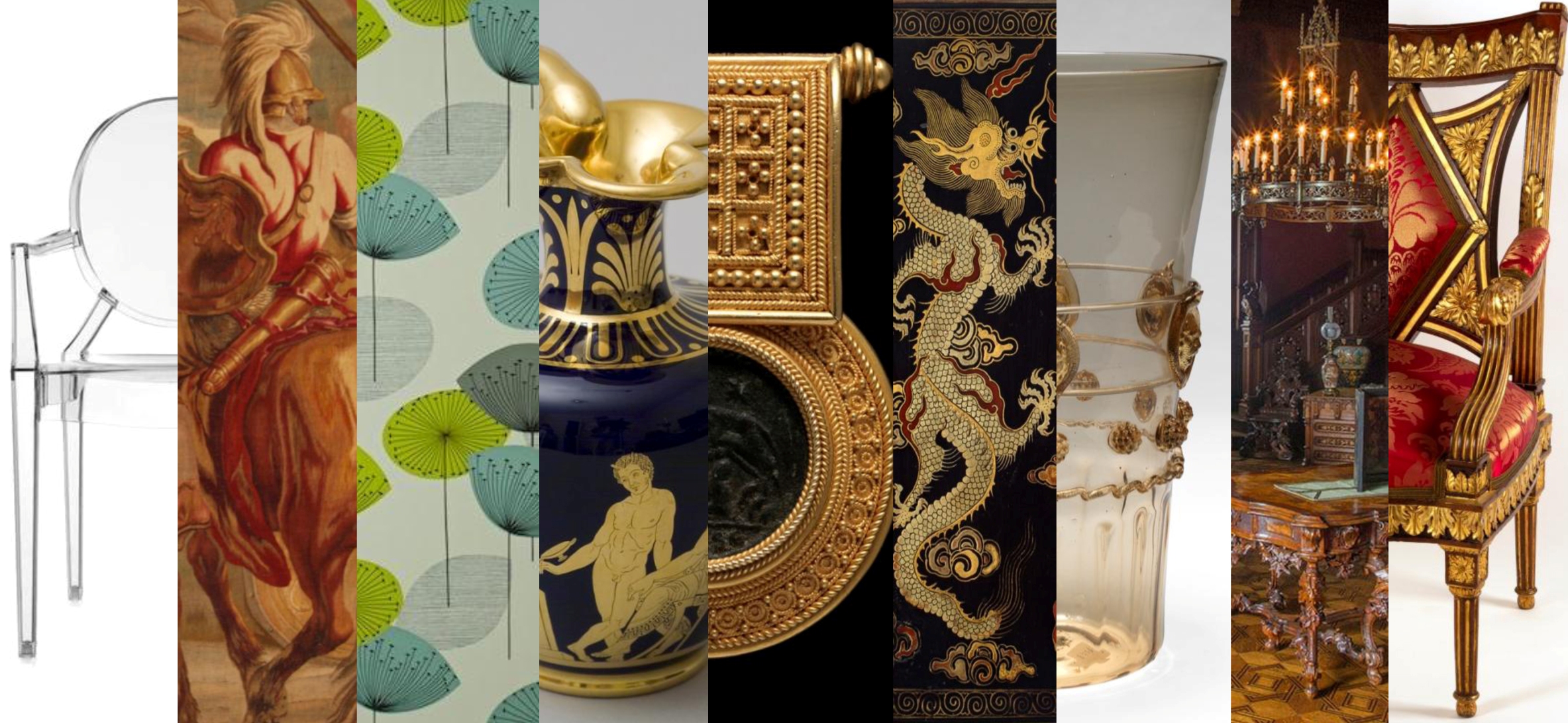
Decorative Arts and Design are to be interpreted as any domestic or public furnishings including but not limited to textiles, silverware, furniture, wallpaper, tableware, interior decoration as a whole, graphic design, as well as personal accessories (excluding fashion). We also welcome presentations on revivals within decorative and applied art traditions (ceramics, lacquer, metalwork, textiles, woodwork, etc.) made for utilitarian or connoisseurial purposes.

 Hence we encourage papers proposals on a wide variety of topics including a broad array of Asian, European or North and South American Revival styles. We also include the retro design styles of the 20th and 21st centuries, referring to the resurgence of old yet relatively recent styles.

It is fascinating how heritage is being used and valued, reconsidered both from the positions of a curator, artist or a designer. We are interested in the examples, phenomena and notions that reflect upon the relation to the past, treating it with both unsentimental and sentimental nostalgia, introducing ways of dealing with the recent past from different periods in history.

The conference will feature presentations of 15 minutes in English.

Abstracts

Please send an abstract of 250–300 words, including your name, title, institution and ICOM membership number to:

Contacts

Maria José Gaivão Tavares, Curator of the Furniture Collection at National Palace of Ajuda and ICDAD Secretary:

icdad.secretariat@gmail.com

Deadline for papers proposition: April 15th  

Final notification for acceptance: June 30th

ICDAD Scholarship Young curators (under 35) and graduate students members of ICDAD are encouraged to submit papers and apply for the ICDAD conference scholarships:

Portuguese Scholar: 400 € + free conference registration

European Scholar: 1000 € + free conference registration

Non-European Scholar: 2000 € + free conference registration

Scholarship does not include post-conference tour or conference dinner.

Note: If you are going to present a paper you must be a member of ICOM/ICDAD at the moment of registration.

Click here for more information.

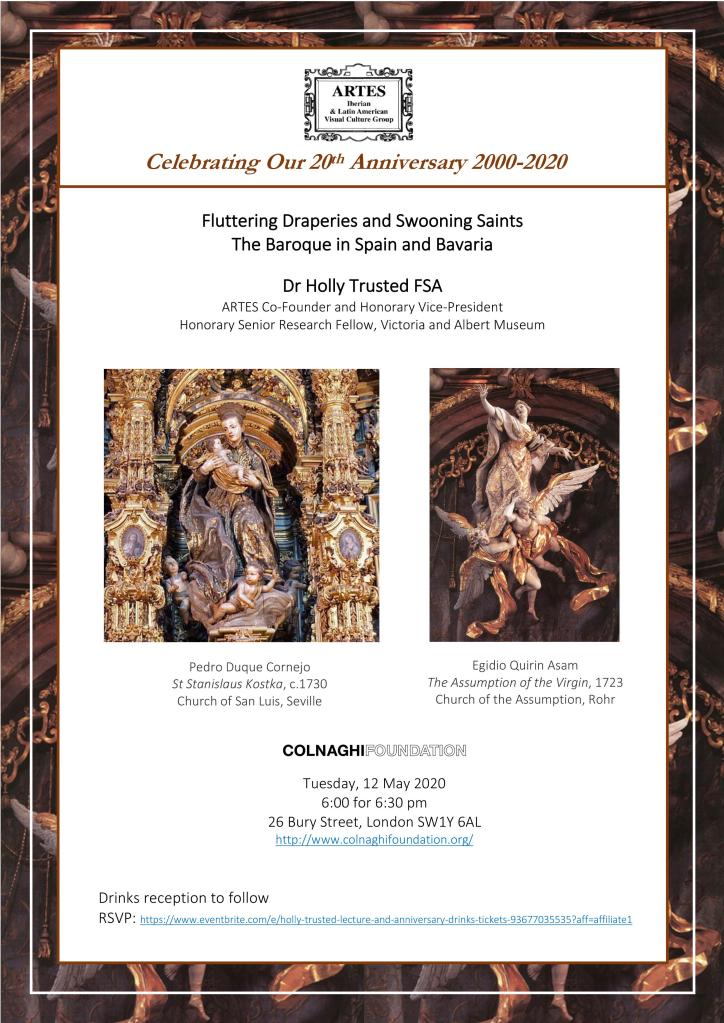
CANCELLED: ARTES 20th Anniversary Event: Dr Holly Trusted FSA, ‘Fluttering Draperies and Swooning Saints: The Baroque in Spain and Bavaria’, Colnaghi Foundation, 12 May 2020

‘Picasso and Paper’: An Exhibition at the RA and a Programme of Events Organised by the Instituto Cervantes London

Picasso didn’t just draw on paper – he tore it, burnt it, and made it three-dimensional. From studies for ‘Guernica’ to a 4.8-metre-wide collage, this major exhibition, open until 13 April 2020 at the Royal Academy, brings together more than 300 works on paper spanning the artist’s 80-year career. Click here for more information.

In conjunction with the exhibition, the Instituto Cervantes has organised a programme of talks and concerts paying homage to the famous Spanish artist.

Murillo Study Day, National Gallery of Ireland, Dublin, 28 February 13.30–17.30

This event will feature an afternoon of presentations and a special exhibition preview in celebration of the opening of Murillo: The Prodigal Son Restored at the National Gallery of Ireland.

Showcasing a unique series of works by one of the most celebrated artists of the Spanish Golden Age, Bartolomé Esteban Murillo (1617-1682), this in-focus exhibition explores themes of sin, repentance and forgiveness across six remarkable canvases. Donated to the National Gallery of Ireland by the Beit family in 1987, the six works have not been displayed together publicly for several decades. Murillo: The Prodigal Son Restored will celebrate the recent conservation of the series, which has revived the splendour of Murillo’s colours, brushwork, and mastery of narrative.

12pm – 1.15pmExhibition preview (Present your ticket for admission) Hugh Lane Room, Beit Wing, Level 3
1.15pm – 1.25pmRegistration Lecture Theatre, Beit Wing, Level -1
1.30pmWelcome Sean Rainbird, Director, National Gallery of Ireland
1.35pmIntroduction  Dr Aoife Brady, Curator, National Gallery of Ireland
1.50pmMurillo: The Prodigal Son Revisited Muirne Lydon, Conservator, National Gallery of Ireland
2.10pmThe Prodigal Son series. “Quatro cuadritos” by Murillo in the Museo del Prado. Elena Cenalmor Bruquetas, Researcher, Museo del Prado
2.30pmDiscoveries and Display: Murillo’s Virgin and Child in Glory Kate O’Donoghue, Curator, National Museums Liverpool, Walker Art Gallery
2.55pmQuestions and discussion
3.10pmTea / coffee Courtyard
3.50pmIntroduction Prof. Stefano Cracolici, Director, Zurbarán Centre
4pm“All rooms are furnished with great works of art” – the Beit collection Pauline Swords, Curator, Russborough, Co. Wicklow
4.20pmA Painter of Street Urchins and Beggars? The perception of Murillo in Britain. Isabelle Kent, Independent scholar
4.40pm“Something of immortal value”: Murillo at the Meadows Museum Dr Amanda Dotseth, Curator, Meadows Museum, Dallas
5.05pmQuestions and discussion
5.20pmClose

Click here for more information and to book tickets (Full price €25, students/OAPs €22.50, Friends €20)