Conference: X Jornadas Complutenses de Arte Medieval (Madrid)

2016-10-buscoconference

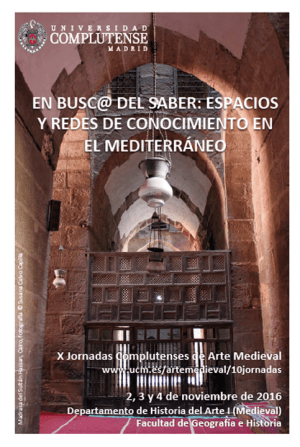
En Busc@ Del Saber: Espacios y Redes del Conocimiento en el Mediterráneo Medieval

Departamento de Historia del Arte Universidad Complutense, Madrid
2 – 4 November 2016

Sesiones
1. “El Espejo de príncipes: paideia, uirtus y adab”, centrada en las distintas formas de espacios seculares del conocimiento.
2. “La ciencia y su práctica”, dedicada a las redes y lugares donde se desarrolló y practicó la ciencia medieval.
3. “El libro y sus espacios”, orientada tanto a la producción medieval de libros como a los espacios de producción y disfrute de la obra escrita.
4. “Maestros, sabios y benefactores” visibiliza la relación de los patronos con los productores y gestores del conocimiento, valorando las sinergias generadas entre todos los agentes implicados en el desarrollo del saber.

Conference: La seda en la historia de España y Portugal (València)

2016-10-rutassedaSilk in the History of Spain and Portugal
Facultat de Geografia i Història of the Universitat de Valencia
26-28 October 2016

Congreso internacional sobre la influencia del cultivo de la morera y la manufactura de la seda en la historia de España y Portugal y su inserción en las rutas internacionales de la seda.

Program
Miércoles, 26 de Octubre de 2016

– 9,30 horas: Inauguración.
– 10 horas: Laura Rodríguez Peinado, Universidad Complutense de Madrid.
La seda en la antigüedad tardía y Al-Andalus
– 11 horas: Germán Navarro Espinach, Universidad de Zaragoza. Valencia en las rutas de la seda del Mediterráneo Occidental (siglos XIII-XV)
– 12,30: Ricardo Franch Benavent, Universitat de València.
La seda en la Valencia moderna: de la expansión productiva y manufacturera del siglo XVI al periodo de esplendor del siglo XVIII.
– 17 horas: Joana Sequeira, Universidade Nova de Lisboa. La seda en Portugal (siglos XIII-XVI)
– 18 horas: Félix García Gámez, Profesor de enseñanza secundaria. La seda en Andalucía durante la edad moderna: balance y perspectivas de estudio.
19 horas: Debate

Jueves, 27 de Octubre de 2016
– 10 horas: Adela Fábregas García, Universidad de Granada. La seda en el reino nazarí de Granada
11 horas: Francisco José Aranda Pérez, Universidad de Castilla-La Mancha.
El horizonte de la seda en el Reino de Toledo en la época moderna
– 12,30 horas: Pedro Miralles Martínez, Universidad de Murcia.
La seda en Murcia durante la Edad Moderna: del auge del hilado al fracaso del tejido
– 17 horas: José Nieto Sánchez, Universidad Autónoma de Madrid.
Producción, consumo y redistribución de la seda en el Madrid del siglo XVIII.
– 18 horas: Daniel Muñoz Navarro, Universitat de València.
La seda en el comercio colonial español de la segunda mitad del siglo XVIII.
19 horas: Debate

Viernes, 28 de Octubre de 2016
– 10 horas: Ana María Ágreda Pino, Universidad de Zaragoza. La seda en Aragón en época moderna.
– 11 horas: Àngels Solà Parera, Universitat de Barcelona. La seda en la Cataluña de los siglos XVIII y XIX.
– 12 horas: Debate 12,30 horas: Clausura
Tarde:
Visita al Museo del Colegio del Arte Mayor de la Seda de Valencia.

Organizers: Ricardo Franch Benavent – Germán Navarro Espinach
Secretaría Científica: Daniel Muñoz Navarro

Conference: Al-Murābiṭūn (Granada, 19-22 October 2016)

2016-10-univandalucia-logoAl-Murābiṭūn: Noveno centenario del esplendor de un Imperio Palace of Carlos V, Alhambra, Granada
19-22 October 2016

The Universidad Internacional de Andalucía and the Escuela de la Alhambra present this colloquium/course in honor of the memory of Prof. Henri Terrasse. Programme.

Art and Ideology in the Twelfth-Century Western Mediterranean (New York: 15 October 2016)

2016-10-bgcBard Graduate Center
38 West 86th Street, New York City
15 October 2016, 9:00AM – 5:50PM

In the twelfth century, new powers emerged throughout the Western Mediterranean, from the Almohads of North Africa to the Norman Kingdom of Sicily. In the Iberian Peninsula, upstart rulers with broad ambitions emerged in both Muslim and Christian territories. New city-states appeared with the dissolution of the Almoravid Empire in al-Andalus, and older kingdoms, including Castile-Leon and Aragon, began massive expansions under rulers who claimed imperial titles. This symposium explores how the rulers of this region deployed art (conceived in the broadest sense) to legitimise new claims, how they asserted their authority through the construction of palatial and liturgical spaces, and what kinds of objects their kingdoms produced, traded, or coveted. Talks will investigate how these rulers looked to imperial and caliphal precedents and rivals for models, how they elaborated on these models, and which communities of artisans and workmen they drew from. By bringing together scholars who work on the component kingdoms of this region, the symposium seeks to clarify the connections among them, crossing the geographic, ethnic, and religious lines imposed by modern scholarship. In doing so, it aims to develop new models for understanding the imbricated world of the medieval Western Mediterranean. Further details, Programme & Registration here.

Sponsored by the Trehan Research Fund for Islamic Art and Material Culture in conjunction with the Spain-North Africa Project.


Lecturer in Spanish, University of Edinburgh

2016-09-edinbgu-logoLecturer in Spanish

The Department of Hispanic Studies at the University of Edinburgh is advertising for a Lecturer in Spanish with a specialism in Peninsular Spanish Visual Media or Cultural Studies.

The successful appointee will have a record of excellence in research, with a portfolio of publications appropriate to their career stage. The appointee will provide teaching at all levels of the undergraduate curriculum, and will have a commitment to innovative approaches to teaching. The appointee will be expected to develop courses and modules for students at both first-year and Honours level which engage with aspects of Spanish culture and civilisation that go beyond the literary. The successful candidate will be expected to play a full part in the collegiate life of the subject area, of the Department, and of the School, and to undertake appropriate administrative roles. Click here for further details.

Deadline for applications: 26 October 2016.


PhD scholarship at The Courtauld Institute, London, sponsored by CEEH

logo-ceeh-bn-2Applications are invited for a fully funded doctoral scholarship in Spanish art-historical studies, commencing at The Courtauld Institute in London in the academic year 2019/20.

The scholarship has been created through the generosity of CEEH (Centro de Estudios Europa Hispánica), in association with ARTES

The Courtauld Institute is one of the world’s leading centres for art-historical research, and the scholarship will cover The Courtauld’s Home/EU/International tuition fees for three years (or four if required), together with an annual stipend of £12,000 for living costs and travel.

courtauld_institute-logo_teal-and-grey_gif-1

HOW TO APPLY

Applicants should apply to The Courtauld’s PhD programme following the standard process, and then submit an application via the Courtauld Scholarship application form

Applicants must demonstrate that Spanish art, architecture or visual culture forms the focus of their proposed research topic, and are advised to contact prospective supervisors to discuss research proposals at least eight weeks before the application deadline of 11 January 2019, and ideally earlier.  As a minimum, by the time they begin their doctoral studies, applicants are expected to hold a postgraduate qualification such as an MA or equivalent and should have at least reading knowledge in Spanish. In the first instance applicants should send prospective supervisors a CV, sample of written work in English, and a 300 word proposal. In assessing applications the scholarship committee will consider the extent to which the research proposal falls under the supervisor’s areas of research expertise.

Upcoming Exhibition: Maíno in London

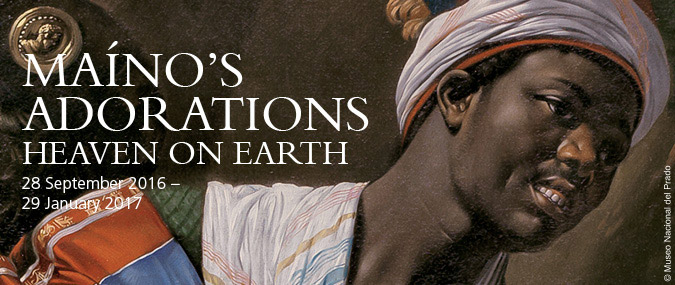
2016-08-MainoMaíno’s Adorations. Heaven on Earth

National Gallery, London
28 September 2016 – 29 January 2017

For the duration of the National Gallery’s Beyond Caravaggio exhibition the Museo Nacional del Prado has lent the National Gallery two of its masterpieces by Fray Juan Bautista Maíno (1581-1649) for a display in Room 1. Both paintings — The Adoration of the Shepherds and The Adoration of the Kings — were painted between 1612 and 1614, after the artist’s return from Italy, as part of the high altar of the Dominican church of San Pedro Martír in Toledo. Not only do they display Maíno’s Caravaggesque naturalism, which he had seen at first hand in Rome, but they also combine that with the classicising style of Anibale Caracci and Guido Reni, both of whom Maíno new personally.

Upcoming exhibition: Picasso Portraits, London

2016-07-PicassoPortraitsNPG

Picasso Portraits

National Portrait Gallery, London

6 October 2016 – 5 February 2017

Major exhibition of over eighty works focusing on the artist’s portrayal of family, friends and lovers from all periods of his  career and in all media. Works on show range from the realist paintings of his boyhood to his later ultra-spontaneous canvases. Includes celebrated masterpieces loaned by international institutions to works in private collections being shown in the United Kingdom for the first time.

Exhibition co-organised by the National Portrait Gallery, London and the Museu Picasso, Barcelona.

Picasso at LACMA

2016-08-Picasso-LACMA-1

Picasso and his Printers

Los Angeles County Museum of Art
23 July – 27 November 2016

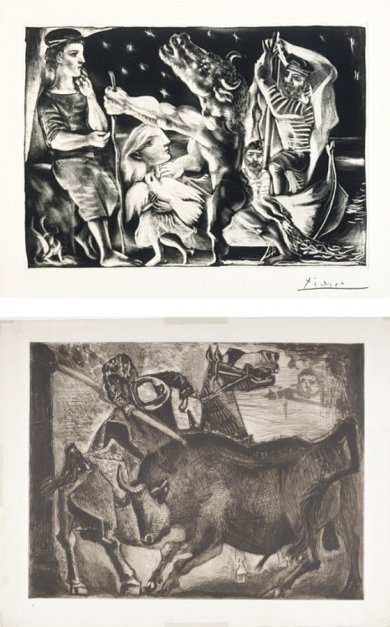
The stimulus Picasso received from his printers was critical to his exploration of his graphic art and this exhibition, largely drawn from LACMA’s collections, covers seven decades of his career, from his conventional early drypoints to the radical approach to etching of the 1930s when he began his close association with Roger Lacourière and his later innovative collaborations with Fernand Mourlot for lithography and Hidalgo Arnéra for linocut printing.

1st London Design Biennale

2016-09-cia-courtyard1st London Design Biennale: Utopia by Design

Somerset House, London, 7 – 27 September 2016

The first London Design Biennale will open this September at Somerset House with over 30 countries and territories participating, including Chile, Cuba, Mexico, Portugal and Spain. Taking over the entirety of Somerset House, the Biennale explores big questions and ideas about sustainability, migration, pollution, energy, cities, and social equality. Engaging and interactive installations, innovations, artworks and proposed design solutions – all in an immersive, inspiring and entertaining tour of the world.

Spanish Pavilion

The Spanish Pavilion’s VRPolis Diving into the Future aims to show viewers, via virtual reality goggles, the future of  the city of Santander in 2100, focusing especially on its port, bay area, Plaza Porticada and the calle Marcelino Sanz de Sautuola.