Art from the Andes: Spanish Colonial Paintings (Portland)

2015-12-Archangel-Raphael-with-Fish-260x260
Art from the Andes: Spanish Colonial Paintings from the Elvin A. Duerst Bequest

Portland Art Museum, Maine

19 December 2015 – 20 March 2016

Art from the Andes features distinctive religious paintings that illustrate the creative melding of cultures in the Andes following the Spanish conquest. The paintings were left to the Museum by Elvin A. Duerst, a native of McMinnville, long employed by the State Department in South America.

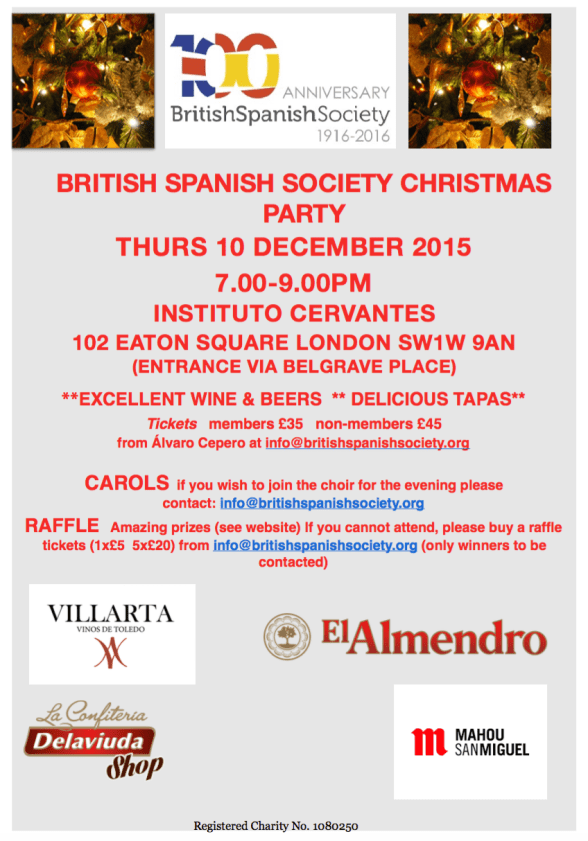
British Spanish Society Christmas Party! *THURSDAY 10th DECEMBER* 7-9pm @ Instituto Cervantes

British Spanish Society Christmas Party! *THURSDAY 10th DECEMBER* 7-9pm @ Instituto Cervantes

Screen Shot 2015-12-07 at 17.30.24.png

Essay prize and Scholarships: Call for Submissions, deadline 15th February 2016

ARTES offers a number of prizes and scholarships, which all have the same deadline of 15th February 2016. Click the links below to find further details:

Juan Facundo Riaño Essay Prize: sponsored by the Embassy of Spain in London, this prize is awarded to the best essay on any aspect of Hispanic visual culture.

ARTES Coll & Cortés Scholarships, in association with the British-Spanish Society. These scholarships are sponsored by art dealers Coll & Cortés, and are aimed at students and researchers working on Hispanic art before 1800


Spanish embassy logocollcortes_logoArtes logo


Dalí by Robert Descharnes (Dalí Museum)

2015-09-dali-revealed

Dalí Revealed: Candid Moments from the Artist’s Life

Photographs by Robert Descharnes (1926-2014).

Dalí Museum, St. Petersburg, Florida

On view until Spring 2016

The photographer made the acquaintance of the Surrealist artist in 1950, while they were both traveling to the United States.

Luis Buñuel: Aesthetics of the Irrational

2015-11-Bunuel
Luis Buñuel: Aesthetics of the Irrational

London, ICA
12 Nov 20156 Dec 2015

Retrospective of the films of Luis Buñuel (1900–1983), celebrating his genius, irreverence and unique poetic style. The season features panel discussions and Q&As with speakers including eminent collaborator Jean-Claude Carrière, grandson Diego Buñuel, and leading academics such as Maria Delgado, Jo Evans, Peter Evans and Rob Stone.

Artes Coll & Cortes Scholarship Report: Matilde Grimaldi

Anthonie van der Wijngaerde, Vista de Tortosa, 1563. Osterreichische Nationalbibliothek, Vienna. Cod. Min. 41, fol. 7.

I was the recipient of the generosity of the ARTES Coll & Cortés Travel Scholarship both in 2014 and in 2015, which contributed significantly to the advancement of my PhD research. Both grants were used to support periods of field research in Catalonia, specifically four months in Spring-Summer 2014 and one month in the Summer of 2015.

My PhD research focuses on the reconstruction of the lost Romanesque cathedral of Tortosa, a small town in Southern Catalonia. The Romanesque structure was built in the second half of the twelfth century and later demolished between 1428 and 1703 for the construction of the extant Gothic building. Besides the reconstruction of the lost building, my aim is to shed some light on the connections between Tortosa and the other ecclesiastical buildings of the area, including other Southern Catalan cathedrals and small-scale churches. This is especially important since Tortosa was the first cathedral erected in the region after the Christian conquest of 1148.

Due to the nature of my research, field work is of extreme importance for the study of

archaeological remains in Tortosa, the consultation of local archives, and the analysis of the architectural evidence of the surrounding region for the elaboration of comparisons with contemporary ecclesiastical buildings.

The main achievement of my 2014 stay concerned the reconstruction of the design of the lost cathedral. Earlier analyses had allowed me to develop a number of hypotheses on the original plan of the building, but the lack of solid physical evidence was creating a number of difficulties. Luckily my presence in Catalonia allowed me to learn of a Georadar survey of the Gothic church conducted by a team from the Architecture Faculty of the University Rovira i Virgili in Reus. I was able to meet the research team and work with them on the topic, finally receiving a concrete validation and refinement of my theories.

Seu Vella of Lleida, eastern sector

Another valuable goal reached thanks to the scholarship was the analysis of the architectural context of Southern Catalonia. During both my 2014 and 2015 stays I was able to embark on a number of visits to sites spread across the region, surveying the major cathedrals of Tarragona and Lleida as well as the numerous smaller churches, such as San Salvador de Horta de Sant Joan, Sant Joan dels Ventalles of Ulldecona, and Santa Maria de Agramunt. These visits allowed me to reinforce one of the principal propositions of my research, namely the role of the Romanesque cathedral of Tortosa in shaping the architectural milieu of the region. I hope this argument will not only shed light on the development of Romanesque in Catalonia but also be a case study of the typical drivers behind the creation of a new artistic model.

On top of the two achievements described above, the ARTES Coll & Cortés Travel Scholarship allowed me to refine endless other aspects of my research and meet and interact with local scholars. I am therefore extremely grateful to the ARTES Coll & Cortés Travel Scholarship for making all this possible.


AAH CONFERENCE – ORIENTALISM & SPAIN IN THE 19 & 20TH CENTURIES – 7-9 APRIL 2016 – UNIVERSITY OF EDINBURGH

AAH2016 Annual Conference and Bookfair
University of Edinburgh
7 – 9 April 2016

ORIENTALISM & SPAIN IN THE 19TH & 20TH CENTURIES

Convenors:
Claudia Hopkins, University of Edinburgh, c.hopkins@ed.ac.uk
Anna McSweeney, SOAS, University of London, am105@soas.ac.uk

Spain represents a unique and fertile context in which to explore attitudes to the art and culture of the Islamic world. Spain was routinely ‘orientalised’ by northern European cultures in the 19th century, as foreign visitors indulged in oriental reveries when reflecting on Spain’s Islamic past (711–1492) and admiring its ‘Moorish’ remains at the Alhambra palace in Granada, the mosque/cathedral in Cordoba, or the Giralda in Seville. For the Spaniard, however, this Islamic heritage raised potentially disorientating questions about cultural roots and national identity. Spanish attitudes to the Islamic past were further complicated by Spain’s ambivalent relations with the Islamic present in Morocco, ranging from war and conflict (1859–60) to Franco’s recruitment of Moroccans at the start of the Spanish Civil War.

This session builds on recent research by historians of art, literature and culture, whose work has revealed that the European discourse on the Islamic world is much more polyphonic than traditional postcolonial theory assumed. The session invites papers that examine 19th- and 20-century visual responses to Spain’s Islamic past and Spain’s nearest ‘Orient’, Morocco, by both Spanish and non-Spanish artists across all media (architecture, fine art, illustrated books, photography, film, fashion etc.). How did artists translate Spain’s Islamic world into visual formats? How was such imagery produced, viewed, and marketed? What were the artistic, ideological, political, and social positions on which visual responses were grounded? How important were they in the formation of broader attitudes to the Islamic world?

Email paper propsals to the session convenor(s) by 9 November 2015. Download a Paper Proposal Guidelines

– See more at: http://www.aah.org.uk/annual-conference/sessions2016/session21#sthash.CunhcXx5.dpuf