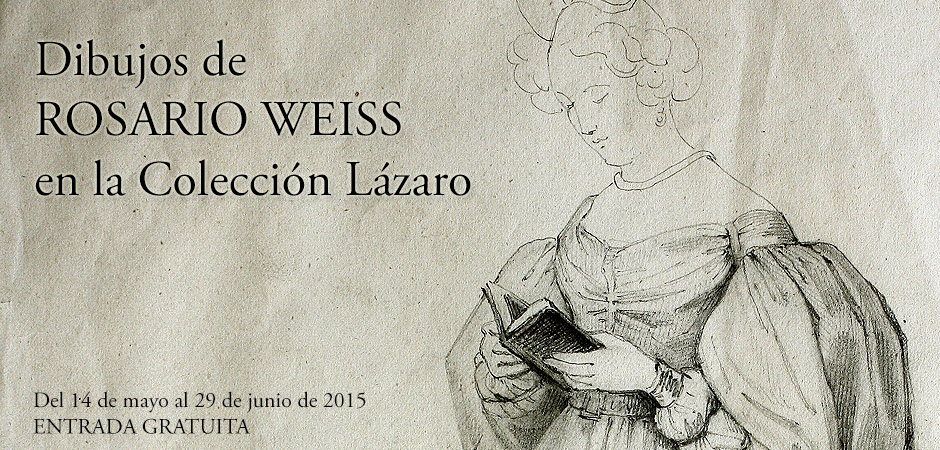
Drawings by Rosario Weiss from the Lazaro Collection, Museo Lázaro Galdiano, Madrid
14 May – 29 June 2015
Exhibiting some 36 drawings (from a collection of 58) by the goddaughter and follower of Goya, who learned her drawing and lithographic print-making skills alongside Goya in the 1820s in Madrid and Bordeaux. Her miniature portraits and copies after Goya’s paintings are also on display. Several of the drawings by the short-lived artist were acquired by José Lázaro Galdiano from the nieces and heirs of Rosario.
Vicente Carducho: teoría y práctica del dibujo en el Siglo de Oro, Biblioteca Nacional de España, Madrid, 29 May – 6 September 2015. Major exhibition of drawings, many never shown before, by Vicente Carducho (Florence 1576-1638 Madrid), a key artist at the Spanish court. Accompanied by contextualizing documents and prints by Carducho’s contemporaries drawn from the Biblioteca Nacional, and other public institutions and private collections in Spain and Italy. The display is the result of a detailed cataloguing process of the library’s collection of works by Vicente Carducho and is divided into six sections, covering his career from its beginning in the Escorial, where he worked alongside his brother Bartolomé, to his commissions from Philip III and Philip IV in Valladolid, El Pardo, and culminating in his pictorical cycle for the Carthusian monastery of El Paular (1626-1632). The final sections feature the artist’s theoretical writings and the influence of Carducho’s workshop and studio assistants.
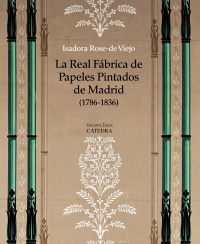
The Spanish Royal Wallpaper Factory was the last 18th century royal factory to be created (under Carlos III), yet was almost entirely forgotten. Read all about it in this new publication:
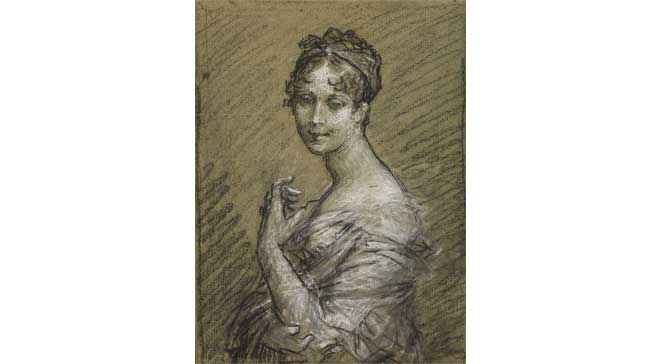
The Spanish Paintings & the newly opened Prud’hon Exhibition
Monday 29 June 2015
1.30 – 4.30 pm
Timetable
1.30: Talk by Xavier Bray
2.15: ARTES AGM
3.15: Tea
3.30: Tour of the Spanish paintings & the Prud’hon exhibition
If you would like to attend, please contact Morlin artesiberia@gmail.com.
Guests of members are welcome (£10 per person payable on the day).
Membership of ARTES is £35 and £20 for students. More information and a membership form can be found under the Join Us tab above.
Please note: this event includes the ARTES AGM. Guests are welcome.
The Barber Institute of Art & The Birmingham Museum & Art Gallery (BMAG)
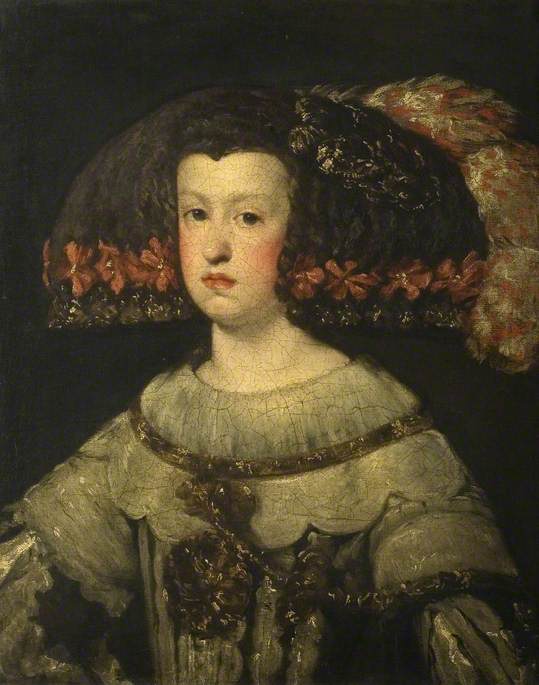
After Velázquez, Mariana of Austria, wife of Philip IVBartolomé Esteban Murillo, The Marriage Feast at Cana
Monday 6 July 2015 11.00 – 16.30 pm
This visit is at the kind invitation of Robert Wenley of the Barber Institute who will introduce the key Spanish works. Helen Hillyard, National Gallery Curatorial Trainee at the BMAG, will also give us an introduction to her display and its Spanish works.
Provisional Timetable 11.00 – Arrive at the Barber for Tea & Coffee
11.30 – Look at key Spanish works in the Barber collection and explore the galleries
13.30 – Leave for Birmingham Museum & Art Gallery and lunch
15.00 – Look at the Spanish works in the Birmingham Museum
& Art Gallery collection and explore the galleries
16.30 – Day finishes
If you would like to attend this events, please contact Morlin at artesiberia@gmail.com. This event is free for members. There will be a charge for guests of £10 (payable on the day) Membership of ARTES is £35 and £20 for students. For more information and membership forms to download and send, go to the Join Us tab above.
This visit is at the kind invitation of Curator Letizia Treves of the National Gallery will be talking about the El Greco display. She will be joined by Xavier Bray from the Dulwich Picture Gallery will be talking about El Greco’s interest in sculpture and by Véronique Gerard Powell will be talking about the Louvre Crucifixion.
Please note, numbers for this event are limited. If you would like to attend or are interested in membership , please contact Morlin at artesiberia@gmail.com . While this visit is free for ARTES members, there will be a charge for guests.
62nd Annual Meeting of the Renaissance Society of America Boston, 31 March–2 April 2016 Park Plaza Hotel and Hynes Convention Center
Isabella Stewart Gardner Museum, Boston
Call for Papers: Art and Experience in 15th Century Naples: Defining an Artistic Center
(Deadline: May 31, 2015)
This panel investigates critical questions surrounding the study of fifteenth-century Neapolitan art. We invite papers that explore questions as fundamental as:
What is Neapolitan art?
Who were the predominant artists and patrons of the period?
What were the social and political functions of art in Quattrocento Naples and in what respect did they differ from those of other centers?
What was the relationship between court and city in the Aragonese period and what relevance did it have for the production of art?
Was there a conception of “napolitanità” in the fifteenth century, and if so, can it be linked to distinctive artistic styles, forms and types?
More specifically:
How did artists working in Naples handle the importation of foreign models, and which visual elements were adapted, translated, or dismissed during this process?
In what ways did Neapolitan art and artists participate in global networks of artistic exchange, and how did these trans-regional interactions impact material culture at home and abroad?
In what way does Naples challenge traditional art historical concepts and narratives such as “school” or “Renaissance”?
By 31 May please submit a paper title, 150-word abstract (preferably including an image), keywords, and a 300-word curriculum vitae to both organizers, Nicole Riesenberger (nriesenb@umd.edu) and Adrian Bremenkamp (adrian19@zedat.fu-berlin.de).
62nd Annual Meeting of the Renaissance Society of America Boston, 31 March–2 April 2016 Park Plaza Hotel and Hynes Convention Center
Isabella Stewart Gardner Museum, Boston
Call for Papers: Framing the Renaissance in the 21st Century
(Deadline: June 5, 2015)
Claire Farago’s 1995 edited volume, Reframing the Renaissance, has had a tremendous impact on the field of early modern art history. On the 21st anniversary of its publication, we invite scholars to reflect on its role in transforming the way we approach the visual cultures of the early modern world. We are interested in papers that address the ways Reframing has helped precipitate broader historiographical, geographical, and pedagogical reformulations of the “Global Renaissance” and contemporaneous visual cultures. What challenges do we still face in writing histories of art produced within the contexts of exploration, conquest, colonialism, and imperialism? How can we enhance our methodologies to approach art historical phenomena beyond the inhibiting geopolitical constructs of nation states, or even continents? If the Renaissance was “Reframed” in 1995, which qualifier would we use in 2016: Globalized? Decentered? Decolonized? We invite scholars from different generations and subdisciplines to offer insights on the ways that Reframing the Renaissance has changed the field as we know it and to expand its applicability to new scholarly arenas.
Please send a 150-word abstract and a 300-word CV to Eloise Quiñones Keber (equinones213@gmail.com) and Ananda Cohen Suarez (aic42@cornell.edu) by June 5, 2015.
62nd Annual Meeting of the Renaissance Society of America Boston, 31 March–2 April 2016 Park Plaza Hotel and Hynes Convention Center
Isabella Stewart Gardner Museum, Boston
CFP: Beyond the Wanderjahr: Microhistories of artistic travel in Renaissance Europe
(Deadline: June 6, 2015)
Recent scholarship has emphasized the extent to which works of art circulated in fifteenth- and early-sixteenth-century Europe, but the movements of individual artists, less tangible and less easily categorized as an aggregate whole, bear witness to exchange and dialogue at a more localized level. Beyond the famous examples of individual travellers crossing the Alps (Fouquet, Dürer, Gossaert, Van Heemskerck), many lesser-known cases of peripatetic displacement occurred, motivated by a variety of concerns beyond the nebulous desire to explore new areas for proto-touristic or proto-art-historical reasons. The diplomatic excursions of Jan van Eyck to Portugal and Gentile Bellini to Istanbul are well-known, but how do the seemingly erratic circulations of Michel Sittow (from Tallinn to Flanders to Denmark to Toledo), Aristotile Fioravanti (from Bologna to Moscow) or Nicolò Brancaleon (from Venice to Ethiopia) confirm or challenge received notions of center versus periphery, heartland versus hinterland? Furthermore, how can physical evidence of artistic travel by anonymous craftsmen (masons, sculptors, weavers, armorers) be addressed by a discipline still deeply inflected by its commitment to Grand Tour geopolitics and the North/South divide? How did artists themselves perceive geographical and political boundaries, and how can lesser-known instances of individual travel across broader geographic distances be appreciated both as unique events and as indices of wider concerns? Returning to the individual narrative, this session seeks to “ask large questions in small places” by examining the lived realities of artists’ journeys in Renaissance Europe.








 ARTES
ARTES 