The exhibition Miró: The Experience of Seeing of works by Miró from the last two decades of his career (1963-1981) organized by the Museo Nacional Centro de Arte Reina Sofía from its own collections, and touring venues in America, has now reached Denver Art Museum, Denver, Colorado, under the title Joan Miró: Instinct & Imagination.
Accompanied by an exhibition catalogue.
Brings together models, drawings and archival photographs as well as new photography of key buildings, not only those by the Brazilian Oscar Niemeyer and Mexican Luis Barragán but also less well known structures by Cuban architects, such as Hugo d’Acosta.
The exhibition is accompanied by two major publications: a catalogue and an anthology of primary texts translated from Spanish and Portuguese.
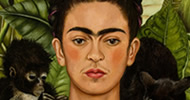
Focuses on the couple’s work in the 1930s boom-town motor-city and Kahlo’s increasing adoption of traditional Mexican dress and symbolism in her work as a reaction against the American city’s elite. Around 70 works are on display, including eight of Rivera’s preparatory drawings for his Detroit Industry mural, and 23 pieces by Kahlo.
Accompanied by a substantial exhibition catalogue
Exhibition closes: 12 July 2015
Thanks to the ARTES-Coll & Cortés Travel Scholarship, I travelled to Spain in June to visit buildings designed by the fifteenth-century French master mason Juan Guas.
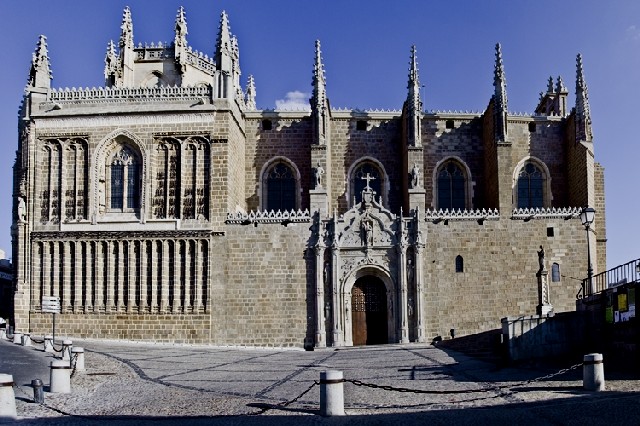
San Juan de los Reyes
During a previous trip, I visited the monastery of San Juan de Los Reyes in Toledo. Designed by Guas, this monastery is a royal foundation established to celebrate the Battle of Toro (1476). Although this battle was fought between the Catholic Monarchs and Alfonso V of Portugal, the exterior of the monastery’s church is festooned with the chains of Christian prisoners freed after the conquest of Grenada [right]. Celebration of a victory against a Christian king and anti-Moorish propaganda thus intersect in the church.
This intersection generates questions: was there always an intention to associate the church with the reconquista and the unification of Spain? Is this association consciously reflected in the style of the building, a flamboyant Gothic design that incorporates Moorish elements such as epigraphic inscriptions and artesonado ceilings?
Other questions regard Guas’ role in this stylistic fusion. The mid-twentieth century historians José Maria de Azcárate and Fernando Chueca Goitia considered Guas the creator of a national style that fused flamboyant Gothic with Spain’s unique Mudéjar heritage. Since Guas was the Catholic Monarchs’ royal architect, elements of royal propaganda in his designs are not surprising. But does this extend to the creation of a ‘national style’? With this question in mind, I designed the trip kindly sponsored by the ARTES-Coll and Cortés Travel Scholarship.
My travel started at the Prado Museum. Here I observed Flemish and ‘Hispano-Flemish’ works to consider how Flemish style and techniques were received in another medium.
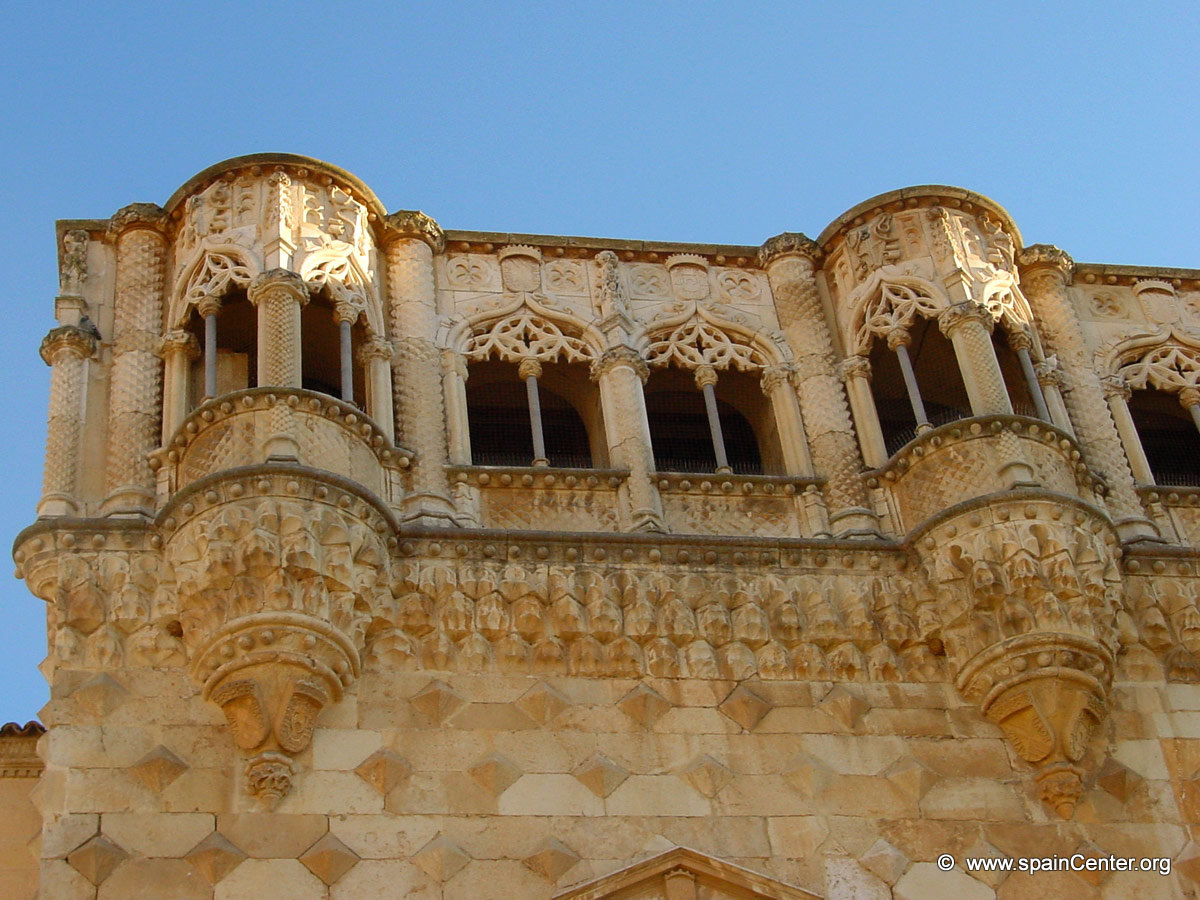
Palacio del Infantado
I then started visiting Guas’ buildings, first the Castle of Manzanares el Real and then the Palacio del Infantado in Guadalajara. Together with San Juan de los Reyes, these are usually pinpointed as Guas’ ‘Hispano-islamic’ works. Indeed, I noticed features possibly inspired by Mudéjar sources, for example blind ‘horseshoe arches’ at the top of the Infantado’s gallery [left], and long epigraphic inscriptions.
Yet Mudéjar details are not the only decoration; moreover, Manzanares and the Infantado were built for the Mendoza family, not for the kings. Rather than celebrate the new national unity, Mudéjar designs may simply contribute to express noble magnificentia.
The desire to express magnificentia offers a specific motivation for Guas’ fusion of Gothic and Mudéjar in these palaces. Contrary to what some scholars have implied, Guas did not simply ‘absorb’ Toledo’s Mudéjar buildings and unconsciously reproduce their features.
My next destinations were Segovia and Avila. Segovia cathedral is attributed to Juan Gil de Hontañón, trained in Guas’ workshop. The detailing of the bases of the cathedral’s nave piers is almost identical to that of Manzanares’ courtyard, suggesting broader stylistic uniformity than it appears when focusing on a single architect.
Visiting the monastery of El Parral in Segovia and that of Santo Tomás in Avila evidenced similarities between buildings sponsored by royal patronage: for example, both monasteries’ churches have choirs elevated over slender segmental arches.
My next stop, El Paular monastery, contains an alabaster altarpiece where flamboyant Gothic elements are used in a typically Spanish floor-to-ceiling retablo. Unsurprisingly, it is attributed to sculptors close to Guas, who designed the monastery’s cloister. This has different vault designs on each side, possibly depending on its position relative to El Paular’s church.
San Gregorio
I then visited Valladolid’s Colegio de San Gregorio [right]. Covered with figural decoration and branch tracery, San Gregorio’s façade contradicts the characterization of Guas’ decoration as geometric, aniconic and therefore ‘oriental.’
For all its display of heraldic devices, the building hardly fits the ideological framework built around Guas’ style by Azcárate and Goitia. Indeed, San Gregorio’s decorative complexity underscored my overall impression of Guas’ style as resistant to nationalistic labels.
I am very grateful to ARTES and Coll & Cortés for this invaluable opportunity to analyse the stylistic labels attached to Guas through first-hand encounter with his oeuvre.
The research undertaken in the United Kingdom thanks to the ARTES / Coll&Cortés scholarship has been included in the framework of my doctoral thesis, ‘Tradition and copy in biblical manuscript illumination in the Iberian Peninsula. The Bibles of San Isidoro de León (1162) and San Millán de la Cogolla (ca. 1200)’, supervised by Dr. José Luis Senra at the Universidad Complutense de Madrid.
The main body of research had already been completed before being awarded the scholarship: I had thoroughly examined the Bibles of San Isidoro de León and San Millán de la Cogolla, which form the core of the project, as well as their model, the 10th-century Bible of San Isidoro. I had also been able to analyse many other Iberian and French 12th-century manuscripts in order to establish possible influences. Still, the work I carried out in London has allowed me to deepen my understanding of manuscript illumination in Romanesque Europe in general, and of the scriptorium of San Isidoro de León in particular.
Firstly, in order to unveil foreign influences at work on these Spanish Bibles and assess their place in the history of medieval book illustration, I needed to study objects from all over Europe. In this process, the examination of codices preserved in British libraries was the most important task to accomplish due to the strong connections between Spain and England in the 12th century. At that time, artists and workshops travelled from one territory to the other following the path of aristocrats, clergymen and royals such as queen Eleanor Plantagenet, who married the Castilian king Alfonso VIII in 1177. Clear artistic links, such as the involvement of some of the painters from the Winchester Bible on the murals of the chapter house of Sigena, were an important starting point when tackling this issue. Therefore, I needed to look at 12th-century English manuscripts, mainly Bibles such as the ones from Lambeth, Rochester or Bury Saint Edmunds, to assess their possible influence on the Isidorian and Emilianense manuscripts. Furthermore, the British Library preserves some very important illuminated biblical codices dated around the same time as the Leonese and Riojan Bibles from outside England, such as the Bibles from Parc Abbey, Arnstein, or Floreffe, which I had to see.
The comparative analysis I undertook was focused on style, but also looked at iconography and compositions. This study verified the existence of general correspondences between late Romanesque Spanish and European manuscript illustration. However, the parallels do not apply to the details in the Isidorian and Emilianense Bibles, suggesting that there was no direct interdependence between our miniaturists and English and Flemish workshops, as has been otherwise established in relation to French illumination.
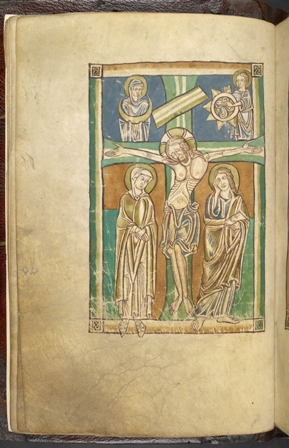
The other task I carried out thanks to the scholarship was the analysis of a Sacramentary, British Library, Add. Ms. 39924, the only production of the Isidorian scriptorium currently outside the canonry’s library. In order to carry out a complete study of the workshop in San Isidoro de León in the second half of the 12th century, I needed to examine this manuscript commonly ascribed to it. The codex, made around 1187, was explored from the codicological and palaeographical points of view to verify its origin, and its two full-page miniatures of the Crucifixion and Maiestas were also closely scrutinised.
These observations showed that this work is similar to the other codices issued by the Leonese scriptorium, thus supporting its ascription to it. Quite simple in its decoration, it has been rebound more than once, in view of the current disorder of the quires, which appear in a very chaotic sequence, and the loss of many folios. The analysis of the two illustrations (ff. 9v-10r) and the simple decorated initial (f. 41v), has confirmed its date in the late 12th century. The fact that the style displayed in the two full-page miniatures has no counterpart in any of the other codices made in San Isidoro, corroborated how this scriptorium had to resort to external miniaturists’ workshops to decorate their manuscripts, an instance previously evidenced in the 1162 Bible. Thus, the information gathered from the study of this Sacramentary has confirmed some of my findings about the scriptorium in the Real Colegiata de San Isidoro de León.
In conclusion, the work carried out thanks to the ARTES / Coll&Cortés scholarship has been crucial for the understanding of the place held by the Romanesque Bibles from San Isidoro de León and San Millán de la Cogolla in the wider field of European illumination in the second half of the 12th century. Moreover, it has helped me understand how the scriptorium in San Isidoro de León worked, thus lending weight to the interpretation of data carried out in my doctoral thesis.
The Portuguese sculptor has unveiled the latest of her installations: a monumental pair of 7-metre-tall candlesticks created from glass wine bottles, on display at the North entrance of the 19th-century country house of the Rothschild family at Waddesdon Manor, Buckinghamshire. They have been bought for the Manor’s contemporary art collection and the bottles used in Vasconcelos’ fibre-optic lit sculpture came from the Chateau Lafite Rothschild vineyard in Bordeaux.
Itinerarios XXI, Fundación Botín, Santander, 28 March – 31 May 2015
Exhibition of works by nine Spanish, Portuguese and Latin American contemporary artists who are the recipients of the 21st Fundación Botín Visual Arts Grants for 2013-2014. Carles Congost (Gerona, 1970), Albert Corbí (Valencia, 1976), Patricia Esquivias (Caracas, 1979), Jon Mikel Euba (Vizcaya, 1967), Rodrigo Oliveira (Portugal, 1978), Wilfredo Prieto (Cuba, 1978); Julia Spínola (Madrid, 1979), Justin Randolph Thompson (Peekskill, NY, 1979) and Jorge Yeregui (Santander, 1975).
A downloadable leaflet –at http://www.fundacionbotin.org/89dguuytdfr276ed_uploads/2015_03_26_06_31_03.pdf –illustrates examples of the artists’ works including sculptures, photographs and artist’s books.
Equipo Crónica, Museo de Bellas Artes, Bilbao,10 February – 18 May 2015
The most extensive retrospective to date of nearly 150 paintings, drawings, prints, posters and sculptures, covering Equipo Crónica’s entire creative career from 1964 when three Valencian artists, Rafael Solbes (1940-1981), Manuel Valdés (1942) and Juan Antonio Toledo (1940-1995) established the group, to 1981 when Solbes died.
Featuring major works from many collections both public and private, the exhibition gives pride of place to a large group on loan for the occasion from the IVAM, in Valencia. Against a background of Pop and new figuration, Equipo Crónica made a name for itself with a number of exhibitions in Paris in the 1960s. Their activity was deliberately linked to the social and political situation in Spain at the time and involved working as anonymous members of a team producing images, many of which were drawn from the media, or critically appropriated references from history and art. The group conjured up in visual terms a particular era in Spanish history, one that roughly coincides with the final ten years of the Franco régime and the beginning of Spain’s transition to democracy.
Art historians Tomàs Llorens Serra (who wrote the original short essays that provided theoretical backing for the group) and Boye Llorens Peters have curated the exhibition.
Helena Almeida, Inhabited Drawings/Desenhos habitados, showing at Richard Saltoun Gallery, Great Titfield Street, London W1W 6RV, 27 March – 22 May, along with work by her Madeira-born contemporary Lourdes Castro (b.1930).
This is the first London show for Portuguese artist Helena Almeida, a student of the University of Fine Art, Lisbon, who has developed a body of work that marries unconventional materials with photography, drawings, and performance. She has had recent solo shows at Centro de Arte Moderna, Fundação Gulbenkian, Lisbon (2006), Kettle’s Yard, Cambridge, (2009), and the John Hansard Gallery, Southampton (2010). Her work is included in the collections of the Tate, the Museu d’art modern i contemporani de Palma, and she represented Portugal in 2005 at the Venice Biennale.









 ARTES
ARTES 