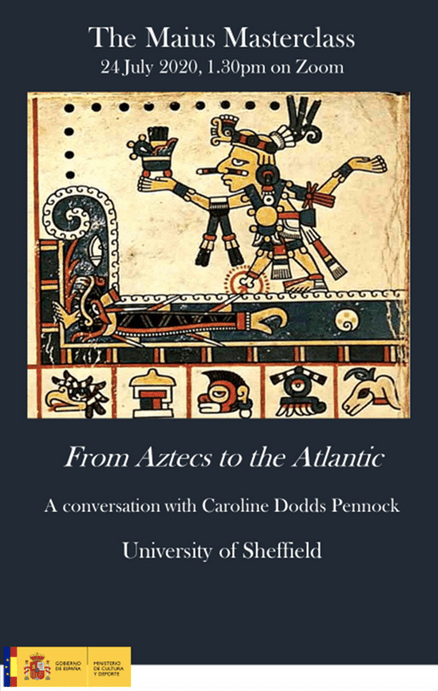
For their next online event, on Friday 24 July at 1.30pm, the Maius Masterclass will welcome Dr Caroline Dodds Pennock (University of Sheffield). Caroline is the only Aztec historian in the UK, and her research focuses on indigenous and Spanish American history and the Atlantic world, with a particular interest in issues of gender, violence, and cultural exchange.
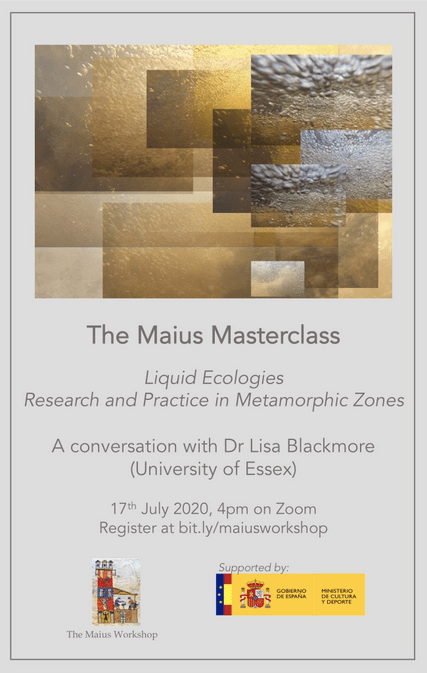
The next Maius Masterclass is on Friday 17 July 2020, when they will welcome Dr Lisa Blackmore (University of Essex), an expert in the aesthetics and politics of modernity in Latin American and Caribbean art, architecture, and visual culture.
Applications are invited for a 0.7 FTE (24.5 hours per week) Teaching Fellow in History of Art (19th century Europe), to start on 1 August 2020, fixed term for 1 year.
There is a preference for specialism in Spanish art or orientalism, but specialists in any area of nineteenth-century European or Latin American art are invited to apply. We welcome versatile applicants who have secondary interests in areas of high student need, for example curation, museum studies or the theory and historiography of art history.
Deadline: 15 July 2020
For more details and how to apply please search for Vacancy Reference 052491 on this site:https://www.vacancies.ed.ac.uk
In general terms the conference design will be maintained as it was, but specific dates and any other changes will be circulated shortly in a revised CFP. In the meantime, the Call for Papers remains open.
The Gregorian Reform led to a reframing of the role of bishops and diocesan institutions that cemented their power and ultimately permitted the construction of the great Gothic cathedrals of Europe. To mark the 800th anniversary of the Cathedral of Burgos, we propose to explore the dynamics, strategies, institutions and personnel behind the construction of the medieval diocese leading to the building of the temples we admire today. Our focus will be on the period 1150-1250, culminating as it does in the construction of the Cathedral of Burgos, but we welcome papers on other parts of Europe and set in other medieval periods that explore the following themes related to the emergence of the mature medieval diocese:
Territorial consolidation: diocesan borders, inter-diocesan hierarchies and conflicts.
Structural consolidation: network of parishes, fiscality, ecclesiastical offices and benefices
Institutional consolidation: cathedral chapters, use of archdeaconries, archpriesthoods and secular abbeys.
Intra-diocesan conflict: monasteries, collegial churches etc.
The agents: bishops, chapter, clergy (bishop-chapter conflict, patronage and client networks, diocesan reforms, education, cultural production)
Submissions: proposals no longer than 300 words for either individual papers or panels should be submitted by August 1st to burgensis2020@gmail.com
Languages: Spanish, English Registration Fee: 50 euros
Key Dates:
Deadline for submissions, August 1st
Confirmation of acceptance, September 15th
Registration opens, October 1st
Registration ends, November 30th
Venue: Facultad de Humanidades, Universidad de Burgos
Convenors: Susana Guijarro (Univ. Cantabria), David Peterson (Univ. Burgos)
Organised by: Área de Historia Medieval (Univ. de Burgos) & Grupo de I+D de la Universidad Cantabria Cultura, Sociedad y Poder en la Castilla Medieval y Moderna.
This book sets out to describe the experiences of foreign ambassadors dispatched to Spain during the long reign of Philip IV (1621–65). Through a selection of diplomats of various nationalities—from the Holy Roman Empire, the Holy See, France, England, Venice, Tuscany, Genoa, the small Italian states, Sweden, Denmark, and the Ottoman Empire—it paints a broad picture of political missions to the ‘Planet King’ and of personal agendas in Golden-Age Madrid. With their different perceptions of the Habsburg court and life in a city that was entirely transformed into the capital of a worldwide monarchy in the decades of the mid-seventeenth century, these men bear fascinating witness to the interactions between a dominant state at pains to preserve its hegemonic role and a variety of powers ranging from close allies to sworn enemies on the international stage.
The operations of the administrative and political system with which new ambassadors were confronted on reaching Madrid are scrutinised here by a distinguished group of academics, museum curators and independent researchers who provide complementary approaches to diplomatic history. Twenty-one specialists from eight different countries contribute texts devoted to thirteen ambassadors and highlight specific assignments in the foreign service, showing how much these agents relied on their own backgrounds and interests when assessing Spaniards and Spain. Mostly based on unpublished sources and lavishly illustrated with more than 280 images, this anthology of essays sheds light on Madrid as a centre of international diplomacy and offers a new perspective on the king who was deemed by Europeans to be the most powerful monarch in the world.
Click here for more information and to purchase the book.
One of their current exhibitions, The Golden Age of Spanish Modern Art, ‘offers a re-evaluation of Spanish painting at the turn of the 20th century, presenting exquisite and innovative works by Spanish artists, particularly from Catalan, who trained in the academies of Barcelona and spent most of their working lives in Paris. Visit us this summer as we place these artists back on an equal footing with the other great European painters of their day’.
The National Gallery, opens July 8th, open daily 11am– 4pm and Friday until 9pm, advanced online booking required
Their exhibition, Titian: Love, Desire Death, which reunites for the first time since the sixteenth century Titian’s six poesie paintings commissioned in 1551 by Prince Philip of Spain, has been extended until 17 January 2021. The exhibition will no longer be traveling to the National Gallery of Scotland. Visitors will also be able to see the newly acquired painting by Sorolla, The Drunkard, Zarauz.
The Royal Academy, opens to members on July 9th and to the general public on July 16th, Thurs–Sun: 11am– 4pm, advanced online booking required
Its exhibition Picasso and Paper, has been extended until 2nd August 2020. The exhibition features more than 300 drawings, prints, collages, and sculptures by Picasso, spanning his entire career and including studies for Guernica and a 4.8-metre-wide collage.
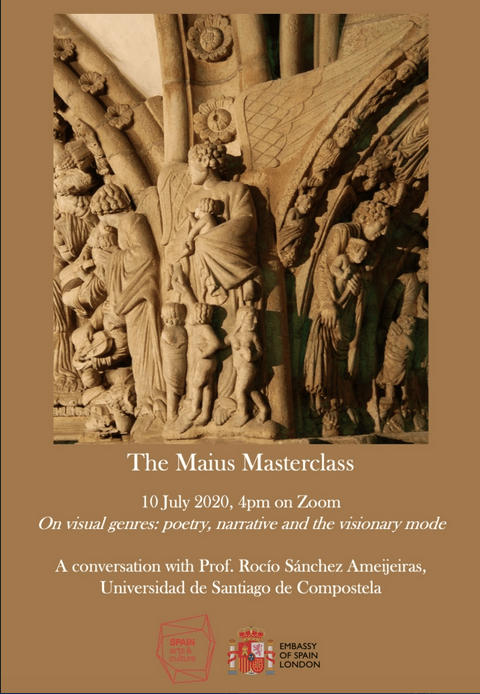
The second Maius Masterclass will take place on 10 July 2020, 4–5pm on Zoom. We will welcome ProfessorRocío Sánchez Ameijeiras (Universidad de Santiago de Compostela), who will explore the theme of visual genres as one of the recurring threads of her academic career.
Please click here tojoin (you will be asked to register and download Zoom, so we recommend you sign up in advance). You can use your PC, Mac, iPad, iPhone or Android device.
The series is kindly supported by a Hispanex Grant from the Spanish Ministry of Culture and SPAIN Arts & Culture/Embassy of Spain in London.
image: Durham University and the Zurbarán Centre for Spanish and Latin American Art
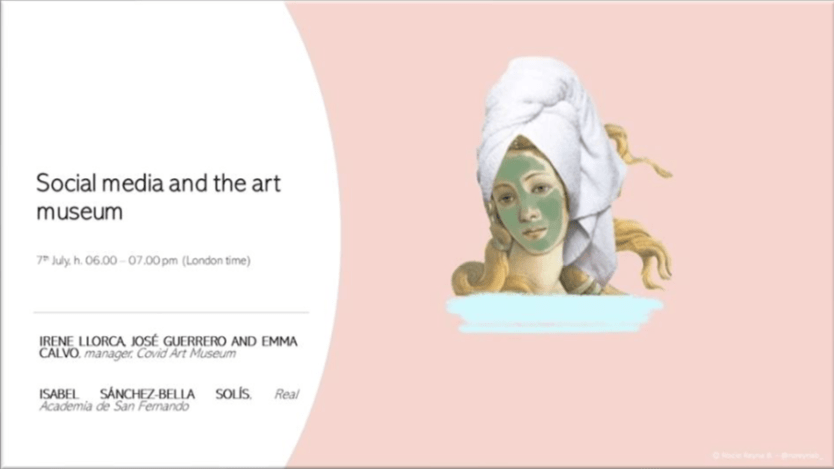
The Covid-19 pandemic has forced us all to rethink our ways to travel, gather, and socialize. Museums and exhibition venues have not been exempt from necessary adjustments. These four informal early evening conversations are an occasion for reflecting upon the role of social media and the arts during lockdown and upon the challenges that the times post Covid-19 context will pose to the museum experience. They are intended as a dialogue on undertaking or prospect about the dialogue for new initiatives and positive responses to cope with the current uncertainty.
We are delighted to be discussing these challenges with academics and curators, including representatives from the Real Academia de San Fernando, the Meadows Museum, the Sir John Soane’s Museum, the Bowes Museum, and the Royal Academy of Arts.
We are pleased to announce below the speakers for our talks, scheduled at 6-7 pm (UK time) every Tuesday in July. Each session will include talks from experts on the topic. The 15-minute presentations will be followed by half an hour of informal conversation with the attendees.
Advanced registration is required for access to the webinar. Please send an email to one of the organisers Elisabetta Maistri (elisabetta.maistri@durham.ac.uk), or to Patricia Manzano Rodríguez (patricia.manzano-rodiguez@durham.ac.uk), both Ph.D. candidates at the Zurbarán Centre for Spanish and Latin American Art, University College, MLAC, Durham University.
The four sessions will be:
JULY 7: Social Media and the Art Museum
Irene Llorca, José Guerrero and Emma Calvo, Managers of the Covid Art Museum on Instagram.
Isabel Sánchez-Bella Solís, Real Academia de San Fernando (Madrid).
JULY 14: Temporary Exhibitions after Covid-19 Outbreak
Dr Amanda W. Dotseth, Curator in the Meadows Museum (Dallas, Texas).
Patrizia Piscitello, Head of Exhibitions and Loans in Museo di Capodimonte (Naples).
JULY 21: Impact of Covid-19 in Temporary Exhibitions
Helen Dorey MBE, FSA, Deputy Director and Inspectress at Sir John Soane’s Museum (London).
Dr Jane Whittaker, Head of Collections at the Bowes Museum (co. Durham).
JULY 28: Educational Mission of Museums and Covid-19
Dr Rebecca Lyons, Director of Collections & Learning, Royal Academy of Arts (London)
Prof. Nuria Rodríguez Ortega, Head of the Art History Department of the Universidad de Málaga (Málaga).
Leonardo Impett, Bibliotheca Hertziana (Rome) and Durham University (to be confirmed).
There is a new page on the ARTES website dedicated to 3D models of architecture and objects from the Iberian Peninsula (click here). A page dedicated to 3D models for Latin America is coming soon. Find them under the ‘Online Resources’ tab on the top of the site. These lists are not exhaustive, and will be updated regularly.
Have anything to add to the Iberian list, or ideas for the Latin American list? Please comment on this post with your suggestions (‘leave a reply’).
Photo: Conchi Paz, Courtesy of Galician regional government
On June 5th, fisherman Fernando Brey tripped over a moss covered stone in the Sar river in Galicia when he was struck by its unusual shape. Indeed, this was not an ordinary riverbed rock. He had literally stumbled upon a sculpture of the Virgin and Child, whose faces are now missing, with two worn angels behind the Virgin’s shoulders, who appear to hold up her mantle. Brey quickly shared his discovery with Apatrigal, a local heritage association, and the Galician Ministry of Culture, who believe the work dates to the 14th century.
According to Apatrigal’s statement, the 150kg granite sculpture is carved on all sides other than the back, including the underside of its base, leading them to believe it was meant to be suspended on a wall. They also hypothesize that the work may have originally been located in the now-lost 12th-century Convent of Santa María de Conxo, which was very close to the discovery site in the Sar river. The sculpture has now been moved to the Museo das Peregrinacións in Santiago de Compostela, where it will be cleaned and analysed to determine its probable origin and dating. ‘Studies should tell us whether this is a very valuable gothic statue’, regional minister of culture Román Rodríguez said, as reported in The Guardian, ‘but beyond its cultural and historic value, we’ll also need to try to put together the story of this statue: What happened, and how could it remain undiscovered so close to the city for so many centuries? It must be quite a story’.