CFP: Arts and Models of Democracy in post-authoritarian Iberian Peninsula, University of Huddersfield, 28–29 November 2019

Mural for the commemoration of the Carnation Revolution made by Caos, Add FuelDraw and MAR at the Universidade Nova de Lisboa in 2014

The process of democratisation in Portugal and Spain originated from a similar socio-political context. Besides having an almost identical geographical context, two long authoritarian and military dictatorships shaped the two counties on the basis of a nationalist and deeply catholic identity. From the point of view of popular culture, both dictatorships promoted a disengaged culture, based on songs, football matches, bullfights and the stereotypes of Iberian folklore. In the early 1970s, the illiteracy rate and cultural practices indexes in both countries were still among the highest in Europe. Despite these similar starting conditions, the Portuguese transition to democracy was very different from that of Spain; whereas Portugal created a rupture with the previous institutional context through a military coup, in Spain the post-Franco democratisation was founded on negotiated reform. These two processes of transition to democracy in Portugal and Spain, although dissimilar from each other, led to new ways of both high and popular cultural expressions. As a result, the decade following the two dictatorships was characterised by significant and euphoric experiments in the fields of literature, visual and plastic arts, cinema and music. Scholars have paid scant attention to the ways in which artists thought and put into practice the very notion of democracy in these years. Democracy is a highly contested category, one that has been imagined in many different ways, and any particular realisation of which carries costs as well as benefits. According to the historian of democracy Pierre Rosanvallon (2008), the rise of a democracy entails both a promise and a problem for a society.

This two-day conference aims to innovatively question how artistic practices and institutions formed ways of imagining democracy and by what means arts and culture participate in the wider social struggle to define freedom and equality for the post-Estado Novo and post-Francoist period: how did artistic practices instantiate ideas of democracy in this context? Inversely, how did such democratic values inform artistic practice? How did Portuguese and Spanish artists and intellectuals negotiate between creative autonomy and social responsibility? And more broadly, what is the role of culture in a democracy? The core purpose of the conference is to bring scholars together from different subject areas and exploring any artistic practice (literature, visual and plastic arts, cinema and music). PhD students, early careers and senior researchers are invited to submit an abstract to engage in an interdisciplinary and comparative debate on how the field of culture framed different ideas of democracy in the Iberian post-authoritarian transitions during the 1970s and early 1980s.

Papers will be 30-minutes in length with 15 minutes of discussion time, to enable the fullest exchange. Please submit proposals (300 words) and a short bio to I.ContrerasZubillaga(at)hud.ac.uk and g.quaggio(at)sheffield.ac.uk by the deadline Friday 31 May 2019. The programme will be announced in early July.

Click here for more information.

Bigas Luna Tribute, Manchester, 28–31 March 2019

Bigas Luna (1946–2013) is among Spain’s most influential filmmakers. In the 1990s, his popular comedy/drama Jamón, jamón, was among the most studied texts in Hispanic Studies courses in the UK. He also famously launched the careers of Hollywood stars such as Javier Bardem and Penélope Cruz.

Over a period of four days and in two different venues, the Bigas Luna Tribute Manchester will include four film screenings, two receptions and an exhibition. The exhibition will remain open for the duration of the festival, until April 13th. The event will include the ‘Iberian Portraits’ trilogy in full with introductory presentations by Bigas Luna specialists, a cava reception following the screening of Jamón, jamón (1992), the first UK screening of the posthumous documentary BigasxBigas (2017) – including a Q&A with its co-director Santiago Garrido Rúa – and the videoart exhibition ‘Barbaric Comedies‘, inspired by Valle-Inclán.

THURSDAY 28 MARCH 

Instituto Cervantes Manchester (326-330 Deansgate Campfield, Avenue Arcade, Manchester M3 4FN). 

  • 6.30 PM: Opening of ‘BarbaricComedies’ video art exhibition with an introduction by co-curator Prof Santiago Fouz Hernández (Durham) and wine reception sponsored by the Instituto Cervantes Manchester.
    NB Exhibition will be open until April 12th Mon-Friday 10AM to 8PM. Free entry.
    Viewer discretion is advised. 
  • 7PM: Screening BigasxBigas (2017) – with introduction and Q&A with co-director Santiago Garrido Rúa. TicketsTrailer.
FRIDAY 29 MARCH  

HOME Manchester (2, Tony Wilson Place, M15 4FN Manchester)

  • 7.50 PMJamón, jamón (1992), starring Penélope Cruz, Javier Bardem and Jordi Mollà – with introduction by Prof Santiago Fouz Hernández (Durham University).
  • Followed by cava reception (first drink is included with film ticket), sponsored by Durham University, ¡Viva! Festival and festival sponsors. TicketsTrailer.
SATURDAY 30 MARCH  

HOME Manchester (2, Tony Wilson Place, M15 4FN Manchester)

  • 5.50 PMHuevos de oro / Golden Balls (1993), starring Javier Bardem, Maribel Verdú and Benicio del Toro- with introduction by Prof Santiago Fouz Hernández (Durham University).  TicketsTrailer.
SATURDAY 31 MARCH  

HOME Manchester (2, Tony Wilson Place, M15 4FN Manchester)

  • 5.40 PMLa teta y la luna / The Tit and the Moon (1994), starring Mathilda May, Biel Durán and Miguel Poveda- with introduction by Dr Abigail Loxham (University of Liverpool). TicketsTrailer.
  • Followed by discussion about the ‘Iberian Portraits’ trilogy with Dr Loxham and Prof Fouz Hernández. 

CFP: ‘Imperial Entanglements: Trans-Oceanic Basque Networks in British and Spanish Colonialism and their Legacy’, Museum of Liverpool, Liverpool UK, 9–10 August 2019

Port-cities in Britain are known and studied as crossroads and gateways of empire. People, ideas, goods, money, etc. flowed in and out of these porous urban environments. For many people, port-cities were not only a place of transience, they could also be a home city with a strong sense of community. From the 16th through the 19th centuries, some of those who called port-cities their homes were part of the Anglo-Spanish diaspora. From Cadiz to London or Bilbao to Liverpool, Spanish and British citizens crossed the oceans in order to participate in Anglo-Spanish trade and imperial expansion. These voyages inevitably led to the creation of Anglo-Spanish communities in the littoral regions of both empires. The growth and success of Anglo-Spanish communities in port-cities was driven in part by imperial ventures such as the textile industry, mining, and the slave trade. It is not always easy to reconcile the history of exploitative ventures with the immigrant communities whose creation they facilitated. However, it is important to bring together local and imperial histories in order to understand how Anglo-Spanish communities were built, thrived, and sometimes waned.

This conference seeks to bring together scholars interested in the lives of Anglo-Spanish communities across both the Spanish and British empires. The conference also seeks to address the tensions that investigating family and local history can bring to communities today. The conference will be open to the public in the hopes that those interested in the conference themes will come and engage with the ideas being presented. The themes of this conference were inspired by the histories of two Anglo-Basque families, the Zuluetas and the Larrinagas, both of whom have contentious legacies in London and Liverpool.

The organisers are particularly interested in paper or panel proposals in the areas of family history; literature; art history; business history; food history; urban history; slave-trade history; shipping history; and cultural history. Please click here for more information. Please send individual paper or panel proposals to Dr. Anna Brinkman (a.brinkman@warwick.ac.uk) by midnight on 25 March.

Featured Exhibition: Frida Kahlo and Arte Popular, MFA Boston, until 16 June 2019

Exhibition of more than 70 works that focuses on the relationship between Kahlo’s paintings and the traditional Mexican ‘folk art’ by unknown artists that she collected and championed as part of her celebration of Mexican nationalist culture. On loan to the exhibition are some 40 pieces of folk art from the San Antonio Museum of Art, which are similar to the ceramics, textiles, toys and figurines which Kahlo collected. These are displayed alongside eight paintings by Kahlo on loan to Boston, including her Self-portrait with Thorn Necklace and Hummingbird (1940), and her early Dos Mujeres (Salvadora y Herminia), recently acquired by the  MFA. A section of the exhibition will explore how the small painted ex-voto ‘retablos’, of which Kahlo collected some 400 examples, inspired her own work such as The Suicide of Dorothy Hale, which she painted in 1938. The exhibition is supported by the Darwin Cordoba Fund for Latin American Art.

Click here to find out more.

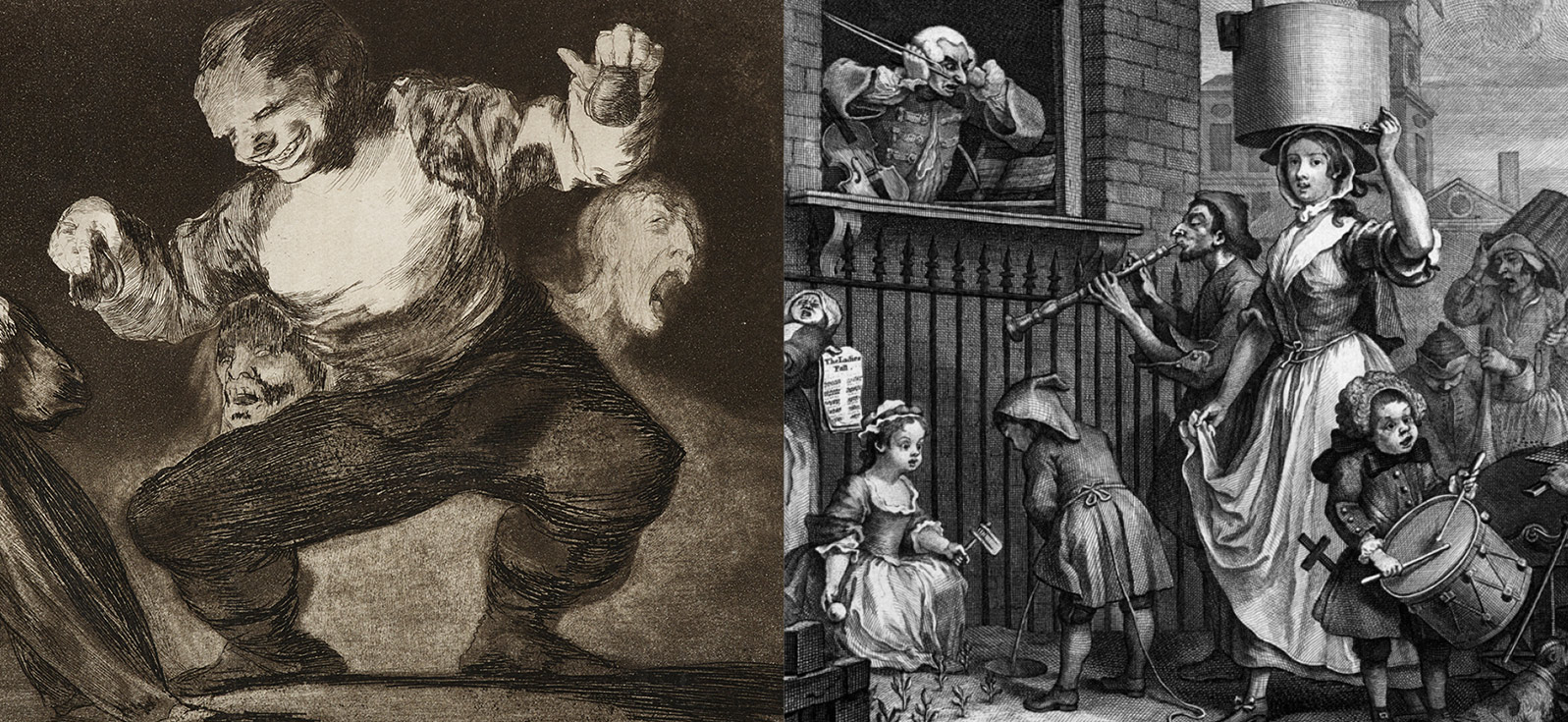
Featured Exhibition: Prints of Darkness: Goya and Hogarth in a Time of European Turmoil, Whitworth Art Gallery, Manchester, until August 2019

Goya-and-Hogarth_the-Whitworth_web_medFrancesco José de Goya Lucientes (1746-1828) and William Hogarth (1647-1764) were the most remarkable artists of their times. Both were famous painters, but their most compelling works are the prints that they made and published themselves. Often produced in serial format, like graphic novels, the prints were aimed at a more popular market than their paintings. This is the first exhibition to show Goya and Hogarth’s works together. It features a hundred prints, selected from the stellar collections of the Whitworth and the Manchester Art Gallery, and provides a unique opportunity to compare their extraordinary graphic work.

Both outsiders, Hogarth and Goya cast their candid gazes on their dysfunctional societies. Poverty, homelessness, warfare, violence, cruelty, sexual abuse and human trafficking, social inequity, political corruption, racism, superstition, hypocrisy, rampant materialism, nationalism, mental illness, and alcoholism all were subjected to their forensic scrutiny —no topic was off-limits. These challenging prints provoke a spectrum of responses, including shock, discomfort, laughter, pleasure, pain and empathy. The scenarios that Goya and Hogarth unflinchingly depicted are startlingly familiar to the contemporary viewer, and the images provoke us to turn our embarrassed gazes on our own society, and ourselves.

The exhibition is also timely, as it takes place during the troubled run-up to Britain’s exit from the European Union. Hogarth and Goya both lived through extended periods of warfare with France, and Hogarth claimed to hate the French, although he was a frequent visitor to Paris and hired French engravers for his print series Marriage a-la Mode. Angry, troubled, and ambivalent, Hogarth seems to embody the tortured mind-set of Britain on the eve of Brexit.

Click here for more information.

Featured Exhibition: Revealing, Reversible and Resplendent: 15th-17th-Century Italian and Spanish Textiles, Nelson Atkins Museum of Art, Kansas City, until 16 June 2019

Orphrey fragment (detail), Late 16th-early 17th century. Italian/Spanish. Silk and linen, 23 7/8 x 8 3/8 inches. 2008.45.

This exhibition showcases silk and linen fragments spanning the 15th to 17th centuries, a period of expanded exploration and trade, when Italy and Spain emerged as major centres of textile production. During this era, textiles with three-dimensional effects became popular within the Christian church and the secular world. Cloth and threads were fashioned into elaborate embroidery, gilded three-dimensional images, brilliantly-hued reversible fabrics, and even textiles purposely cut in a pattern that revealed glimpses of one’s undergarments below—a style fashionable during the 17th century. To create relief images, professionally trained embroiderers attached applied work, or appliqués, onto garments, such as orphreys – decorative panels for church vestments.

Click here for more information on this exhibition.
The Courtauld Summer School 2019: Dr Nicola Jennings, ‘Spanish Splendour: The Arts of Iberia 1350–1500’, 15–19 July 2019

The Courtauld Summer School features a variety of week-long intensive art history courses at one of the world’s leading Institutes for the study of art history, conservation and curating. Open to everyone over the age of 18. Click here for more information on the programme. ARTES members may be particularly interested in Spanish Splendour: The Arts of Iberia 1350–1500.

Spanish Splendour: The Arts of Iberia 1350–1500
Dr Nicola Jennings

Image: Gil de Siloé, main altarpiece, detail, 15thcentury, Cartuja de Santa Maria de Miraflores, Burgos, Spain, 
© Nicola Jennings

This course looks at the arts in the kingdoms of Aragon and Castile between 1350 and 1550, a period which saw the establishment of the new kingdom of Spain and the development of traditions of painting, architecture and sculpture which can today be seen in museums, churches and palaces around the world. With visits to the Victoria & Albert Museum, the National Gallery, and the British Museum’s print room, the sessions will frame this art in relation to the active part played by Spaniards in political, cultural, and commercial exchange around the Mediterranean and with the Burgundian Netherlands and northern France. Aragon saw both the highpoint and the decline of an extensive political and commercial empire resulting in polyglot works such as the altarpiece of St George at the Victoria & Albert Museum. Castile saw taste for the Islamophile ‘Mudejar’ style give way to so-called ‘Hispano-Flemish’ art such as Bartolomé Bermejo’s Saint Michael vanquishing the Devil at the National Gallery. The arrival in Iberia of increasing numbers of superbly crafted ivories, altarpieces, metalwork and tapestries from the southern Netherlands, of paintings by the likes of Jan van Eyck and Rogier van der Weyden, and of prints by Schongauer and Dürer played a key role in this process.

Dr Nicola Jenningshas an MA and a PhD from The Courtauld, where she is currently an Associate Lecturer; she is also Director of the Colnaghi Foundation, London. She previously held positions at the National Gallery and at City University, London. Nicola is a specialist in late-Gothic Spanish art, with a particular research interest in the connections between immigrant French and Flemish and local Spanish artists in fifteenth-century Iberia, and in the works they produced for prominent converts from Judaism.  Her writings include contributions to monographs on Lorenzo Mercadante and Alonso Berruguete, and various articles and book chapters based on her thesis.

Cost:  £555.  For further information please see the websitecourtauld.ac.uk/learn
or contact short.courses@courtauld.ac.uktel:  020 3 9477 650

Featured Exhibition: Displaying Latin America, Harvard Art Museums, until 12 May 2019

Standardized Housing, Buenos Aires, 1931-1932: Building types A, B, C: isometrics

This exhibition explores the vibrant cosmopolitan architecture culture in Latin America during the interwar period, using original materials from archival collections at Harvard. Presented here are works by Argentinian architects Jorge Ferrari Hardoy and Juan Kurchan, who collaborated with Le Corbusier, and by German architect Franz Möller, who worked with Walter Gropius, both of whom were key propagandists of modern architecture. In 1931, Möller opened the office Gropius-Moller Arquitectos in Buenos Aires. Among the firm’s projects was the Ciudad Balnearia de Chapadmalal, a private commission for a large-scale seaside resort, represented here by the clubhouse. This high-end leisure development contrasts with Gropius Standard—a one-story, low-cost house intended for young professional couples that could transform over time to meet the needs of a growing family. This system continued Gropius’s interests in prefabrication, which can be traced back to his Bauhaus years, but was adjusted to suit local building and climatic conditions.

In the early 1940s, Ferrari Hardoy and Kurchan conceived of an apartment building on Virrey del Pino Street to showcase the possibilities of “city in the park” modern planning; they envisioned the project as a fragment of a future greater whole. The 10-story apartment block is set back on an urban lot, and an ample garden separates the building from the street. Three august carefully preserved eucalyptus trees were woven into the facade, fusing practical climatic considerations and formal aesthetic concerns. Both architects were engaged in the Plan Director, a master plan for the Argentinian capital that had been developed with Le Corbusier in Paris. Le Corbusier’s daring proposal for skyscrapers on the Rio de la Plata, which had sprung from his 1929 visit to Argentina, would have extended the city of the Pampas into the river. This key functional and symbolic node sets the development of the Plan Director into a multinode city linked by circulation arteries. After the war, working for the city government, Ferrari Hardoy and Kurchan refined the plan and vigorously endeavored to publicize and implement it.

Click here for more information.

New Web Resource: Latin American and Caribbean Contemporary Art Web Archive

Carlos Cruz-Diez, Un être flottant, 2016
© Courtesy Galerie Mitterrand / Benoit Fougeirol

The Latin American and Caribbean Contemporary Art Web Archive is a collection developed by the Ivy Plus Libraries Confederation‘s Art & Architecture Librarians, and is an extension of an existing effort focused on collecting publications in all formats that document contemporary art and artists of Latin America and the Caribbean. The agreement defines contemporary art as it refers to ‘developments in the visual arts from 1975 to the present,’ with material sought ‘for the entire career of artists who have been active at any time since 1975.’

This archive aims to preserve for researchers the personal and official websites belonging to notable contemporary Latin American and Caribbean artists in order to assure the continuing availability of the important content they contain.

Click here to access and browse the collection on Archive-It here

ARTES Event: Visit to Kingston Lacy, Dorset, May 9, 2019

The Spanish Room at Kingston Lacy

ARTES has organised a tour of Kingston Lacy, the country estate of the Bankes family. The house has an important art collection, including works by Velázquez, Tintoretto, Rubens, Van Dyck and Brueghel. It is also famous for its ‘Golden’ or ‘Spanish Room’, featuring an early 17th-century Venetian ceiling and hangings of gilded leather. In 1857 Gustav Waagen said of the paintings once decorating this room: “I know no other collection in England containing so many valuable pictures of the Spanish school” .

The visit will consist of: 
-Tour of art collection and rooms
-Picnic lunch
-Visit to the grounds and kitchen gardens, including the Japanese Gardens.

Members are advised to contact ARTES for practical information regarding timings, trains and prices. It will be possible to take part in the visit as a day-trip from London. 

Please RSVP by 24 April to p.baker_bates@open.ac.uk and artesiberia@gmail.com