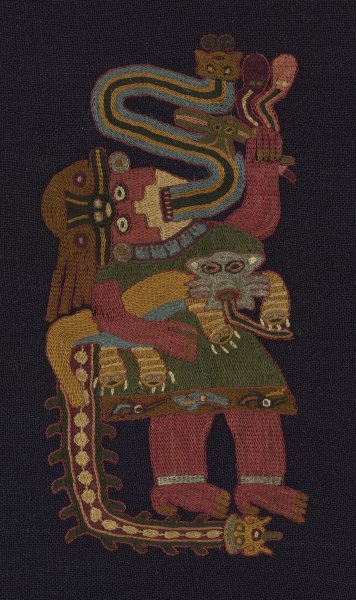
Orphrey fragment (detail), Late 16th-early 17th century. Italian/Spanish. Silk and linen, 23 7/8 x 8 3/8 inches. 2008.45.
This exhibition showcases silk and linen fragments spanning the 15th to 17th centuries, a period of expanded exploration and trade, when Italy and Spain emerged as major centres of textile production. During this era, textiles with three-dimensional effects became popular within the Christian church and the secular world. Cloth and threads were fashioned into elaborate embroidery, gilded three-dimensional images, brilliantly-hued reversible fabrics, and even textiles purposely cut in a pattern that revealed glimpses of one’s undergarments below—a style fashionable during the 17th century. To create relief images, professionally trained embroiderers attached applied work, or appliqués, onto garments, such as orphreys – decorative panels for church vestments.
Click here for more information on this exhibition.
The Courtauld Summer School features a variety of week-long intensive art history courses at one of the world’s leading Institutes for the study of art history, conservation and curating. Open to everyone over the age of 18. Click here for more information on the programme. ARTES members may be particularly interested in Spanish Splendour: The Arts of Iberia 1350–1500.
Spanish Splendour: The Arts of Iberia 1350–1500 Dr Nicola Jennings
This course looks at the arts in the kingdoms of Aragon and Castile between 1350 and 1550, a period which saw the establishment of the new kingdom of Spain and the development of traditions of painting, architecture and sculpture which can today be seen in museums, churches and palaces around the world. With visits to the Victoria & Albert Museum, the National Gallery, and the British Museum’s print room, the sessions will frame this art in relation to the active part played by Spaniards in political, cultural, and commercial exchange around the Mediterranean and with the Burgundian Netherlands and northern France. Aragon saw both the highpoint and the decline of an extensive political and commercial empire resulting in polyglot works such as the altarpiece of St George at the Victoria & Albert Museum. Castile saw taste for the Islamophile ‘Mudejar’ style give way to so-called ‘Hispano-Flemish’ art such as Bartolomé Bermejo’s Saint Michael vanquishing the Devil at the National Gallery. The arrival in Iberia of increasing numbers of superbly crafted ivories, altarpieces, metalwork and tapestries from the southern Netherlands, of paintings by the likes of Jan van Eyck and Rogier van der Weyden, and of prints by Schongauer and Dürer played a key role in this process.
Dr Nicola Jenningshas an MA and a PhD from The Courtauld, where she is currently an Associate Lecturer; she is also Director of the Colnaghi Foundation, London. She previously held positions at the National Gallery and at City University, London. Nicola is a specialist in late-Gothic Spanish art, with a particular research interest in the connections between immigrant French and Flemish and local Spanish artists in fifteenth-century Iberia, and in the works they produced for prominent converts from Judaism. Her writings include contributions to monographs on Lorenzo Mercadante and Alonso Berruguete, and various articles and book chapters based on her thesis.
Cost: £555. For further information please see the websitecourtauld.ac.uk/learn or contact short.courses@courtauld.ac.uktel: 020 3 9477 650
Standardized Housing, Buenos Aires, 1931-1932: Building types A, B, C: isometrics
This exhibition explores the vibrant cosmopolitan architecture culture in Latin America during the interwar period, using original materials from archival collections at Harvard. Presented here are works by Argentinian architects Jorge Ferrari Hardoy and Juan Kurchan, who collaborated with Le Corbusier, and by German architect Franz Möller, who worked with Walter Gropius, both of whom were key propagandists of modern architecture. In 1931, Möller opened the office Gropius-Moller Arquitectos in Buenos Aires. Among the firm’s projects was the Ciudad Balnearia de Chapadmalal, a private commission for a large-scale seaside resort, represented here by the clubhouse. This high-end leisure development contrasts with Gropius Standard—a one-story, low-cost house intended for young professional couples that could transform over time to meet the needs of a growing family. This system continued Gropius’s interests in prefabrication, which can be traced back to his Bauhaus years, but was adjusted to suit local building and climatic conditions.
In the early 1940s, Ferrari Hardoy and Kurchan conceived of an apartment building on Virrey del Pino Street to showcase the possibilities of “city in the park” modern planning; they envisioned the project as a fragment of a future greater whole. The 10-story apartment block is set back on an urban lot, and an ample garden separates the building from the street. Three august carefully preserved eucalyptus trees were woven into the facade, fusing practical climatic considerations and formal aesthetic concerns. Both architects were engaged in the Plan Director, a master plan for the Argentinian capital that had been developed with Le Corbusier in Paris. Le Corbusier’s daring proposal for skyscrapers on the Rio de la Plata, which had sprung from his 1929 visit to Argentina, would have extended the city of the Pampas into the river. This key functional and symbolic node sets the development of the Plan Director into a multinode city linked by circulation arteries. After the war, working for the city government, Ferrari Hardoy and Kurchan refined the plan and vigorously endeavored to publicize and implement it.
The Latin American and Caribbean Contemporary Art Web Archive is a collection developed by the Ivy Plus Libraries Confederation‘s Art & Architecture Librarians, and is an extension of an existing effort focused on collecting publications in all formats that document contemporary art and artists of Latin America and the Caribbean. The agreement defines contemporary art as it refers to ‘developments in the visual arts from 1975 to the present,’ with material sought ‘for the entire career of artists who have been active at any time since 1975.’
This archive aims to preserve for researchers the personal and official websites belonging to notable contemporary Latin American and Caribbean artists in order to assure the continuing availability of the important content they contain.
Click here to access and browse the collection on Archive-It here.
ARTES has organised a tour of Kingston Lacy, the country estate of the Bankes family. The house has an important art collection, including works by Velázquez, Tintoretto, Rubens, Van Dyck and Brueghel. It is also famous for its ‘Golden’ or ‘Spanish Room’, featuring an early 17th-century Venetian ceiling and hangings of gilded leather. In 1857 Gustav Waagen said of the paintings once decorating this room: “I know no other collection in England containing so many valuable pictures of the Spanish school” .
The visit will consist of: -Tour of art collection and rooms -Picnic lunch -Visit to the grounds and kitchen gardens, including the Japanese Gardens.
Members are advised to contact ARTES for practical information regarding timings, trains and prices. It will be possible to take part in the visit as a day-trip from London.
Please RSVP by 24 April to p.baker_bates@open.ac.uk and artesiberia@gmail.com
Over the course of millennia, textiles were the primary form of aesthetic expression and communication for the diverse cultures that developed throughout the desert coasts and mountain highlands of the Andean region. Worn as garments, suspended on walls of temples and homes, and used in ritual settings, textiles functioned in multiple contexts, yet, within each culture, the techniques, motifs, and messages remained consistent.
This exhibition features over 60 textiles along with a small selection of ceramics from the museum’s collection that together explore the ways select Andean cultures developed distinct textile technologies and approaches to design. While emphasizing the unique aspects of each culture and highlighting Andean artistic diversity, the exhibition also invites comparisons across cultures and time periods. These objects speak to shared ideas concerning everyday life, the natural world, the supernatural realm, and the afterlife, demonstrating a unified visual language that spans the Andes region from its ancient past to modern communities.
The Centro de Estudios Europa Hispánica and the Center for Spain in America (CSA) encourage studies on Spanish history, art and literature by establishing doctoral and postdoctoral scholarships at European and American universities, as well as at research centres whose holdings are particularly relevant to the knowledge of Spanish culture. They likewise establish assistantships for curatorial work at museums with significant holdings of Spanish painting.
ARTES is a Registered Charity (no. 1112883) dedicated to raising awareness and understanding of Iberian and Latin American Visual Culture. You can support our work by becoming a member of our friendly, enthusiastic and international community.
CANONS AND REPERTOIRES:Constructing the Visual Arts in the Hispanic World, Durham University, 20–21 June 2019
The visual arts in Spain have long been haunted by the spectres of six giants: El Greco, Ribera, Velázquez, Murillo, Goya and Picasso. Still today, these canonical figures tower over all others and continue to shape the story of Spanish art, which has been traditionally told in monographic form. Although the strength of the Spanish canon has informed different disciplines (literature, aesthetics, performing arts), given the recent ‘material turn’, the prosopographical dimension of the visual arts in Spain poses a disciplinary challenge. Similarly, following the ‘global turn’, the visual arts of Iberia pose a geographical challenge, intersecting with the Mediterranean, Arabic, Latin American, British and continental European worlds. The notions of ‘Spain’ and ‘Spanish art’, therefore, are necessarily nebulous and problematic, raising a host of questions: To what extent does Spanish art exist before the establishment of Spain as a nation state? To what extent is the art of the Habsburg and Bourbon empires a Spanish art outside Spain? What is the role of Spain in the wider canon of European art? Who has exploited the visual arts of the Hispanic world, geographically, politically and intellectually? These questions ultimately point to a tension between canons and repertoires; between centres and peripheries; and between consolidating the ‘core’ and expanding the ‘remit’ of the so-called Spanish school.
This conference will explode the disciplinary, material and geographical limits of Spanish art, inaugurating the Zurbarán Centre as a critical and innovative research institution for the study of Spanish and Latin American art in the twenty-first century. Papers may challenge the canonical construction of Spanish art, which can be traced back to writings from Palomino’s Lives of the Eminent Spanish Painters and Sculptors (1724) to Stirling Maxwell’s Annals of the Artists of Spain (1848), to more recent publications by scholars in the field. Papers may also probe the chronological, geographical and material boundaries of the ‘El Greco to Goya’ survey, interrogating the ways in which academics, curators, scholars and teachers narrate this material through various platforms, including publications, museum displays, exhibitions, lectures, gallery talks and academic courses. Speakers are encouraged to address the various ‘terrains’ of Spanish art, from geographical constructions of Iberia as Europe’s frontier or edge, to exchange with all that lies beyond the Pillars of Hercules. Topics for discussion may include, but are not limited to:
What is ‘Spanish art’?
Who are the cultural stakeholders of Spanish art?
What are the discords between regional, national, anti-national and transnational narratives of Spanish art, for example in museum collections and displays?
How does Spanish art feature in diplomatic exchanges?
Collections of Spanish art as an ‘imprint’ of Spain, and the role of foreign collections in disseminating Spanish art as a distinct school
Spain at the intersection of Christian, Jewish and Islamic cultures
Copies, quotations and appropriations of Spanish art
Languages and literatures: strategies of describing, narrating and translating Spain in word and image
Performing ‘Spanishness’ in the arts, including music, theatre and film
Spanish discourses in aesthetics
Spanish art beyond Iberia
Mobility and portability of Spanish art
Travel and discovery: geographies, centres, peripheries and liminal spaces
Legacies: textual and visual responses to Spain abroad
Eschewing binaries: high and low, sacred and secular, medieval and renaissance
Specialists of Spanish arts, artistic communication and exchange, as well as experts of other regions are invited to discuss the role and definition of Spain in their own disciplines. Presentations may be delivered in English or Spanish. Please send paper titles and abstracts of no more than 250 words, together with a CV and 150-word biography, to Dr Edward Payne by 31 March 2019: edward.a.payne@durham.ac.uk.
Jean Laurent, known in Spain as Juan Laurent, is a fundamental figure in the history of Spanish photography and one of the pioneers of the medium in Europe. Born in Burgundy, Laurent moved to Madrid from Paris in 1844. In 1856 he opened a studio at 39 Carrera de San Jerónimo, previously the address of Charles Clifford, another famous early photographer. Laurent’s photographs portrayed Spain at a time of great political, social and cultural change. The holdings of his company, Casa Laurent y Cía, were acquired by the Ministerio de Cultura in 1975. This exhibition offers a wide-ranging introduction to this vast personal collection.





 ARTES
ARTES 