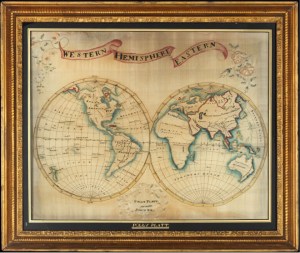
Bard Graduate Center welcomes submissions for the 2018 Mr. and Mrs. Raymond J. Horowitz Book Prize, awarded annually to the best book on the decorative arts, design history, or material culture of the Americas. The prize will reward scholarly excellence and commitment to cross-disciplinary conversation. Eligible titles include monographs, exhibition catalogues, and collections of essays in any language, published in print or in digital format. The winning author(s) or editor(s) will be chosen by a committee of Bard Graduate Center faculty and will be honored with a symposium on the subject of the book. Submissions must have a 2018 publication date.
Three copies of each print title should be sent to the below address along with an entry submission form. For digital publications, please email a copy of the form along with a link to the publication and a PDF of the publication to horowitz.prize@bgc.bard.edu.
Horowitz Book Prize Committee
Bard Graduate Center
38 West 86th Street
New York, NY 10024
Submissions must be postmarked by March 1, 2019. There is no limit to the number of submissions, but please note we are unable to return items submitted for review. Incomplete submissions will not be considered. Shipping is the responsibility of the applicant and we are not able to confirm receipt of submissions. The winning title will be announced in later summer 2019.
For questions, contact Laura Minsky, Assistant Director for Research Programs, at horowitz.prize@bgc.bard.edu.
In 1966, Samuel Shore, head of Shorewood Publishers in New York, commissioned Salvador Dalí (1904–1989) to commemorate the twentieth anniversary of the founding of the State of Israel in 1948. Such a commission was not uncommon for the artist. In fact, from approximately 1965 to 1979, the artist’s output was largely comprised of painted works on paper, completed on commission and made expressly for production as limited-edition prints.
The Shore commission was for a series of twenty-five paintings depicting the renewal of the Jewish people. Dalí completed his mixed media paintings in gouache, watercolour, and Indian ink on paper; the paintings were then reproduced as lithographs and published in a limited edition of 250 sets of twenty-five lithographs each. Dalí took inspiration from both the Hebrew Bible as well as contemporary history to address a variety of subject matter related to Jewish history and diaspora, spanning the course of over 2,000 years. Titled Aliyah, a Hebrew word that literally means ‘migration to the land of Israel’, the series was completed in 1968 in time for the celebration of Israeli Independence Day on April 3. Following their exhibition in 1968 the paintings and prints were offered for sale and dispersed; there are only a handful of complete sets known today. This rare complete set is shown for the first time since its acquisition by the Meadows Museum in 2017.
The set was generously given to the Museum by Linda P. and William A. Custard in celebration of Meadows Museum advisory council member Janet Pollman Kafka, and her twentieth year as Honorary Consul of Spain in Dallas.
The painter’s study. Estudio del pintor. Private collection, Madrid. Photo: María Bisbal.
Hernán Cortés Moreno (Cádiz, 1953) has succeeded in renewing the genre of Spanish portraiture by introducing to it elements of abstraction, pop art and cinematography. This exhibition of some 130 portraits of key individuals important to the history, politics and culture of Spain over recent decades and includes a portrait of Sir John Elliott, the historian of Spain and the Americas and Emeritus President of ARTES. Other sitters include the former Socialist prime minister, Felipe González, the historian, physician and philosopher Gregorio Marañón and the British-born architect Norman Foster as well as friends and family members from the 1980s onwards.
Click here for more information, and here for the artist’s website
The latest version of InformARTES, our annual newsletter, is now available online. It records the events we organised and the scholarships we awarded in 2018, and contains a detailed listings of forthcoming exhibitions and new books in the field of Spanish and Latin American art and visual culture.
We hope InformARTES will inspire you to join us or renew your membership — please click here for more information. All our best wishes for 2019!
This exhibition marking the 110th anniversary of Bilbao’s Museo de Bellas Artes aims to provide a path through the museum’s collections via a display of 110 works selected by the writer Kirmen Uribe (born1970), using alphabetically ordered words composed in four languages, Basque, Spanish, English and French, to contextualise the works. In this way Uribe wishes to fuse art and literature. The show brings together paintings by Cranach the Elder, Martin de Vos, Orazio Gentileschi, Gauguin, Mary Cassatt, and Francis Bacon, with masterpieces by Ribera, Murillo, Francisco de Zurbarán, Goya, Sorolla, Ignacio Zuloaga, Eduardo Chillida, Jorge Oteiza, and Antoni Tàpies. Works on paper by artists such as Hockney are shown with sports posers by Arteta. The show inaugurates the newly remodelled rooms 1-31 in the old building.
The Centro de Estudios Europa Hispánica and the Center for Spain in America (CSA) encourage studies on Spanish history, art and literature by establishing doctoral and postdoctoral scholarships at European and American universities, as well as at research centres whose holdings are particularly relevant to the knowledge of Spanish culture. They likewise establish assistantships for curatorial work at museums with significant holdings of Spanish painting.
The following doctoral scholarships are currently open for applications:
The exhibition Southern Geometries, from Mexico to Patagonia celebrates the wealth of color and diversity of styles in the geometric art of Latin America, bringing together 250 artworks made by over 70 artists from the Pre-Columbian period to present. Including modernist abstract art, sculpture and architecture as well as ceramics, weaving, and body painting, the exhibition explores the wide range of approaches to geometric abstraction in Latin America, whether influenced by Pre-Columbian art, the European avant-garde or Amerindian cultures. Southern Geometries weaves visual relationships among diverse cultures and regions across time, inviting visitors to discover the vibrant patterns and designs of Latin American art.
The V&A’s Cast Courts have been recently renovated (a project lasting nearly ten years in total), and re-opened to the public on 1 December.
ARTES members are invited to meet on 17 December at 10.30 am in room 46a at the Victoria and Albert Museum for a talk on the Spanish casts in the galleries.
The tour will be given by Holly Trusted, ARTES Hon Vice-President and Lead Curator of the Cast Courts. We will look at a number of these important and fascinating plaster copies, including the Portico de la Gloria from Santiago de Compostela and the Romanesque sculptures from Oviedo and Santo Domingo de Silos.
This event is free for members. Please email artesiberia@gmail.com to book a place.
Non-members are welcome to attend for a nominal fee. Please click here to buy a ticket. Please click here to discover the benefits of joining ARTES and become a member.
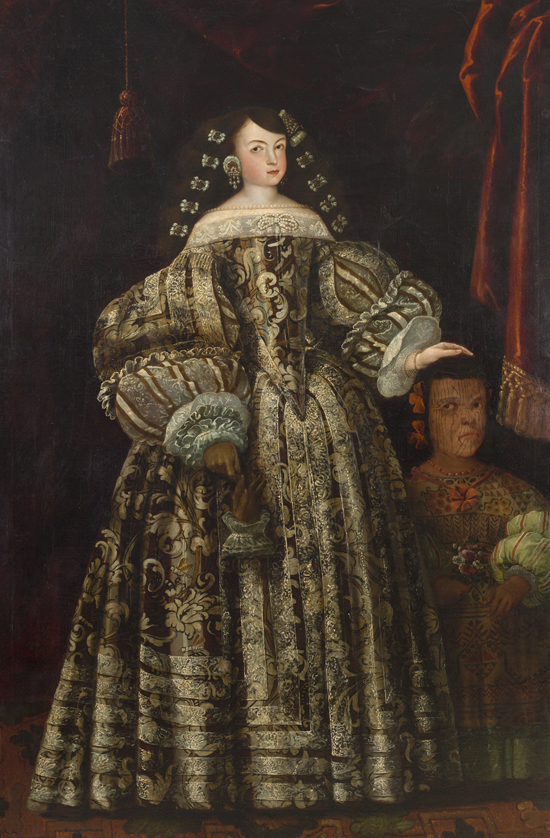
Curated by Andrés Gutiérrez Usillos, this exhibition focuses on an anonymous portrait of c. 1670. The work represents Doña María Luisa de Toledo, daughter of the Marquis of Mancera, Viceroy of New Spain, accompanied by a tattooed Indigenous woman. The show explores the world of the women portrayed in the painting, for example by reconstructing Doña María Luisa de Toledo’s trousseau, composed mainly of American and Asian items acquired in Mexico. The presentation thus analyses the clashes and encounters among the different worlds which coexisted in Viceregal America from a rare female perspective.
Click here for more information, and here for an exhibition brochure.
My name is Pablo Ordás and I was granted an ARTES Coll & Cortés Travel Scholarship to conduct research in the UK. Thanks to this scholarship I was able to spend three weeks (22/10/2018–10/11/2018) at The British Library, researching Spanish manuscripts closely related to my previous PhD research, dedicated to ‘The Gothic Cloister in the Kingdom of León: Spaces, Destinies and Images’.
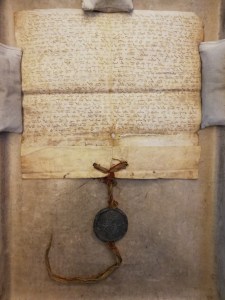
British Library, Add Ch 24807. Copyright: British Library
The British Library houses a small but very interesting collection of Spanish charters (Add Ch 24802–24815 & 24819) that date back from the reign of Alfonso IX of León (†1230) to a papal confirmation of Innocent VIII (†1492). Because of my previous research I was especially interested in the two confirmation of privileges granted by Alfonso XI, for different reasons: Add Ch 24805 preserves the lead seal of the king, something exceptional since most of the documents were stripped of their seals in the following centuries; Add Ch 24807 is a confirmation of previous privileges that were confirmed by the king’s father, Fernando IV (†1312) and that date back to his grandfather Sancho IV (†1295). Remarkably, the first 9 lines of the latter document are a series of intitulationes that describe the original documents. Another interesting aspect is that this charter was given during the tutorship of the infantes don Pedro and don Juan, Alfonso XI’s uncle that died in the Disaster of the Vega de Granada in 1319. The rarity of royal confirmations during the minority of age of the king and this first tutoría (1312–1319) make this document exceptional.
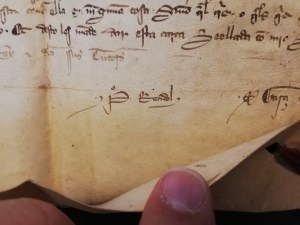
Detail of British Library, Add Ch 24807. Copyright: British Library
A real surprise came under the fold at the bottom of the parchment, where the name of Pedro Rendol is mentioned. Pedro Rendol is a somewhat obscure character that paid an important role in the rebellion of 1296 when infante don Juan el de Tarifa (†1319) and Alfonso de la Cerda (†1333) claimed the crowns of León and Castile respectively. Apparently don Juan was crowned at León, with the agreement of the clergy and the city council, thanks, among others, to Pedro Rendol. When the rebellion was suppressed and Fernando IV punished its most important leaders, Pedro Rendol’s possessions were confiscated but he managed to remain a relevant player in Castilian politics. His presence in this royal charter, next to his former patron infant don Juan, proves it.
Add Ch 28406 is the testament of Doña Blanca de Portugal, abbess of the monastery of Las Huelgas de Burgos. I was interested in the fragments of a wax pendant seal that are still attached to the silk threads hanging from the document. The condition of wax seals such as this is generally worse than that of lead seals. This example no exception: the seal is broken and only the upper half is preserved.
Finally, I was able to work with a very remarkable manuscript, the Primera Partida by king Alfonso X (Ms Add 20787). The miniatures of this manuscript have been barely studied and only a monography from the 1970s (Juan Antonio Arias Bonet, Alfonso X el Sabio: Primera Partida según el manuscrito Add. 20.787 del British Museum, Valladolid, 1975) is dedicated to this exceptional book. The volume is illuminated with 26 miniatures, from capital letters (7) to vignettes (19) that are used as visual representations of the following tituli.
The Law Code of King Alfonso X (‘el Sabio’), Primera Partida, British Library, Add 20787. Copyright: British Library
The book is usually related to the same workshop that illuminated the most famous of Alfonso’s literary productions, the Cantigas de Santa María. However, some questions arise from a study of the manuscript’s miniatures: no traces of the Cantigas’ characteristic frames with royal arms are present in the British Library manuscript; illustrations related to the reigns of Alfonso X’ (1252–1284) and his son Sancho IV (1284–1295), always depict the the king beardless, something that would become common under the reigns of Fernando IV (1295–1312) and Alfonso XI (1312–1350). Could this be a later manuscript that follows the aesthetic path of the Cantigas? A deeper study should be undertaken in order to answer this question. So far we can only attest to the importance of the volume’s iconography and the close relationship between the miniatures and the text.
I am sure that these documents will make my research richer and I will be able to include this information in my future research. The charters related to Alfonso XI and Doña Blanca are of particular importance for the history of León cathedral.
To conclude, I am indebted to Dr. Tom Nickson from The Courtauld Institute for his support and guidance, and for organising the seminar Art, music and ceremony in Medieval Castile at Trinity College (Cambridge, 29/10/2018) while I was in the United Kingdom. Finally, I would like to express my sincere gratitude to ARTES and Coll & Cortés for their generous support, without which this stay would have been impossible.

 Bard Graduate Center welcomes submissions for the 2018 Mr. and Mrs. Raymond J. Horowitz Book Prize, awarded annually to the best book on the decorative arts, design history, or material culture of the Americas. The prize will reward scholarly excellence and commitment to cross-disciplinary conversation. Eligible titles include monographs, exhibition catalogues, and collections of essays in any language, published in print or in digital format. The winning author(s) or editor(s) will be chosen by a committee of Bard Graduate Center faculty and will be honored with a symposium on the subject of the book. Submissions must have a 2018 publication date.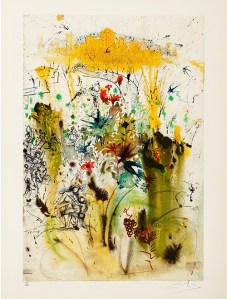

 This exhibition marking the 110th anniversary of Bilbao’s Museo de Bellas Artes aims to provide a path through the museum’s collections via a display of 110 works selected by the writer


 The exhibition Southern Geometries, from Mexico to Patagonia celebrates the wealth of color and diversity of styles in the geometric art of Latin America, bringing together 250 artworks made by over 70 artists from the Pre-Columbian period to present. Including modernist abstract art, sculpture and architecture as well as ceramics, weaving, and body painting, the exhibition explores the wide range of approaches to geometric abstraction in Latin America, whether influenced by Pre-Columbian art, the European avant-garde or Amerindian cultures. Southern Geometries weaves visual relationships among diverse cultures and regions across time, inviting visitors to discover the vibrant patterns and designs of Latin American art.
 The V&A’s Cast Courts have been recently renovated (a project lasting nearly ten years in total), and re-opened to the public on 1 December.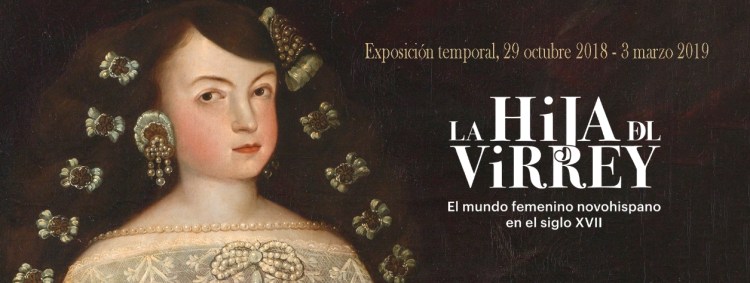

 ARTES
ARTES