Closing Soon: Lightness and Boldness. Goya’s Drawings


962b4ed1-3c56-4f33-b464-8072e75a2d5f
Francisco de Goya, I am still learning. Album G, 54
Ca. 1826. Black chalk, Lithographic crayon on grey laid paper, 192 x 145 mm.

Ligereza y atrevimiento. Dibujos de Goya, Centro Botín, Santander. Closes 24 September 2017.
One of the first exhibition’s in the  recently opened Renzo Piano designed Centro Botín, this show is curated by the Prado’s Head of Drawings and Prints, José Manuel Matilla, and the Chief Curator of the Goya and 18th-century Art Department, Manuela Mena. The exhibition includes 80 drawings, from the Prado’s holdings of some 520, selected as representative of the different periods of Goya’s artistic activity from 1796 to his death in 1828. Also shown are preparatory drawings for a selection of prints from his series, Sueños, Caprichos, Desastres de la guerra, Tauromaquia and Disparates. This exhibition is the result of an ambitious research and cataloguing project based on the drawings of Francisco de Goya, thanks to the collaboration agreement entered into by the Fundación Botín and  Prado Museum in 2014. The first volume of the catalogue raisonné is due to appear later in 2017 and a larger exhibition is provisionally scheduled at the Prado in 2019.


13th London Spanish Film Festival 2017, 21 September 2017 to 24 September 2017

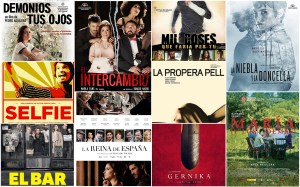
49842_i_1320spanish20film20festivalThe London Spanish Film Festival launches its 13th edition with an extraordinary line-up of recent Spanish films, most of them UK premieres and a unique opportunity to view them in London. From enigmatic thrillers to fresh comedies, from moving or poetic dramas to international coproductions, documentaries and promising shorts, this selection offers an insight into the compelling variety of Spanish cinema.

Some featured movies:

Click here for information and bookings.

Opens today: ‘Zurbarán: Jacob and his Twelve Sons, Paintings from Auckland Castle’


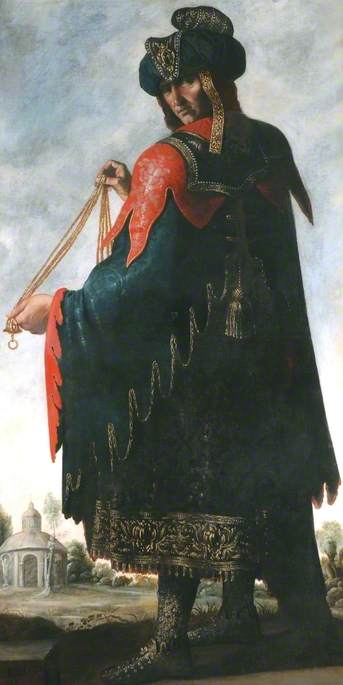
de Zurbaran, Francisco, 1598-1664; Levi III
Levi from the Auckland Castle Series

Zurbarán: Jacob and his Twelve Sons, Paintings from Auckland Castle, Meadows Museum, Dallas, USA, September 17, 2017 – January 7, 2018 

Francisco de Zurbarán was born in Fuente de Cantos, in Western Spain, but spent most of his working life in Seville. Like Ribera, Zurbarán is also considered a Caravaggista (a follower of the Italian painter Michelangelo Merisi da Caravaggio, active 1571-1610) particularly for his exceptional use of chiaroscuro.

These 13 paintings (12 by Zurbarán and one a direct copy of the work by Zurbarán) are a visual narrative of Jacob’s deathbed act of bestowing a blessing on each son, foretelling their destinies and those of their tribes. Although each painting holds its own as an exceptional portrait, seeing the works together provides a unique experience for viewers, transporting them across history to make them a witness to that moment. At the Meadows, the paintings will be displayed together in one gallery.

It is not known who originally commissioned the series, but they were auctioned from the collection of a Jewish merchant named Benjamin Mendez in 1756. Richard Trevor, Bishop of Durham, acquired the paintings for Auckland Castle, seeing in the public presentation of these works an opportunity to make a statement about the need for social, political and religious understanding and tolerance between Christians and Jews in Great Britain.

While in the USA, the paintings will also undergo in-depth technical study for the first time at the Kimbell Art Museum. This will include the use of infrared reflectography, ultra-violet light, x-radiography and pigment analysis. The goals of this work are twofold: first, to gain a better understanding of Zurbarán’s artistic process by exploring this unique series of related works; and second, to identify any additional needs for their ongoing conservation and care after they return to the U.K.

Accompanying the exhibition and conservation research will be an illustrated catalogue containing scholarly essays exploring the series from various historical, religious and artistic perspectives. Dr. Mark A. Roglán, Director, Meadows Museum, is the scientific director of the project and has helped to gather contributions by Claire Barry, Director of Conservation, Kimbell Art Museum; Professor John Barton, Oriel and Laing Professor of the Interpretation of Holy Scripture, Emeritus at Oxford University; Dr. Jonathan Brown, Carroll and Milton Petrie Professor of Fine Arts at New York University; Dr. Christopher Ferguson, Curatorial, Conservation and Exhibitions Director, Auckland Castle; Dr. Susan Grace Galassi, Senior Curator, The Frick Collection; Akemi Herráez Vossbrink, PhD Candidate at the University of Cambridge; Alexandra Letvin, PhD Candidate at Johns Hopkins University; and Dr. Edward Payne, Senior Curator, Spanish Art, Auckland Castle. This exhibition and study have been co- organized by the Meadows Museum, SMU; The Frick Collection; and Auckland Castle; in association with the Kimbell Art Museum. A generous gift from The Meadows Foundation has made this exhibition and study possible, with additional support from the Centro de Estudios Europa Hispánica and the Center for Spain in America.

ARTES EVENT: Visit to Kingston Lacy, Dorset, November 9, 2017 – RSVP by September 20

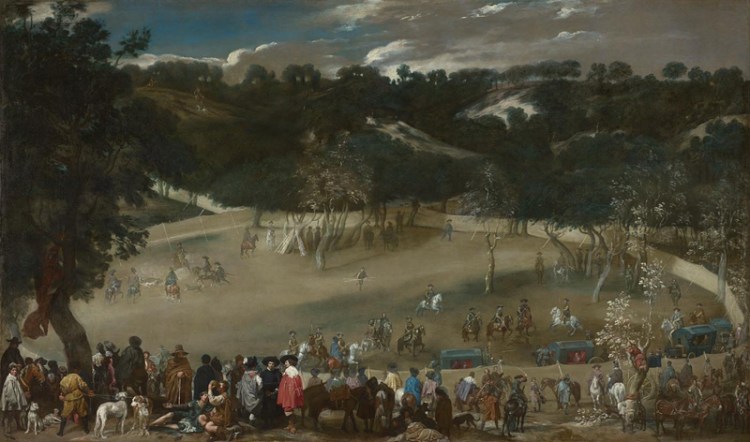
Philip IV hunting Wild Boar (La Tela Real)
Diego Velázquez, 1599 – 1660 Philip IV hunting Wild Boar (La Tela Real) probably 1632-7 Oil on canvas, 182 x 302 cm Bought, 1846 NG197 https://www.nationalgallery.org.uk/paintings/NG197 – Currently on loan to Kingston Lacey

Tour of art collection and rooms. Kingston Lacy has works by Velasquez, Tintoretto, Rubens, Van Dyck and Breughel (Visits starts at 1030 approximately)

Lunch

Visit to grounds and kitchen garden, including Japanese gardens.

Visit ends at 1600.

Those requiring lunch are requested to make a booking with the kitchen at Kingston Lacy (philip.anderson@nationaltrust.org.uk)

The visit cost per head is £14.50 for members and £20 for non-members.

National Trust Members  will have free access but may be required to pay £2.50 for the tour with the curatorial team.

Provisional train times (to be confirmed in September):

-Train out at 0720 to arrive in Poole – taxi to Kingston Lacy for 1030;
-Return journey depart KL at 1600 for 1640 train from Poole to London arr 1906

To attend, please advise Susan Wilson (susanruddwilson@sky.com) by 20 September 2017. In your email, please specify if you are a National Trust member. Please make your own booking for the train & lunch if required. 

Research Group: Research Network of Interdisciplinary Medieval Studies

logo_rede_estudos_medievaisThe Red de Estudios Medievales Interdisciplinares is the result of a collaboration between scholars researching Medieval Art at various departments of the University of Compostela, other Galician and Portuguese universities and the Instituto de Estudos Gallegos “Padre Sarmiento” del CSIC (Consejo Superior de Investigaciones Científicas).

The group welcomes scholars in Spain and abroad, and runs various research activities, for example: cultural and formative site visits, training courses, events leading to multidisciplinary publications, website articles, European research projects.

To learn more and get involved in their research activities, visit their website. 

Closing Soon: Leo Matiz (1917-1998) muralista de la lente

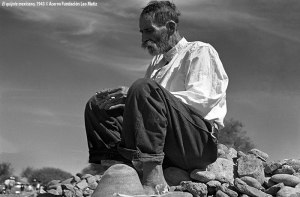
quijote-leomatizLeo Matiz (1917-1998) muralista de la lente, Antiguo Colegio de San Ildefonso, Mexico City. Closes 17 September 2017

Exhibition of 81 photographs by Colombian photographer and photojournalist Leo Matiz. Matiz established his reputation with his work in Mexico between 1941 and 1947, when he photographed artists and muralists such as Diego Rivera, Frieda Kahlo and David Siqueiros and became a close friends with José Clemente Orozco, as well as Latin American film stars and intellectuals and Spanish film directors such as Luís Buñuel. He subsequently mounted photographic campaigns in his native Colombia and in Venezuela in the 1950s, which were reproduced in periodicals such as Life and Paris Match. The exhibition also includes drawings, caricatures and Matiz’s notes to provide a context for his work.

For more information see the exhibition’s website

Featured Exhibition: Picasso/Rivera: Still Life and the Precedence of Form

mm-70-1000pxPicasso/Rivera: Still Life and the Precedence of Form, Meadows Museum, Dallas, USA, until  5 November

This focused exhibition of paintings is inspired by a work in the Meadows Museum’s collection, Picasso’s Still Life in a Landscape (1915). In the early 20th century, Picasso and the Mexican artist Diego Rivera both lived and worked in Paris. Initially friends, in 1915 they fell out because Diego Rivera accused Picasso of plagiarising the foliage from one of his own paintings.

The source of Rivera’s ire was the perceived semblance between his 1915 Zapatista Landscape (The Guerrilla) and Picasso’s Seated Man (1915-16), which in its first iteration – as seen by Rivera in another visit to Picasso’s studio in August 1915 – was known as Man Seated in Shrubbery. Rivera noted acute similarities between his canvas and that of the early state of Picasso’s work; namely, both works featured a similarly structured still life set outdoors. The Mexican artist’s very specific complaint was his former mentor’s liberal borrowing of Rivera’s formulaic foliage – scumbled patches of green and white paint on a dark ground.

Picasso/Rivera: Still Life and the Precedence of Form takes as its point of departure another case study of the two artists’ works: Picasso’s Still Life in a Landscape (1915) at the Meadows, which will be displayed for the first time with Rivera’s Still Life with Gray Bowl (Lyndon Baines Johnson Presidential Library, Austin), painted in the same year. Exhibited in close proximity, these two paintings together encapsulate the two artists’ overlapping of themes and motif appropriation during that period.

Picasso/Rivera: Still Life and the Precedence of Form affords a closer look at the development of Picasso’s Still Life in a Landscape in the Meadows collection by presenting it together with its analogue from the Columbus Museum of Art as well as Rivera’s variation on the theme from Austin. The visual dialogue taking place in 1915 between these two giants of modern art will be further outlined through the display of Rivera’s 1915 Still Life with Bread Knife, a second generous loan from the Columbus Museum of Art. Beyond the rich anecdotes regarding the relationship of the two artists, this group of paintings provides an opportunity to find parallels as well as deviations between these canvases. In spite of limited wartime resources, 1914-15 proved to be a fecund era of creativity for both Picasso and Rivera.

ARTES EVENT: Visit to Kingston Lacy, Dorset, November 9, 2017 – RSVP by September 20

Philip IV hunting Wild Boar (La Tela Real)
Diego Velázquez, 1599 – 1660 Philip IV hunting Wild Boar (La Tela Real) probably 1632-7 Oil on canvas, 182 x 302 cm Bought, 1846 NG197 https://www.nationalgallery.org.uk/paintings/NG197 – Currently on loan to Kingston Lacey

Tour of art collection and rooms. Kingston Lacy has works by Velasquez, Tintoretto, Rubens, Van Dyck and Breughel (Visits starts at 1030 approximately)

Lunch

Visit to grounds and kitchen garden, including Japanese gardens.

Visit ends at 1600.

Those requiring lunch are requested to make a booking with the kitchen at Kingston Lacy (philip.anderson@nationaltrust.org.uk)

The visit cost per head is £14.50 for members and £20 for non-members.

National Trust Members  will have free access but may be required to pay £2.50 for the tour with the curatorial team.

Provisional train times (to be confirmed in September):

-Train out at 0720 to arrive in Poole – taxi to Kingston Lacy for 1030;
-Return journey depart KL at 1600 for 1640 train from Poole to London arr 1906

To attend, please advise Susan Wilson (susanruddwilson@sky.com) by 20 September 2017. In your email, please specify if you are a National Trust member. Please make your own booking for the train & lunch if required. 

Call for papers: ‘Cultura de moda en América Latina’ Special Issue, Revista Dobras

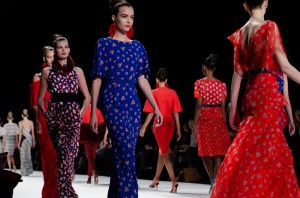
carolina_herrera_aw14_13
Carolina Herrera, AW 2014

Revista Dobrasthe Brasil’s most important academic journal dedicated to the history of fashion, is planning a special issue on fashion in Latin America for spring 2018.    Contributions (articles, reviews and interviews) in Portuguese, English, French or Italian are sought until 15 October 2017.

Possible topic include:
– Fashion as heritage in latin America: collections, museums, exhibitions of regional or artistic costumes…
– Identity and representation in Latin America fashion: identity, exoticism, colonialism, neocolonialism in fashion
– Latin America in national and international media: the representation of Latin American fashion culture in magazines, newspapers, websites, blogs, TV series and films.
– Fashion education in Latin America
– The fashion worker in Latin America: the population’s participation in the clothing industry for multinational companies.
– Fashion and politics: relations between fashion and power, between industries and consumers.
– Fashion as a profession in latin America
– Popular fashion, artists’ designs and luxury
– Fashion as craft in Latin America