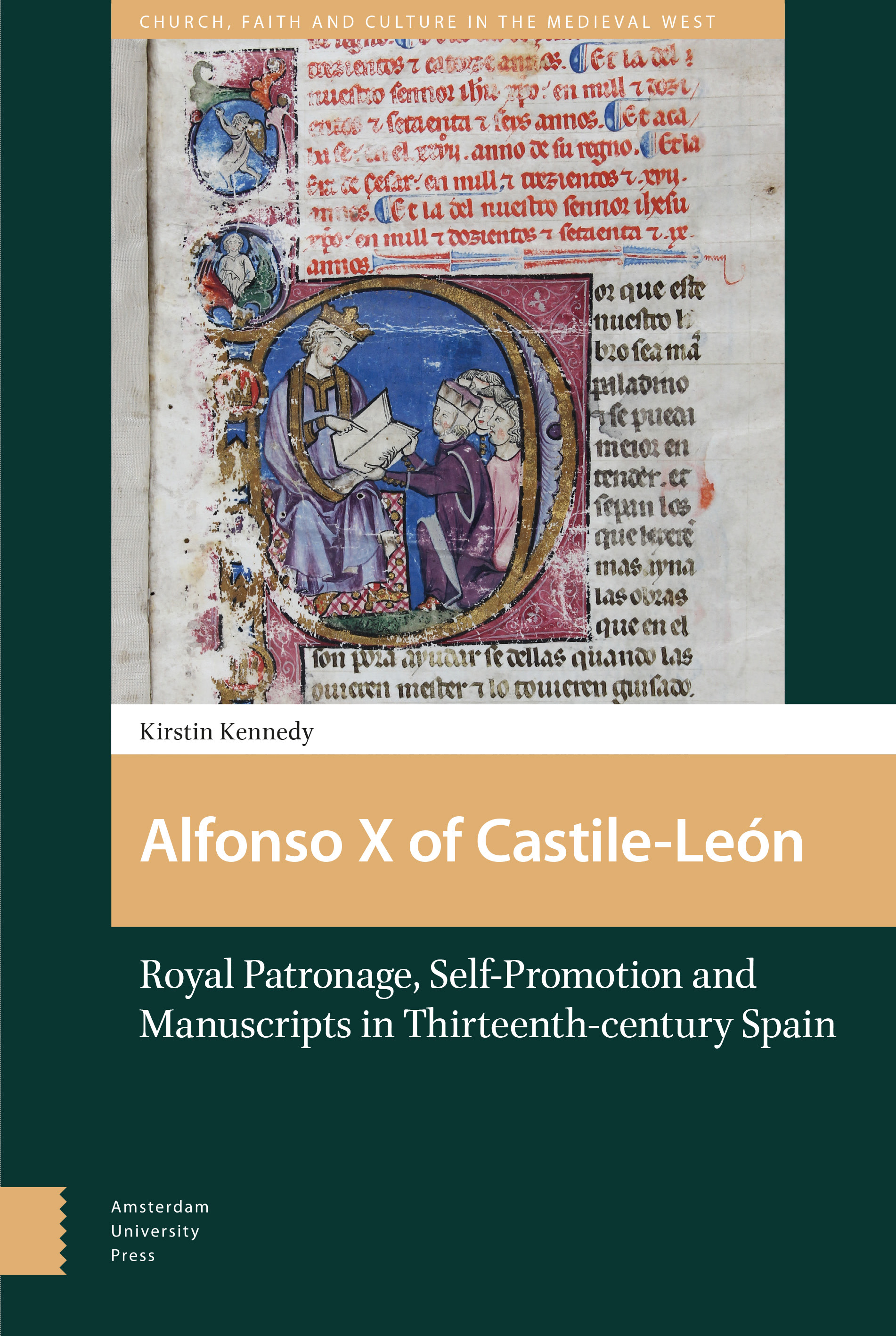
New Publication: Kirstin Kennedy, Alfonso X of Castile-León: Royal Patronage, Self-Promotion and Manuscripts in Thirteenth-century Spain (Amsterdam University Press, 2019)

Alfonso X ‘the Learned’ of Castile (1252–1284) was praised in his lifetime as a king who devoted himself to discovering all worldly and divine knowledge. He commissioned chronicles and law codes and composed poems to the Virgin Mary, he gathered together Jewish scholars to translate works of Arab astrology and astronomy, and he founded a university of Latin and Arabic studies at Seville. Moreover, according to his nephew Juan Manuel, Alfonso was careful to ensure that ‘he had leisure to look into things he wanted for himself’. The level of his personal involvement in this literary activity marks him out as an exceptional patron in any period. However, Alfonso’s relationship with the arts also had much in common with that of other thirteenth-century European royal patrons, among them his first cousin, Louis IX of France. Like his contemporaries, he relentlessly used literary works as a vehicle to promote his royal status and advance his claim to the imperial crown. His motivation for the foundation of the university at Seville was arguably political rather than educational, and instead of promoting institutional learning during his reign, Alfonso preferred to direct the messages about his kingship in the lavish manuscripts he patronized to a restricted, courtly audience. Yet such was the interest of the works he commissioned, that those who could obtain copies did so, even if these were still incomplete drafts. Three codices traditionally held to have been copied for Alfonso in fact show how this learning reserved for the few began to filter out beyond the Learned King’s immediate circle.

Kirstin Kennedy is a curator of metalwork (specializing in silver) at the Victoria and Albert Museum, London. She previously held a British Academy Post-Doctoral Fellowship at King’s College London, in the Department of Spanish and Spanish American Studies (2000–2003).

Please click here for more information.

Job: Professor and Director of the Zurbarán Centre for Spanish and Latin American Art, School of Modern Languages and Cultures Durham University, UK, deadline 17th January 2020

Responsible to: Head of Department

Grade: Grade 10

Salary Range: Competitive salary based on our professorial Pay Scales (starting at £64,606 and going considerably higher based on experience)

Working arrangements: The role is full time, but we will consider requests for flexible working arrangements including potential job shares.

Open date: 30 September 2019

Closing date: 17 January 2020 at 12pm midday     

Preferred start date: Successful candidates will ideally be in post by 01 September 2020.

We are seeking an outstanding academic leader and scholar in Spanish and Latin American Art and/or Visual Culture to direct the interdisciplinary Zurbarán Centre for Spanish and Latin American Art, a collaborative venture with The Auckland Project.

The Director will be an internationally recognised authority in her/his field who will act as an intellectual entrepreneur, developing academic contacts within Durham University, as well as nationally and internationally, and work in close collaboration with The Auckland Project’s forthcoming Spanish Gallery in Bishop Auckland – the central impetus for the creation of the Zurbarán Centre – on research, programming, and the development of joint initiatives. The Director will be located in an appropriate academic department of Durham University (Faculty of Arts and Humanities).

Auckland Castle, at the heart of The Auckland Project, is one of the most important working episcopal palaces in Europe, the seat of the Prince Bishops of Durham since the twelfth century. For more than 250 years, Auckland Castle has been home to the internationally significant cycle of masterpieces from the Spanish Golden Age, Jacob and his Twelve Sons by Francisco de Zurbarán, the inspiration for The Zurbarán Centre. Financier Jonathan Ruffer set up Auckland Castle Trust in 2012 (now The Auckland Project) to secure the future of the Zurbaráns in Bishop Auckland.

Durham University formally established the Zurbarán Centre in October 2016. The Centre’s collaboration with the Spanish Gallery will provide an unusual opportunity to combine engagement with connoisseurship of a new permanent collection with scholarship of, particularly, Golden Age art, playing to Durham University’s established strengths in Spanish and Latin American studies. The Centre is an embedded part of Durham University located in Bishop Auckland, where the Director will be primarily based.

This represents an exciting opportunity to further the ambitions of both partner organisations to become the leading home for the study and appreciation of Spanish and Latin American art. Over the past three years, the Centre has fostered research in Spanish and Latin American art in a global context, with a special focus on the art of Medieval Spain, the Spanish Golden Age, Mexican national art, the 19th-century history of collecting, and Spanish and Latin American cinema and photography.

Lunchtime Talk: Akemi Herráez Vossbrink, ‘Zurbarán: A global perspective’, National Gallery, London, 4 November 2019

Monday, 4 November 2019, 1–1.45 pm, doors open at 12.30 pm, Sainsbury Wing Theatre

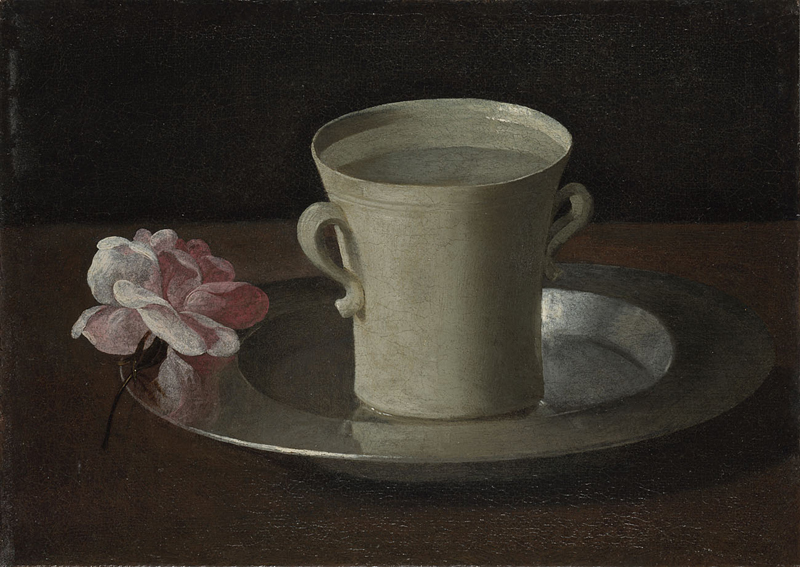
Francisco de Zurbarán, 1598–1664, A Cup of Water and a Rose, about 1630. Oil on canvas, 21.2 x 30.1 cm. Bought for the National Gallery by the George Beaumont Group, 1997. NG6566.

The National Gallery holds one of the finest paintings collections by the Spanish 17th–century artist Francisco de Zurbarán in the world. They have also recently acquired a painting by his son, Juan. Zurbarán lived in Seville, the main European port to the Americas from which he sent over 100 paintings.

Akemi Herráez Vossbrink, The CEEH Curatorial Fellow in Spanish Paintings, discusses the history of collecting Zurbarán, including paintings in their Spanish context, collecting practices in the UK, and the circulation of his work in the Americas.

This event is free and no booking is required. Spaces are limited and available on a first-come, first-served basis.

Click here for more information.


Opens Today: Alonso Berruguete: First Sculptor of Renaissance Spain, NGA, Washington DC, until 17 February 2020

Alonso Berruguete: First Sculptor of Renaissance Spain will be the first major exhibition held outside Spain to celebrate the expressive art of the most important sculptor active on the Iberian Peninsula during the first half of the 16th century, Alonso Berruguete. The exhibition will present an impressive range of more than 40 works from across his career, including examples of his earliest paintings from his time in Italy, where he trained. His abilities as draftsman will also be celebrated with the largest group of his drawings ever to be assembled. The primary focus will be on his painted sculptures in wood, which generally decorated large altarpieces, or retablos. The Museo Nacional de Escultura in Valladolid, Spain, will be lending a substantial group of some of his very best figures. A section of one of his altarpieces will be loosely reconstructed in the exhibition to convey an idea of how his sculptures were originally seen.

The exhibition is curated by C. D. Dickerson III, curator and head of sculpture and decorative arts, National Gallery of Art, Washington.

A fully illustrated catalog accompanying the exhibition will be the first general book on Berruguete published in English and will feature essays by Dickerson as well as Manuel Arias Martínez, deputy director, Museo Nacional de Escultura, Valladolid, and Mark McDonald, curator of Italian, Spanish, Mexican, and early French prints and illustrated books, The Metropolitan Museum of Art. The exhibition was organized by the National Gallery of Art, Washington, and the Meadows Museum, SMU, Dallas.

It will travel to the Meadows Museum, Southern Methodist University, Dallas, from March 29 to July 26, 2020.

Click here for more information.

Maius Workshop Welcome Meeting: Gordon House, London, 10 October 2019, 6:00pm

The Maius Workshop returns for the 2019–20 academic year!

Please join us for an informal welcome meeting, which will take place on Thursday 10 October, 2019, at 6:00pm in Room 209 in Gordon House, 29 Gordon Square, Bloomsbury, London WC1H 0PP (at UCL, but just outside the main campus: click here for directions)

This event is open to anyone interested in pre-modern Hispanic cultures, widely considered: literature and language, history, geography, art and visual culture, medical humanities, music, etc., from Iberia, the Americas, and other Spanish and Portuguese colonies and communities. PhD candidates and ECRs from London universities and beyond are especially invited.

The Maius Workshop’s organisers, Costanza Beltrami, Bert Carlstrom and Elizabeth Chant, will introduce the group and events planned for the coming academic year. It will be an opportunity to meet people with similar research interests working at other universities and departments.

If you would like to attend, please register on Eventbrite: click here.

Image caption: Joaquín Domínguez Bécquer, ‘La Feria de Sevilla’, 1867. Colección Carmen Thyssen-Bornemisza en préstamo gratuito al Museo Carmen Thyssen Málaga, © Colección Carmen Thyssen-Bornemisza. Source: Wikimedia Commons, https://commons.wikimedia.org/w/index.php?curid=21170539

New Publication: Carmen Fracchia, ‘”Black but Human” Slavery and Visual Arts in Hapsburg Spain, 1480–1700’ (Oxford and New York: Oxford University Press, 2019)

In ‘Black but Human’ Carmen Fracchia, Reader in Hispanic Art History at Birkbeck, explores the emergence of the slave and freed slave subjects in the visual form of Imperial Spain. The book considers the links between visual regimes and early modern Spanish discourses on slavery and human diversity that are the historic roots of contemporary racism in the Hispanic world.

‘Black but Human’ is the first study to focus on the visual representations of African slaves and ex-slaves in Spain during the Hapsburg dynasty. The Afro-Hispanic proverb ‘Black but Human’ is the main thread of the six chapters and serves as a lens through which to explore how a certain visual representation of slavery both embodies and reproduces hegemonic visions of enslaved and liberated Africans, and at the same time provides material for critical and emancipatory practices by Afro-Hispanics themselves.

The African presence in the Iberian Peninsula between the late fifteenth century and the end of the seventeenth century was as a result of the institutionalization of the local and transatlantic slave trades. In addition to the Moors, Berbers and Turks born as slaves, there were approximately two million enslaved people in the kingdoms of Castile, Aragón and Portugal. The ‘Black but Human’ topos that emerges from the African work songs and poems written by Afro-Hispanics encodes the multi-layered processes through which a black emancipatory subject emerges and a ‘black nation’ forges a collective resistance. It is visually articulated by Afro-Hispanic and Spanish artists in religious paintings and in the genres of self-portraiture and portraiture. This extraordinary imagery coexists with the stereotypical representations of African slaves and ex-slaves by Spanish sculptors, engravers, jewellers, and painters mainly in the religious visual form and by European draftsmen and miniaturists, in their landscape drawings and sketches for costume books.

Click here for more information and to pre-order this book

Lecture: Isabelle Kent, ‘“The aura of popularity”: Collecting Murillo in Britain and Ireland’, The Wallace Collection Lecture Theatre, London, Monday, 30 September 2019, 5.30pm

New Exhibition and CEEH Publication: VALENTÍN CARDERERA Y SOLANO, Biblioteca Nacional de España, Madrid, September 27, 2019 – January 12, 2020

VALENTÍN CARDERERA Y SOLANO (Huesca, 1796 – Madrid, 1880) was a painter, scholar, communicator, collector and traveller. His life was marked by his efforts to safeguard Spain’s historical heritage and he journeyed around much of the Spanish mainland to bear witness in his drawings and watercolours to significant monuments, many at risk of disappearance as a result of the modernising drive ushered in by the new liberal order. Member of the Romantic generation and friends with the Madrazo family, Carderera was also in contact with some other figures like Richard Ford and Prosper Mérimée, with whom he shared the same nostalgia for the past and the need to define his position in the complex debate between tradition and progress.

The exhibition—featuring more than a hundred pieces including paintings, drawings, engravings, manuscripts, books, maps and objects—pays tribute to Carderera’s work and the significant legacy he left in the Biblioteca Nacional de España. In 1867 the Spanish State adquired his collection of drawings and prints: more than 45.000 pieces which enriched the department of Fine Arts with engravings of Mantegna, Dürer and Rembrandt, among others, along with one of the very few drawings attributed to Velázquez. Click here for more information.

The exhibition opens on 27 September in the Biblioteca Nacional de España’s Sala Hipóstila. It was curated by José María Lanzarote Guiral and organised by the Biblioteca Nacional de España and Centro de Estudios Europa Hispánica.

It is accompanied by a an exhibition catalogue which reconstructs Carderera’s intense life in six thematic sections, published by CEEH. Until 25 September, the catalogue can be purchased from the CEEH website at special discount price. Click here for more information.

Workshop and Lecture: Music of the Three Andalusias, The Warburg Institute, London, 27 September 2019, 14:00–19:00

Workshop: 14:00–16:00
Lecture and reception: 17:00–19:00  

A lecture and recital by musician, writer and teacher Marc Loopuyt on Muslim, Jewish and Christian music of Medieval Spain, focusing on the rabab and the oud, and on articulation techniques. Articulation in stringed musical instruments from the East will be put in relation with Paganini’s Suonare Parlante, with bird song and the mythical language of the birds. 

The evening lecture will be preceded by an afternoon workshop on the practical foundations of traditional mode based improvisation and ornamentation—details to be finalised. 

Born in France in 1947, with French, Dutch, English and Caucasian roots, Marc Loopuyt discovered the flamenco guitar via immigrant Spanish workers, and subsequently spent three years in Spain learning how to play it. Interested in the strong “colours” in flamenco singing, he crossed the Mediterranean and settled for nine years in Morocco, learning to play the oud. Attracted by the art of the Turkish master Cinuçen Tanrıkorur, he became his disciple and spent many years travelling and living in Turkey and the Middle East, as well as staying for one year in Azerbaijan with the singer Agha Karim Bey. Marc Loopuyt taught for 25 years in the Music Conservatory of Lyon, and has published, performed and recorded widely.

Click here for an excerpt from his flamenco-influenced piece Farruca
Supported by the Cassal Trust, the Matheson Trust.

Click here for more information about this event


Workshop: Science and Nature in Latin America (18th–20th century), University College London, 17 September, 15:00–17:00

Science and nature event poster

In the context of Latin America, traditional History of Science discourses have tended to focus on European actors and their agency. This interdisciplinary workshop will elucidate new and emerging perspectives on the history and theories of science, nature, and the enviornment in the region. By doing so, the workshop hopes to further develop the critical discussion around knowledge production and transfer in Latin America. Our speakers will all offer responses to the following key questions, using examples from their own research:

What can your research say about hierarchies of power and knowledge in Latin America?

What does the History of Science and Nature in Latin America say or contribute to the history of the region in a broader sense?

Participants:

Nicola Miller (UCL)

Helen Cowie (University of York)

Lesley Wylie (University of Leicester)

Sophie Brockmann (De Montfort University)

Ximena Urbina (Pontificia Universidad Católica de Valparaíso)

A discussion will follow the individual presentations, and the event will conclude with a free drinks reception. All welcome.

This event is organised by Elizabeth Chant. Please contact natalia.gandara.16@ucl.ac.uk or elizabeth.chant.17@ucl.ac.uk for further information. Free and open to all, please click here to book your place.