Featured exhibition: Pedro Masaveu: Pasión por Sorolla, Centro Niemeyer, Avilés, until 6 January 2019

Image result for Mi mujer y mis hijas en el jardín sorollaThe exhibition Pedro Masaveu: Pasión por Sorolla, at the Fundación María Cristina Masaveu Peterson of the Centro Niemeyer, Avilés (28 July 2018–6 January 2019), commemorates the 25th anniversary of the death of Pedro Masaveu Peterson (1938–1993). This patron of the arts demonstrated a particular passion for the painter Joaquín Sorolla (1863–1923), one of the most innovative and prolific figures of modern Spanish art. Complemented by works from the Masaveu Collection at the Museo de Bellas Artes de Asturias, Pedro Masaveu’s outstanding collection of works by Sorolla will be on display for the first time in this exhibition.

Click here for more information.

Conference: Gotik global – kolonial – postkolonial, Dresden, October 26–7, 2018

prac3a7a_da_se_03Gotik global – kolonial – postkolonial: Gotisierende Sakralarchitektur auf der Iberischen Halbinsel und in Lateinamerika vom 19. bis zum 21. Jahrhundert
Dresden, Technische Universität, Institut für Kunst und Musikwissenschaft, Raum ABS/E08/H, 26. – 27.10.2018
Tagung der Technischen Universität Dresden, Institut für Kunst- und Musikwissenschaft der Philosophischen Fakultät in Zusammenarbeit mit der Carl Justi-Vereinigung e.V.

Immer wieder werden im iberischen und iberoamerikanischen Raum – wie weltweit –  auch heute noch gotisierende Kirchen errichtet. Einige sind typisch für die Neugotik, andere, wie die Almudena-Kathedrale in Madrid oder diejenige von Vitoria-Gasteiz, scheinen als verspätete Bauten des 20. Jahrhundert aus europäischer Sicht aus der Zeit gefallen zu sein. Doch wird gerade in Lateinamerika bis heute an zahlreichen solcher Projekte weitergebaut.
So scheint es zunächst sinnvoll zu überprüfen, ob die stillschweigende Annahme, „die Gotik“ sei eine abgeschlossene Stilepoche, aus globaler Perspektive überhaupt stimmt. Wie ging die zweifellos zunächst kolonial begründete Gotik-Ausbreitung in den überseeischen Gebieten der ehemals spanischen und portugiesischen Weltreiche in eine eigene postkoloniale Adaption über, welche Gründe gab es hierfür und welche stilistischen Ausprägungen wurden und werden gefunden? Wie begann die Entwicklung in den „Mutterländern“? Ist sie dort und in den ehemaligen Kolonien ähnlich oder unterschiedlich verlaufen, gibt es fortdauernde Verbindungen? Lassen sich Parallelen in anderen Weltregionen beobachten? Sind die Phänomene alleine auf die Gotik beschränkt oder gibt es Parallelen für andere Stile?
Im Workshop der Carl Justi-Vereinigung e.V. soll diese Problematik stichprobenartig untersucht werden. Denn ein systematischer Gesamtüberblick ist zur Zeit kaum möglich, sind doch nicht einmal die potenziell wichtigsten Bauten bekannt.

PROGRAMM:
FREITAG, DEN 26.10.2018

Eröffnung / Begrüßung / Einführung
9.30 Uhr
Grußworte
Prof. Dr. Antonio Hurtado (Dresden), Prorektor der TU Dresden
Prof. Dr. Lutz Hagen (Dresden), Dekan der Philosophischen Fakultät
Prof. Dr. Margit Kern (Hamburg), Vorstand der Carl Justi-Vereinigung e.V.

10.00 Uhr
Bruno Klein (Dresden): Gotische Architektur des 20. und 21. Jahrhunderts –
global – kolonial − postkolonial

10.45 Uhr
Pablo de la Riestra (Nürnberg/Buenos Aires): Einmal Gotik – immer Gotik

11.30 Uhr Pause

Von der Neugotik zur Moderne:
Kastilische und katalanische Beispiele
12.00 Uhr
Henrik Karge (Dresden):
Vicente Lampérez y Romea – Gotik als Idealbild und historisches Phänomen

12.45 Uhr
Judith Urbano (Barcelona): La finalización de la Catedral de Barcelona y otros proyectos neogóticos de Augusto Font y Carreras

13.30 Uhr Pause

15.30
Joan Molet Petit (Barcelona):
Las interpretaciones del gótico en la obra del arquitecto Josep Vilaseca, entre lo arqueologista y lo victoriano

16.15 Uhr
Sergio Fuentes Mila (Barcelona): Revisitar el gótico en la arquitectura civil barcelonesa de finales del siglo XIX. El caso del arquitecto José Doménech y Estapá (1858-1917)

17.00 Uhr
Bettina Marten (Bonn/Dresden): Considerations on the Almudena-Cathedral at Madrid

18.00 Mitgliederversammlung der CJV

20.00 Uhr
Gemeinsames Abendessen

SAMSTAG,  DEN 27.10.2018

Die „moderne“ Neugotik in Lateinamerika
10.00 Uhr
Bruno Klein: Einführung

10.15 Uhr
Martín Checa Artasu (Mexiko-Stadt/Barcelona):
The religious orders as diffusers of the neo-gothic architecture in Latin America

11.00 Uhr
María Aranda Alonso (Madrid/Dresden):
El templo de la Merced de San José de Costa Rica : Punto de partida para estudiar el neogótico en Centroamérica

11.45 Uhr
Paula Vermeersch (São Paulo):
O processo construtivo da Catedral da Sé, São Paulo, 1911-1954

12.30 Uhr
Barbara Borngässer (Dresden):
Neugotik und Moderne im Süden Brasiliens: Die Kirchenbauten Gottfried Böhms

13.15 Uhr
Abschlussdiskussion

16.00 Uhr
Besichtigung aktueller „gotischer“ Architektur in Dresden (Schlosskapelle,  Sophienkirchen-Monument)

Kontakt:
bruno.klein@tu-dresden.de
barbara.borngaesser@online.de
bettina.marten1@tu-dresden.de

Opens today: Bartolomé Bermejo at the Prado Museum, Madrid

d157b0ca-7d78-4246-af56-46820d6c60b5

Open until 27 January 2019, this exhibition explores the career of Bartolomé Bermejo, one of the most fascinating figures within Spanish art of the second half of the 15th century. Bringing together a remarkable group of paintings from Spanish, European and American museums, the Prado is able to present this survey exhibition, which has been organized with the collaboration of the Museu Nacional d’Art de Catalunya and, for the first time, allows for an appreciation of the technical virtuosity and distinctive visual universe of this Cordovan painter active in the Kingdom of Aragon.

For more information, click here.

CFP: The Saint Enshrined: European Tabernacle-altarpieces, c.1150-1400, Valladolid, June 7–8, 2019

unspecified
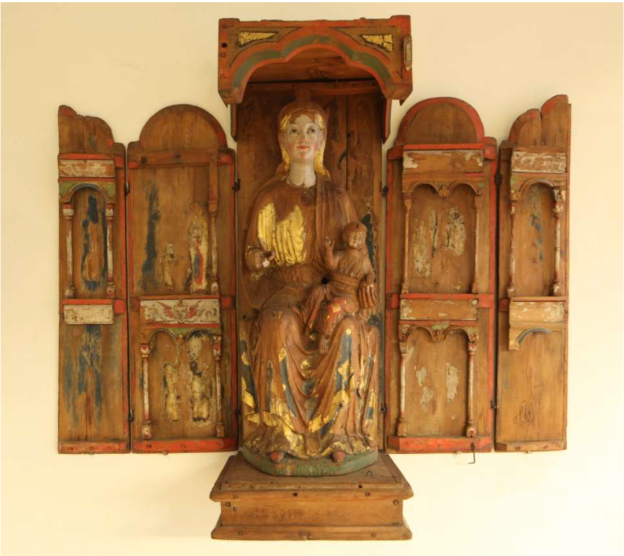
 Tabernacle-shrine from Mule,
Iceland, now in the Nationalmuseet
in Conpenhagen; c.1250.
Photo: Justin Kroesen

Almost every Medieval church had one or more sculptures of saints, many of which were placed on altars, in wall niches or in so-called tabernacle-altarpieces. This last category refers to three-dimensional, canopied structures, embellished with bright colours and equipped with movable wings that housed cult images of the Virgin and Child or saints. This early type of altarpiece became widespread in Europe between c.1150 and 1400. Nowadays, examples are scarce and often fragmented, overpainted and reconstructed. Most of them come from the geographical periphery of Europe and almost all of them are now without their original context, as they hang on museum walls or in churches as isolated relics.

The purpose of this international symposium is to explore and discuss early tabernacle-altarpieces in different regions of Europe: their provenance, patronage, function, and role in popular piety. We invite speakers to submit proposals for 15-minute papers to be presented during the symposium. Proposals should go beyond case studies and look at such topics as the use and re-use of tabernacle-altarpieces, media involved in their creation, regional differences, etc.

How to Submit: Proposals of c.300 words should be submitted to Fernando Gutiérrez Baños, fbanos@fyl.uva.es.

Deadline: Friday 18th of January 2019.

All proposals will be examined by the Scientific Committee. It is hoped that an edited volume of the symposium proceedings will be published. Successful candidates will be offered free registration.

SCIENTIFIC COMMITTEE: Fernando Gutiérrez Baños, Universidad de Valladolid; Justin Kroesen, Universitetsmuseet i Bergen; Elisabeth Andersen, Norsk institutt for kulturminneforskning.

KEYNOTE SPEAKERS: These will include members of the Scientific Committee; Stephan Kemperdick, Staatliche Museen zu Berlin, Gemäldegalerie; Teresa Laguna Paúl, Universidad de Sevilla; Cristiana Pasqualetti, Università degli Studi dell’Aquila; and Alberto Velasco Gonzàlez, Museu de Lleida: diocesà i comarcal.

PROGRAM (PROVISIONAL): Friday 7th  of June, session held in the Universidad de Valladolid (Facultad de Filosofía y Letras, Sala de Juntas); Saturday 8th  of June, field trip to sites in the Diocese of Vitoria.

Call for Articles: The Iberian Peninsula under Debate: Historiography, Cultural Encounters and Identities (5th-16th centuries)


3fdd18_e3c4b86dab8c4e8eba5b868b2c2d518cmv2
A Sé Velha de Coimbra, por Roque Gameiro (1917)

Roda da Fortuna. Revista Eletrônica sobre Antiguidade e Medievo (Electronic Journal about Antiquity and Middle Ages) seeks submission for a thematic dossier, “The Iberian Peninsula under Debate: Historiography, Cultural Encounters and Identities (5th-16th centuries).”


Heiress of the Hispanic-Visigothic tradition, the territorial organization of the Iberian Peninsula was the result of a singular historical reality. The Muslims’ invasion of the region in the 8th century intensified the cultural heterogeneity already existing in the region, adding to political-religious conflicts and an ever-changing border. This state of hostility and also, at various moments, of interaction solidified in the experience of Al-Andalus. This peculiar region offers an important and broad interpretative possibility. With the advance of the Christian frontier after the formation of the Portuguese kingdom and the conquests of Cordova (1236) and Seville (1248), the map of the Peninsula changed definitively.

This thematic dossier intends to gather articles that discuss the Iberian experience during the Middle Ages, up to what has been defined as “maritime expansion” in modern historiography. Encompassing multiple research possibilities and varied approaches in such fields as representations, identities, and religious confessions, the debates on the Iberian worlds constitute an enormous challenge to the historian.

The deadline for submitting articles, reviews, and translations are:
– Submission of proposals: until April 30, 2019
– Acceptance of works: July 2019
– Dossier published: August 2019

Proposals must be sent to the e-mail: revistarodadafortuna@gmail.com 

Click here for more information.


ARTES Members’ Visit to the Año Murillo in Seville (30 November – 2 December 2018)

murillo

ARTES have organised a trip to Seville for members from 30th November to 2nd December 2018, the main aim being a curator-led tour of the exhibition Murillo IV Centenario, opening that week, as well as visits to the Cathedral, Hospital de los Venerables and de la Caridad, Alcázar, Casa de Pilatos and other sites of art historical significance.

Members must make their own travel and accommodation arrangements but should plan to arrive by Friday evening. A full programme (from Friday night to Sunday early evening) will be posted nearer the time.

murilloII

 ARTES members wishing to join the trip should RSVP to artesiberia@gmail.com.    Places will be limited to 15 and will be allocated on a first come first serve basis.*

*We may ask for a deposit to secure a place with the money put towards the cost of dinner on Saturday night.


Images: Moses Striking the Rock at Horeb, c. 1669–70, oil on canvas, 263 x 575 cm, Seville, Hospital de la Santa Caridad

Jesus Multiplies the Loaves and Fishes, c. 1669–70, oil on canvas, 263 x 575 cm, Seville, Hospital de la Santa Caridad

Conference: Performing Otherness: a Postcolonial Approach to Francoist Spain Performing Otherness: a Postcolonial Approach to Francoist Spain, Edinburgh College of Art, October 26, 2018

image001
Photomontage by Jean Harold, sent to Picasso by Jean Cocteau and captioned, on the back: by “Picasso – Negro period”

This international symposium opens up discussion of Spanish art and culture in relation to the construction of discourses of coloniality in 20th-century Spain, especially in the Francoist period.

It attempts to identify methodological approaches that would allow us to understand the consolidation of hegemonic colonial discourses and how they continue in Spain today. This examination involves an analysis of constructs of Otherness in two directions – inwards and outwards. On the one hand, how did artists, performers, writers, or other cultural brokers, based in Spain, exoticise other cultures as well as their own culture as part of official rhetoric (e.g. state-funded exhibitions relating to colonial territories in Africa; translations of Chinese texts/images, state administration of rural Spain). On the other hand, the analysis is concerned with Spanish (self-)representation as Other within international contexts (eg. Picasso in African attire; flamenco in imagery for tourism/political campaigns; Hispanic Studies as a political contestation to the dictatorship).

Organisation: María Iñigo Clavo (Universitat Oberta de Catalunya) of the R&D Research Group “Experiences of the Political in Francoist Spain” (MINECO) with Claudia Hopkins in the School of History of Art, University of Edinburgh.

Schedule

9am – 9.30am: Registration

9.30am – 10am: Welcome and introduction, Yayo Aznar (Universidad Nacional de Educación a Distancia) and María Iñigo Clavo (Universitat Oberta de Catalunya)

10am – 1pm: Panel 1:  Appropriating the exotic, Chair: Paloma Gay-Blasco (University of St Andrews)

  • 10am – 10.30am: Neil Cox (University of Edinburgh), [Talk on Picasso – title tbc]
  • 10.30am – 11am: Esther Planas (University of the Arts London), Dissociative Fugue Disorder. Auto-exoticism as bio politics: Ways of questioning the production of culture during Francoism
  • 11am – 11.15am: Tea/Coffee Break
  • 11.15am – 11.45am: Francisco Aix (Universidad de Sevilla), Flamenco as a means to identity. An Andalusian perspective
  • 11.45am – 12.15pm: Alicia Fuentes Vega (Universidad Complutense Madrid), Title to be confirmed  
  • 12.15pm – 1pm: Panel discussion

2pm – 5pm: Panel 2: On the meaning of colony in Francoism, Chair: Richard Williams (University of Edinburgh)

  • 2pm – 2.30pm: Helena Miguélez-Carballeira (Bangor University), The Spanish rural subject and the Instituto Nacional de Colonización (1939-1971): A Biopolitical Perspective
  • 2.30pm – 3pm: Claudia Hopkins (University of Edinburgh), The Dream of a Spanish-Moroccan Brotherhood. Art and Exhibitions, 1936-1956
  • 3pm – 3.15pm: Tea/Coffee Break
  • 3.15pm – 3.45pm: Carles Prado Pons (Universitat Oberta de Catalunya). A triangulated alterity: China in Spain, 1880-1930
  • 3.45pm – 4.15pm: José Saval (University of Edinburgh). Latin American Boom or Boomerang: the impact of the periphery in the metropolis.
  • 4.15pm – 5pm: Panel discussion and closing remarks

Free to attend, booking required. Click here to reserve a ticket. 

Click here for more information.

Mexico 1968 Documentary Series, Instituto Cervantes, London, 02/10/2018 to 23/10/2018

Memorial del 68
1968 is a turning point for many countries that experienced the effects of the desire for revolution of young people, who had been born after the Second World War and did not feel the commitment of historical debt to those events and the type of life that was founded after. The Mexican case was especially painful because the student and social claims were violently repressed by the state forces that ended in what is known as the Tlatelolco massacre. On October 2 1968, more than three hundred people were killed by the army. This bloody response volatilized the desire for change and led to the start of the Olympics in Mexico, which took place between October 12 and 27, making Mexico a place visited by athletes from all over the world.
The programme will be introduced with a documentary by director Nicolás Echeverría, which recovers the voice of its protagonists, the informative display of the events and some conclusions and interpretations about them, thirty years later. Memorial del 68 allows us to understand the complexity of this year in which young Mexicans tried to change the world. Other documentary films complete the programme, which will be extended over four evenings in October, always followed by conversations with the public, a collaboration between the Institute of Mexican Studies / UNAM in London and the Cervantes Institute in London.
For more information about events in the series, click here.

ARTES Event: Curator’s Tour of ‘Ribera: Art of Violence,’ at Dulwich Picture Gallery, 28 September 2018

ribera-apollo-and-marsyas-banner

ARTES members are invited to join ARTES’s committee member Dr Edward Payne for a special tour of the exhibition Ribera: Art of Violence at Dulwich Picture Gallery, co-curated by Edward and ARTES member Dr Xavier Bray.

The curator-led tour will take place in the morning of Friday 28 September. The event will run as follows:

9.00–9.15 Coffee and welcome at Gail’s, 91 Dulwich Village, London SE21 7BJ, UK

9.15–9.45 Introduction: Why Ribera? Why violence? Why Dulwich Picture Gallery?

9.45–10.00 Private viewing of the exhibition at Dulwich Picture Gallery (doors open to the general public at 10.00)

10.00–11.30 Curator-led tour of the exhibition followed by Q&A and general discussion

This event is free but spaces are limited. Please write to artesiberia@gmail.com to book your place.

01613386710_h-british-museum-cropped-large-banner

Ribera: Art of Violence is the first exhibition in the UK dedicated to the Spanish Baroque painter, draughtsman and printmaker Jusepe de Ribera (1591–1652). Born in Játiva, Valencia, Ribera emigrated to Italy as a young artist. Proud of his Spanish heritage, he eventually settled in Naples, then a Spanish territory, but never again returned to Spain. A hybrid figure, Ribera had a significant influence on the art of both countries in the seventeenth century.

Introducing this artist to a UK audience, the exhibition will focus on some of Ribera’s most powerful images featuring saints and sinners, flaying and flogging. Ribera’s images of pain have often been described as shocking and even grotesque in their realism. In a common historiographical trope, the artist himself has been labelled as sadistic and violent. Challenging this long-standing interpretation, Ribera: Art of Violence will reveal the complex artistic, religious and cultural discourses underpinning the artist’s violent imagery in paint and on paper. This exploration will be anchored by a number of major loans from North American and European collections, with some works travelling to the UK for the first time.

Click here for more information about the exhibition and related events.


1 week to go! ‘Ribera: Art of Violence’ opens 26 September 2018 at Dulwich Picture Gallery, London

ribera-martiri-de-sant-bartomeu-large-bannerThis autumn, Dulwich Picture Gallery will present the first exhibition in the UK dedicated to the Spanish Baroque painter, draughtsman and printmaker Jusepe de Ribera (1591–1652). Born in Játiva, Valencia, Ribera emigrated to Italy as a young artist. Proud of his Spanish heritage, he eventually settled in Naples, then a Spanish territory, but never again returned to Spain. A hybrid figure, Ribera had a significant influence on the art of both countries in the seventeenth century.

Introducing this artist to a UK audience, the exhibition will focus on some of Ribera’s most powerful images featuring saints and sinners, flaying and flogging. Ribera’s images of pain have often been described as shocking and even grotesque in their realism. In a common historiographical trope, the artist himself has been labelled as sadistic and violent. Challenging this long-standing interpretation, Ribera: Art of Violence will reveal the complex artistic, religious and cultural discourses underpinning the artist’s violent imagery in paint and on paper. This exploration will be anchored by a number of major loans from North American and European collections, with some works travelling to the UK for the first time.

613cmo6qaylA scholarly catalogue will accompany the exhibition, showcasing the new research which has informed the display.

Ribera: Art of Violence is co-curated by ARTES committee member Dr Edward Payne, author of a PhD thesis on the theme of violence in Ribera’s art (2012) and contributor to the catalogue raisonné of Ribera’s drawings (2016), and Dr Xavier Bray (Director, The Wallace Collection), former Arturo and Holly Melosi Chief Curator at Dulwich Picture Gallery, and curator of the National Gallery’s exhibitions The Sacred Made Real: Spanish Painting and Sculpture 1600–1700 (2009) and Goya: The Portraits (2015).

The exhibition will be accompanied by an exciting series of events, from an international study day to Animalisa contemporary dance performance. Here is a selection of the most interesting…

  • Ribera: Curator’s Introduction with Dr Edward Payne, 27 September 2018, 12.30pm–1.30pm
  • Skin Deepa workshop on tattoos and skin art led by Dr Matt Lodder, tattoo historian, and Alex Binnie, tattoo artist. 19 October 2018, 7–9.30pm
  • From the Collection: The Aftermath of Violencea journey through shock, grief, acceptance and healing, led by Jennifer Scott, The Sackler Director of Dulwich Picture Gallery, and based on works by Carlo Dolci, Rubens, Van Dyck and Poussin in the Gallery’s collection. 2 November 2018, 12.30–1.30pm
  •  Ribera: Curator’s Introduction with Dr Xavier Bray, 8 November 2018, 7.30pm–8.30pm
  • Beneath The Skin of Ribera’s Bodiesa lecture by Dr Jack Hartnell, Lecturer in Art History at the University of East Anglia. The lecture will reveal the complex and fascinating ways in which the people of the Middle Ages thought about, explored and experienced their physical selves. 30 November 2018, 12.30pm–1.30pm
  • Ribera Study Day, a day of in-depth discussions around the role of violence in art, which will bring together a range of multi-disciplined creative and scholarly minds to prod, probe and discuss profound questions exploring the many facets of Ribera’s work. 10 December 2018, 2.00pm–5.00pm
  • Art and Violence in Renaissance Florence, a lecture by Dr Scott Nethersole, Senior Lecturer in Italian Renaissance Art at The Courtauld Institute of Art in London. This event will explore the relationship between art and violence in 15th-century Florence, exposing the underbelly of a period more often celebrated for enlightened and progressive ideas. 18 January 2019, 12.30–1.30pm

And last but not least, a curator-led tour for ARTES members, which will take place on 28 September 2018 from 9.00am.