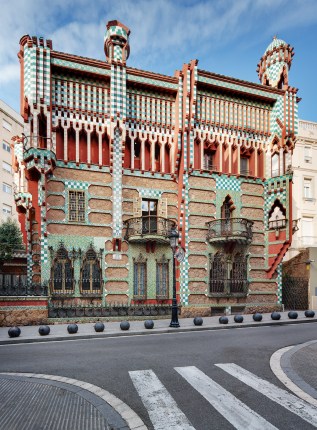
The first home designed by Catalan architect Antoni Gaudí has recently opened to the public. Built between 1883 and 1885 as a summer house for the Vicens family, it is a masterpiece of riotous colour in an eclectic neo-moorish style. After over a century of transformations at the hands of various different owners, the World Heritage Site has been returned to its original disposition, while an addition constructed in 1925 has been transformed into a museum. Located in the Gràcia district and surrounded by a verdant garden, the house is open everyday, from 10 am to 8 pm.
Beach at Portici by Mariano Fortuny y Marsal (1838- 1874) Oil on canvas, 27 x 51 ¼ in. (68.6 x 130.2 cm). Meadows Museum, SMU, Dallas.
The Southern Methodist University’s Website announced today that The Meadows Museum has acquired Beach at Portici, the last painting of famed Spanish artist Mariano Fortuny y Marsal (1838-1874).
This large-scale, unfinished work depicts the carefree atmosphere of a bbeautiful summer day at the beach, demonstrating Fortuny’s hallmark ability to capture light in paint.
Fortuny was an especially popular artist with 19th-century American collectors and audiences, as revealed by the American provenance of this work. Indeed, itwas featured prominently in the American Pavilion’s “Loan Collection of Foreign Masterpieces Owned in the United States” at the 1893 World’s Columbian Exposition in Chicago, one of the most important international exhibitions of the 19th century.
Beach at Portici will be on view at the Meadows Museum beginning January 19, 2018. From June 24 through September 23, it will be the subject of a focused exhibition, At the Beach: Mariano Fortuny y Marsal and William Merritt Chase.
Bartolomé Esteban Murillo, Diego Ortiz de Zúñiga, ca. 1655, oil on canvas, private collection, United Kingdom; image courtesy of Sotheby’s
Until February 11, the Frick Collection in New York is celebrating Bartolomé Esteban Murillo, one of the outstanding painters of the Spanish Golden Age, who will turn 400 years old on 31 December. Well known for his religious paintings and his extraordinary depictions of street urchins, he was also an ingenious painter of portraits. This genre remains, however, the least studied aspect of his work. Inspired by the self-portraits in their holdings, New York’s Frick Collection and London’s National Gallery have co-organized a show which will move to London from February 28 through May 21, 2018.
As widely reported by the media, including the Guardian, an exceptional self-portrait by Murillo just discovered at Penrhyn Castle in Wales has been added to the show on account of its exceptionality.
Cildo Meireles, Meshes of Freedom (1976/77), promised gift of Patricia Phelps de Cisneros through the Latin American and Caribbean Fund. Courtesy of MoMA
The Art Newspaperreports that the Colección Patricia Phelps de Cisneros (CPPC) has donated 200 works of contemporary Latin American art to American and European museums including the Museum of Modern Art (MoMA) in New York, the Museo National Centro de Arte Reina Sofía in Madrid, the Museo de Arte Moderno Buenos Aires (MAMBA) and the Museo de Arte de Lima (MALI).
Featuring artworks by 91 artists from 22 countries, the donation is intended to complement the strengths or interests of each museum, celebrating their commitment to studying and exhibiting contemporary Latin American art.
Joos van Cleve (attr.) The Annunciation 1512-1520 Oil on oak panel Museu de Arte Sacra do Funchal, inv. MASF35Detail of figure 1
The generous award funds provided by ARTES Coll&Cortes allowed me to travel to Lisbon to investigate the transmission of Flemish art, designs, and techniques to Portugal in the late medieval period, on which my PhD research is based. The trip fortuitously overlapped with the exhibition ‘The Islands of White Gold, Art Commissions in Madeira: 15th and 16th Centuries’ at the Museu Nacional De Arte Antiga as well as the ‘Medieval Europe in Motion—The Middle Ages, A Global Context?’ conference hosted at the Calouste Gulbenkian Foundation. Both introduced me to works of art and research with which I had not been familiar and underlined the complexity and ambiguity involved in defining artistic transmission.
Workshop or Circle of Quentin Metsys Triptych of the Descent from the Cross Oil on oak panel Museu Nacional de Arte Antiga, Inv. 1285 Pint
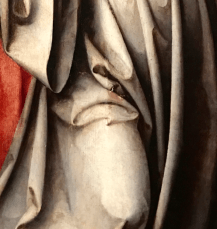
The fluid movement of artists and designs between north and south during this period means that just because something looks Flemish doesn’t necessarily mean it is; unfortunately, ‘style’ is often the determinant factor in classifying the origin of artworks in museums as well as in literature. Production methods can help elucidate if not by who at least where an artwork was made. To this end, the research trip sponsored by ARTES Coll & Cortes allowed me to collect data on the different joinery methods used in 15th and 16th century panel painting. Specifically, I sought out works joined by perpendicular dowels. Internal dowels, the predominate joinery method found in the north, in some cases dictated by guild regulations, are less likely to disrupt the surface of the painting; perpendicular dowels, however, tend to protrude slightly to the surface over time and can often be discerned with the naked eye. Current research proposes that the latter joinery method was predominant exclusively in Portugal (though famously employed by Hugo van der Goes as well).
Detail of figure 2
My preliminary investigations, however, yielded evidence that perpendicular dowels were utilized not only Portuguese panel paintings, but also in panels believed to be imported from Flanders. While it is too early to draw conclusions, the diversity of joinery methods observed suggest that either perpendicular dowels were not as uncommon to northern production as has been supposed or that certain works in Portuguese collections which have been classified as ‘Flemish’ were perhaps produced locally. I’m looking forward to delving in further!
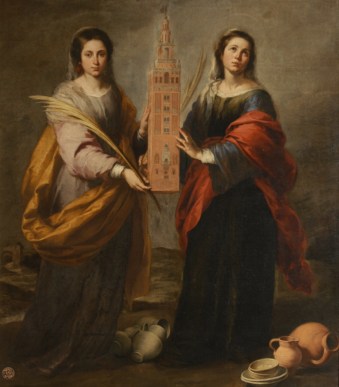
Bartolomé Esteban Murillo Oil on canvas 200 x 176 cm c. 1666 Museo de Bellas Artes, Seville
Baptised on 1 January 1618, Bartolomé Esteban Murillo (d. 1682) became the leading painter of late seventeenth-century Seville. He completed several religious commissions, especially compelling and innovative representations of the Immaculate Conception. He was also an outstanding portraitist, as revealed in the exhibition Murillo: The Self-Portraits, on view at The Frick Collection in New York until February 4. The painter also excelled in genre pictures of children, a production which made him extremely famous among foreign connoisseurs and collectors, especially in England and France in the eighteenth- and early nineteenth-century.
As noted in a contemporary document, Murillo had ‘all his life been a parishioner of la Magdalena [in Seville] without any notable absence’. His oeuvre and memory are closely connected to this city in the South of Spain, then a flourishing emporium for trade with Latin America.
Unsurprisingly, this year the city will celebrate Murillo’s 400th birthday with a number of large-scale cultural events and exhibition. Information on many of these can be found on a dedicated website, Murillo y Sevilla. Here are some highlights:
Murillo y su estela en Sevilla(Murillo and His Followers in Seville), exhibition curated by Benito Navarrete at the Espacio Santa Clara. Until 8 April 2018.
Murillo IV centenario (Murillo’s 4th centenary), exhibition curated by María Valme Muñoz e Ignacio Cano at the Museo de Bellas Artes. 29 November 2018–17 March 2019.
Ignacio Zuloaga Portrait of the Countess Mathieu de Noailles Oil on canvas 152 x 195.5 cm 1913 Museo de Bellas Artes de Bilbao
The art of Ignacio Zuloaga (Eibar 1870–1945 Madrid) is often associated with Romantic ideas of Spain’s Black Legend. This exhibition aims to show the painter in a different light, focusing on his connections with the innovations of Belle Époque Paris. The exhibition illuminates the Symbolist milieu in which the Spanish painter moved during his several stays in France. Curated by Leyre Bozal Chamorro and Pablo Jiménez Burillo, it features more than 90 works by such artists as Paul Gauguin, Pablo Picasso, Santiago Rusiñol, Émile Bernard and Auguste Rodin.
Bartolomé Esteban Murillo, Diego Ortiz de Zúñiga, ca. 1655, oil on canvas, private collection, United Kingdom; image courtesy of Sotheby’s
Until February 11, the Frick Collection in New York is celebrating Bartolomé Esteban Murillo, one of the outstanding painters of the Spanish Golden Age, who will turn 400 years old on 31 December. Well known for his religious paintings and his extraordinary depictions of street urchins, he was also an ingenious painter of portraits. This genre remains, however, the least studied aspect of his work. Inspired by the self-portraits in their holdings, New York’s Frick Collection and London’s National Gallery have co-organized a show which will move to London from February 28 through May 21, 2018.
As widely reported by the media, including the Guardian, an exceptional self-portrait by Murillo just discovered at Penrhyn Castle in Wales has been added to the show on account of its exceptionality.
Mariano Fortuny, Idyll, 1868, watercolour and gouache on paper, Museo Nacional del Prado
The Museo Nacional del Prado has recently opened an exhibition on Mariano Fortuny y Marsal (1838-1874). This artist, who achieved international renown in the last third of the 19th century, was a skilled painter and draughtsman who excelled in watercolour. He was also a graphic artist and a passionate collector of antiquities.
As with previous monographic exhibitions held at the Prado, Mariano Fortuny (1838-1874) offers a reassessment of the artist’s finest works, drawn from both the the Prado’s extensive holdings and from international lenders, including the more than 30 rarely-seen works from the Museo Fortuny in Venice.
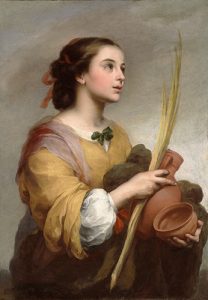
December of 2017 will witness the 400th birthday of Bartolomé Esteban Murillo (1617–1682), one of the outstanding painters of Golden Age Seville. The Meadows Museum, which holds more paintings by the artist than any other collection in the United States, will celebrate his anniversary with a special exhibition. The display will celebrate the Meadows’ extraordinary holdings of artworks by the artist, and pair them with paintings by Murillo’s Sevillian contemporaries, thus highlighting the artistic context with which he remains so intimately associated.
Click here for more information on this exhibition.







 December of 2017 will witness the 400th birthday of Bartolomé Esteban Murillo (1617–1682), one of the outstanding painters of Golden Age Seville. The Meadows Museum, which holds more paintings by the artist than any other collection in the United States, will celebrate his anniversary with a special exhibition. The display will celebrate the Meadows’ extraordinary holdings of artworks by the artist, and pair them with paintings by Murillo’s Sevillian contemporaries, thus highlighting the artistic context with which he remains so intimately associated.
