The Backhouse Bank in Bishop Auckland, soon to re-open as the Spanish Gallery
On 22 March 2018 at 6 pm ARTES Committee Member Edward Payne will lecture on ‘In the Shadow of Louis-Philippe: Building a Spanish Gallery in County Durham,’ at the Visual Cultures Forum of Queen Mary University of London. The lecture will offer a glimpse behind the scenes of an exciting project in the North East of England. It will provide an introduction to the origins of an unusual endeavour—building a Spanish art gallery a stone’s throw away from a bishop’s palace—as well as a sneak preview of the gallery’s contents, including recent acquisitions and plans for potential loans and narratives.
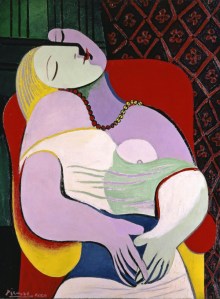
Co-organised by Tate Modern and the Musée Picasso, Paris, the exhibition Picasso 1932 – Love, Fame, Tragedy at Tate Modern chronicles an intensely creative year in the life of this artist. Focusing on representing his lover Marie-Thérèse Walter, he produced some of his most innovative compositions.
Surprisingly, this will be the Tate’s first ever solo exhibition dedicated to Picasso. Featuring paintings, drawings, and archive documents, the exhibition will reveal the man behind the myth, allowing visitors to discover the full complexity of this famous artist and of his exceptional life.
The Catholic Church did not define the mystery of the Immaculate Conception of Mary as a dogma until 1854. Yet as early as 1616 Felipe III created the Real Junta de la Inmaculada and proclaimed the Spanish Crown as the greatest supporter of the doctrine. Ever since, the Spanish Monarchy was at the centre of an intense propaganda campaign intended to promote belief in the immaculate conception. Art played a key role in this project.
This seminar will explore the different aspects of this marketing operation in the Iberian kingdoms, in the Italian Viceroyalties and in Rome itself. From Madrid, Palermo and Seville, the speakers will unveil the images of one of the most striking campaigns of visual propaganda in history.
Coordinator: Rafael Valladares (EEHAR-CSIC)
Director: Pablo González Tornel (Universitat Jaume I)
Participants:
Pablo González Tornel (Universitat Jaume I): Inmaculada Hispánica. Propaganda y persuasión en la España del Seiscientos.
Piers Baker-Bates (Open University, London): Inmaculada Hispánica in Rome: visual propaganda in the service of doctrine.
Maurizio Vitella (Università degli Studi di Palermo): Iconografia della Purissima Regina nel Viceregno di Sicilia.
Benito Navarrete Prieto (Universidad de Alcalá): La Inmaculada como instrumento político desde Murillo al nacionalcatolicismo.
Location: Escuela Española de Historia y Arqueología en Roma. Via di Sant’Eufemia 13. 00187 Roma. Date and time: miércoles 6 de junio de 2018, 16:00 horas.
Bartolomé-Esteban Murillo, The Marriage of the Virgin, c.1660-1670, The Wallace Collection
‘Oh wonderful Spain. Think of this romantic land covered in Moorish ruins and full of Murillos’
Benjamin Disraeli’s 1830 letter attests to the prominence of Bartolomé Esteban Murillo in the minds British travellers and collectors. In celebration of the 400thanniversary of Murillo’s birth, the Wallace Collection, in collaboration with the Centro de Estudios Europa Hispánica, will be exploring this further by hosting an international one-day symposium on 14th May 2018 entitled ‘Collecting Murillo in Britain and Ireland’.
Speakers include Thierry Morel, Veronique Gerard Powell, Xanthe Brooke, Hugh Brigstocke, Isabelle Kent, Xavier Bray, Claudia Hopkins, Thomas Bean, Hilary Macartney and Philip McEvansoneya. We are delighted to have this group of acclaimed scholars coming together to discuss new research surrounding the collecting of Murillo in Britain and Ireland.The seminars delivered will form the basis of a new volume on the subject to be published by CEEH.
Please follow this link to buy tickets for the conference.
Programme*
09:30 – Registration
09:50 – Welcome
Session 1) Early Displays of Works by Murillo in Britain
10:00 – Sir Robert Walpole’s Spanish Pictures. Thierry Morel (Director and Curator at Large, Hermitage Museum Foundation)
10:30 – From Lord Godolphin to John Blackwood and Lawrence Dundas: the first British purchasers of Murillo. Véronique Gerard Powell (Honorary Senior Lecturer, Sorbonne University)
11:00 – tea and coffee break
Session 2) British Collectors in Seville and Madrid
11:30 – Collecting Murillo in Seville: the case of Julian Benjamin Williams (d.1866) and Frank Hall Standish (1799-1840). Xanthe Brooke (Curator of Continental European Art, Walker Art Gallery)
12:00 – William Eden: the discovery of Murillo with his friends in Spain. Travel and collecting. Hugh Brigstocke (independent scholar)
12:30 – The curious case of General Meade (1775 – 1849): his collection in Madrid and its dissemination. Isabelle Kent (Enriqueta Harris Frankfort Curatorial Assistant, The Wallace Collection)
13:00 – Break for lunch (not included)
14:00 – William Buchanan and James Irvine: In-situ talk in the Great Gallery. Xavier Bray (Director, The Wallace Collection) and Isabelle Kent
Session 3) Artists and Scholars travellers to Spain
14:30 – ‘All softness’ – Murillo through British artists’ eyes. Claudia Hopkins (Lecturer, University of Edinburgh)
15:00 – Hand-Book for Travellers in Spain and Richard Ford. Thomas Bean (private researcher)
15:30 – Accessing Murillo: Stirling Maxwell’s contribution to scholarship, collecting and taste in Britain. Hilary Macartney (Lecturer, University of Glasgow)
Session 4) Other Major Collectors
16:00 – Collecting and displaying Murillo in Ireland. Philip McEvansoneya (Lecturer, Trinity College Dublin)
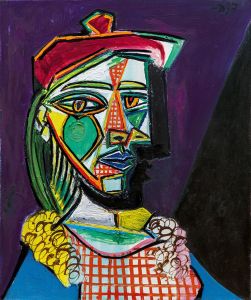
Pablo Picasso’s Femme au béret et à la robe quadrillée (Marie-Thérèse Walter) (1937) will be the star of Sotheby’s evening sale tomorrow. It is one of Picasso’s last paintings of his muse Marie-Thérèse Walter, whom he represented countless times in the 1930s. Several paintings of Marie-Thérèse will feature in the exhibition Picasso 1932: Love, Fame, Tragedy, opening on 8 March 2018 at Tate Modern, London. While works in the exhibition chronicle the romantic highpoint of their relationship, the painting auctioned by Sotheby’s marks its end. Indeed, the dark shadow surrounding Marie-Thérèse’s face may evoke Picasso’s growing passion for Dora Maar, his lover between 1935 and 1943.
The Meadows Museum at SMU in Dallas and the Museo Nacional del Prado in Madrid have announced a new pre-doctoral fellowship, part of the unique international partnership that unites these two leading museums. A grant from the Center for Spain in America (CSA) supports now the pre-doctoral Meadows/Prado Fellowship, designed to provide students with an intensive scholarly, professional, and international experience in curatorial work. The fellowships are an annual exchange with one appointment made by each institution.
The CSA and its Spanish counterpart, the CEEH, have collaborated with the Meadows Museum on several projects prior to this announcement, including the exhibition and catalogue for The Lost Manuscripts fromthe Sistine Chapel: An Epic Journey from Rome to Toledo (2011); the exhibition and catalogue for The Spanish Gesture: Drawings From Murilloto Goya in the Hamburger Kunsthalle (2014); Sorolla in America:Friends and Patrons (2015); and the exhibition catalogue Zurbarán:Jacob and His Twelve Sons, Paintings from Auckland Castle (2017).
Eduardo Chillida, Peine del Vento, 1977 San Sebastián, Guipuzkoa, Spain
This spring, the Meadows Museum will present Dallas’s first exhibition dedicated exclusively to the work of Eduardo Chillida (1924–2002). Chillida, one of Spain’s most celebrated modern sculptors, is famous for his monumental iron and stone sculptures that shape both urban and rural landscapes. This exhibition includes 66 of the artist’s works, from his sculptures, to his drawings, collages, gravitations, graphic works, and a selection of his books. Co-curated by William Jeffett, chief curator of exhibitions for The Dalí Museum, and Ignacio Chillida, the artist’s son, the works in Memory, Mind, Matter: The Sculpture of Eduardo Chillidacome exclusively from the Museo Chillida-Leku in Hernani (San Sebastián, Spain); the exhibition travels to Dallas from the Salvador Dalí Museum in St. Petersburg, Florida. A complimentary exhibition, Chillida inDallas: De Musica at the Meyerson, is curated by Meadows/Mellon/Prado Curatorial Fellow Amanda W. Dotseth and will focus on the landmark commission by Chillida at Dallas’s Morton H. Meyerson Symphony Center. The two exhibitions will open on February 4, 2018, and run through June3.
The exhibition will be accompanied by an educational programme which will include:
FRIDAY, FEBRUARY 2, 10:30 A.M. LUIS CHILLIDA, director, Fundación Eduardo Chillida-Pilar Belzunce
Memory, Mind, Matter: The Public Art of Eduardo Chillida in Focus
FRIDAY, FEBRUARY 16, 12:15 P.M.
AMANDA W. DOTSETH, Meadows/Mellon/Prado curatorial fellow, Meadows
Museum Medieval and Modern: Alabaster from Gil de Siloé to Eduardo Chillida
THURSDAY, APRIL 19, 6:00-7:00 P.M.
BEATRIZ CORDERO, professor, Saint Louis University, Madrid Lightness and Rightness: Eduardo Chillida and James Johnson Sweeney in the Museum of Fine Arts, Houston
FRIDAY, APRIL 20, 12:15 P.M.
JED MORSE, chief curator, Nasher Sculpture Center Chillida in Dallas Part I: Chillida Downtown
SATURDAY, APRIL 21, 10:00 A.M.-1:00 P.M.
FAMILY DAY
FRIDAY, APRIL 27, 12:15 P.M.
SCOTT WINTERROWD, director of education, Meadows Museum Chillida in Dallas Part II: Chillida in Dallas





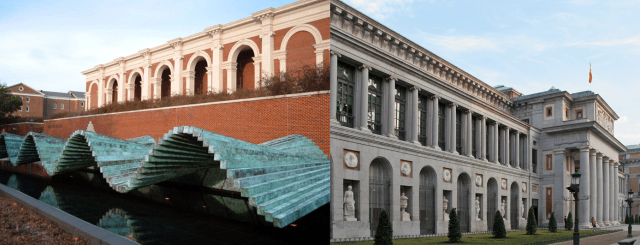 The Meadows Museum at SMU in Dallas and the Museo Nacional del Prado in Madrid have announced a new pre-doctoral fellowship, part of the unique international partnership that unites these two leading museums. A grant from the Center for Spain in America (CSA) supports now the pre-doctoral Meadows/Prado Fellowship, designed to provide students with an intensive scholarly, professional, and international experience in curatorial work. The fellowships are an annual exchange with one appointment made by each institution.

