
17th century 19th century 20th century 2015 2016 2017 Architecture art Artes art history Baroque CEEH Conference Contemporary art Durham University early modern Exhibition Exhibitions golden age Goya History Latin America London Madrid Meadows Museum Medieval Mexico Murillo Museo del Prado National Gallery London New York online seminar series Painting Photography Picasso Portugal Sculpture Seville Spain Spanish Spanish Art Uncategorized usa Velázquez Zurbarán Centre for Spanish and Latin American Art
ARTES CEEH Scholarships – 2026
Thanks to the generous support of CEEH (Centro de Estudios Europa Hispánica), ARTES awards a number of scholarships to students working on any aspect of Spanish visual culture before 1900. The deadline for all applications is 30th April 2026 and the Scholarship Committee will inform successful applicants by 31st May. Scholarship winners are normally invited to an awards ceremony at the ARTES AGM in June. Please read the guidelines for each scholarship, as well as the general guidelines below.
Travel scholarships
Final year undergraduates and postgraduate students registered for a full or part-time degree course at a UK university may apply for up to £1000 towards the costs of travel to Spain for research purposes (which may include field work, attendance at a conference, or other recognised forms of research).
£3000 scholarship for PhD students at a UK university
ARTES offers one scholarship each year to a student registered for a full- or part-time doctoral degree at a UK university. The scholarship is intended to contribute towards the costs of tuition, living and/or research, and therefore students with full funding are not eligible.
£3000 scholarship for PhD students or post-doctoral scholars who wish to conduct research in the UK
Doctoral students or those who received their doctorate less than four years before the application deadline may apply for this scholarship provided that they are that they were or are registered for doctoral study at a university in Spain.
For further information and application guidelines, see https://artes-uk.org/artes-ceeh-scholarships/.
The Juan Facundo Riaño Essay Medal
To encourage emerging scholars that are based in the UK, ARTES, in collaboration with the Embassy of Spain, awards an essay medal to the author of the best art-historical essay or study on a Hispanic theme, which must be submitted in competition and judged by a reading Sub-Committee. The medal is named after Juan Facundo Riaño (1829-1901), the distinguished art historian who was partly responsible for a growing interest in Spanish culture in late nineteenth-century Britain. The winner is also awarded a cash prize of £400, and the runner-up is awarded a certificate and prize of £100 – both prizes are generously sponsored by the Office for Cultural and Scientific Affairs of the Embassy of Spain. Prize-winners also receive a year’s free membership to ARTES, and the winning essays are considered for publication in the annual visual arts issue of Hispanic Research Journal. The deadline is 30th April 026, and we aim to reach a decision by 31st May. For further information and application guidelines, see https://artes-uk.org/the-juan-facundo-riano-essay-medal/.
This info will be updated on the listing pages where further info is available.
ARTES TRIP TO MADRID, 19-21 FEBRUARY 2026
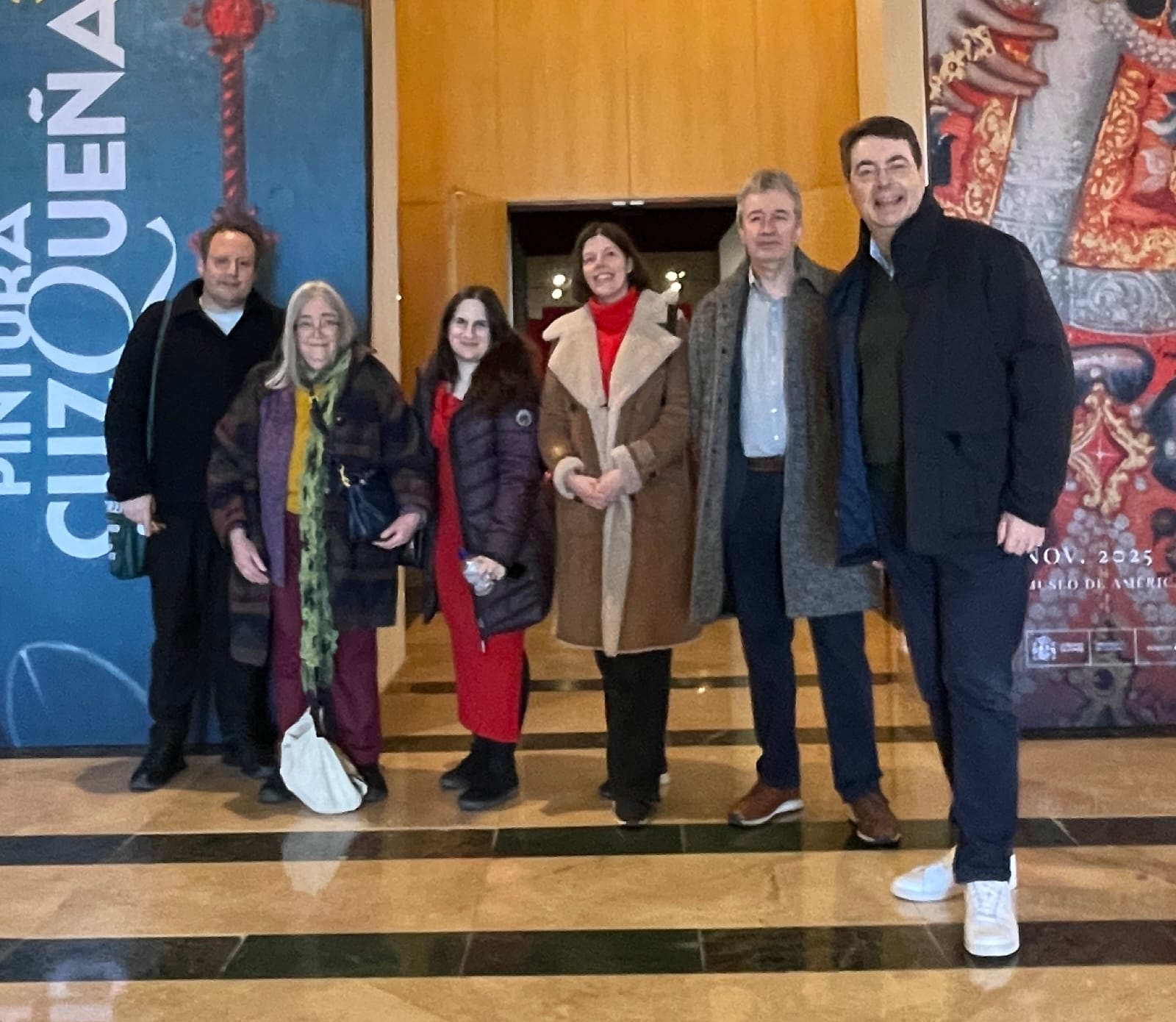
A group of ARTES members had a wonderful time in Madrid, exploring four exhibitions over two days!
The trip began with an informal meeting on Thursday evening at the contemporary Galería Valverde, followed by tapas. The next morning, we visited the Anders Zorn (1860-1920) exhibition at Fundación Mapfre, where the curator, Casilda Ybarra provided fascinating insights into Zorn and his deep connections with Spain and Spanish artists around 1900 during a private tour.
After a delightful lunch, we moved on to the Juan Muñoz. Stories of Art exhibition at the Museo Nacional del Prado, where we encountered Muñoz’s politically charged and enigmatic sculptures, presented in dialogue with the Prado’s old masters.
In the late afternoon, we visited the Museo Reina Sofía for the impressive retrospective Maruja Mallo: Mask and Compass exhibition, which reveals Mallo as a pioneering surrealist artist with an original and strong vision.
The day ended with a convivial dinner in Las Letras. We reconvened the next morning at the Museo de América to view the Pintura cuzqueña. Centro y periferia exhibition, featuring remarkable devotional paintings and objects produced during the Viceregal period in Cuzco.
The trip was a wonderful opportunity to share conversations about art and connect with one another. We are already planning the next ARTES trip abroad, which will likely take us to Lisbon in 2027.
Details will be announced in June 2026.
‘Artistry, Artifice and Accuracy in British Artists’ Drawings of Seville’ with Dr Martin Sorowka
On 3 February at 18:00 UK time, ARTES will hold the next seminar series in collaboration with the Zurbarán Centre. Dr Martin Sorowka will deliver his talk entitled, ‘Artistry, Artifice and Accuracy in British Artists’ Drawings of Seville’.
Please email artesiberia@gmail.com for a link to join.

For more about this publication please visit the link below:-
https://www.ceeh.es/en/publicacion/british-travellers-in-seville-their-drawings-1715-1854/
Abstract
The talk relates to Dr Martin Paul Sorowka’s recently published book British
Travellers in Seville, & their drawings 1715-1854 (CEEH, Instituto Ceán Bermúdez,
ARTES, 2025). Surely an artist on their foreign travels would faithfully set down on
paper the view before their eyes? But no, this is not always so. Focussing on the
Andalusian city of Seville, Sorowka’s talk examines the consequential drawings of
renowned hispanophile artists John Frederick Lewis, David Roberts and John Phillip
to show why historians should treat their work with caution. He will introduce three
unknown amateurs: Cecilia Montgomery, John Gardner Wilkinson and Nathaniel
Armstrong Wells to whom historians should turn to find more trustworthy
representations of the city’s architectural heritage.
About the speaker
Dr Martin Paul Sorowka AFRHistS belongs to the research group HUM976.
‘Expregrafica’, Place, Architecture and Drawing at Seville University, and has
recently published his doctoral thesis with CEEH, Instituto Ceán Bermúdez, and
ARTES as British Travellers in Seville, & their drawings 1715-1854. His archival
research evidences new diverse cross-cultural narratives of artists and travellers in
Spain and the Maghreb, and how knowledge and meaning become embodied in
their written and visual depictions of architecture.
Recent Updates:-

Subscribe to continue reading
Subscribe to get access to the rest of this post and other subscriber-only content.
Online Lecture; ‘Trans Identities in Early Iberian Art: The Legend of St Eugenia’.
Prof. Andrew Beresford (Durham University),
Thursday, 22 January 2026, 5.15 PM GMT
In this talk, Prof. Andrew Beresford will be discussing part of a book project on the Iberian reception of the legends of transgender saints. It focuses on visual and textual representations of St Eugenia, who, according to legend, lived as a monk (Eugenius) until an accusation of adultery forced him to identify again as a woman. Prof. Claudia Hopkins will chair this seminar.
Image: ‘Eugenius Reveals his Secret on Being Accused by Melancia’, from the Santa Eugenia de Sagà Frontal, Master of Soriguerola and workshop, c. 1300. Paris, Musée des Arts Décoratifs PE 121.
For the full list of the University of Edinburgh History of Art Research Seminars, please visit the Edinburgh College of Art (ECA) website: https://www.eca.ed.ac.uk/history-art-research-seminar-series
Burlington Travel Bursaries
An opportunity for PhD, post-doctoral or early career researchers who need to travel, perhaps in the UK or Europe, for studies of European drawings produced before 1900.
The deadline for applying for the bursaries is 1st Feb 2026.
Please see the link below:
https://mailchi.mp/burlington/netherlandish-prize-9168184?e=66a463be93
Madrid Research Workshop
The Center for Iberian Studies, in partnership with the Center for Spain in America (CSA), is pleased to announce the 2026 Madrid Research Workshop in Archives, Libraries, and Art Collections on June 22-26, 2026 in Madrid, Spain.
This intensive and hands-on one-week course is designed for graduate students, independent researchers, and early-career professionals interested in gaining skills to successfully navigate key repositories and methodologies in medieval and early modern Iberian studies.
The deadline for making an application is the 15th January.
Please see further details via the link below:
International Congress, Culture in Motion:
Elites, Collecting, and Art Circulation in Modern Europe
May 20-21, 2026
Artes is extremely pleased to share this current ‘Call for Papers’ in relation to an international conference in Madrid on behalf of :
Àngel Campos-Perales
Assistant Professor
Department of Art History
Faculty of Fine Arts
Complutense University of Madrid
Please see details below:-

Center for Human and Social Sciences, CSIC, Madrid.
Members of European courts in the Early Modern period recognized themselves within a shared culture, derived from a way of being and conversing inherited and characteristic of a distinguished sphere.
Works of art, antiquities, and other objects associated with luxury consumption participated in this prestigious sociability. Thanks to these exchanges, artists traveled on the recommendation of, or were commissioned to serve, foreign courts, while markets for artworks with international destinations were fostered. Celebrations, receptions for illustrious members, and all the trappings of power relied on agents and experts who temporarily materialized artistic solutions, later disseminated to other courts through the contacts and travels of their participants. All of this required a complex logistical network, with a framework established within the diplomatic apparatus, but often also based on informal relationships or political positioning interests among aristocratic families and their respective servants.
This congress is interested in all the people who made this cultural and artistic expansion possible, their points of convergence and divergence, as well as the political and/or emotional instrumentalisation of artistic creations and their creators, with the ultimate goal of contributing new narratives to the European cultural heritage of the Early Modern period.
Panel 1. The Ephemeral as a Cultural Agent: Festival, Ceremony, and Representation. Beyond the exchange and circulation of artistic objects, the festival (courtly and urban) functioned, from the Middle Ages and throughout the Early Modern period, as a stage for the exchange of ideas, not only political, but also regarding changes and innovations in taste and new artistic trends.
The contribution of case studies that approach ceremonial practices from the perspective of contact and exchange between courts, institutions, or powers will be valued, emphasising the festival as a space for contact and exchange.
Panel 2. People, Works, and Ideas in Circulation. This panel proposes a reflection on the processes of circulation in the Early Modern period, understood as dynamic phenomena involving people (travellers, artists, diplomats), as well as artistic objects and ideas in constant movement between different regions of the world.
We invite you to submit proposals for papers that address the mobility of artworks, artistic exchanges, cultural diplomacy, or the circulation of knowledge, from a perspective that transcends geographical and disciplinary boundaries.
Panel 3. Advisors and Opinion Makers. In the Early Modern period, knowledgeable and expert figures became widespread, advising members of the less educated elite on acquisitions or commissions from artists. This section also welcomes contributions on dynamics of emulation among aristocratic families or affiliation with a particular political position through the use of similar or identical artistic promotions.
Panel 4. The Logistics of the Travel of Artworks. This section focuses on topics related to the material conditions of the commission and receipt, packaging, the most suitable means of transport for the physical nature of the gift, the people involved in transport, methods of presentation and safekeeping of the artworks, material losses and mechanisms for replacing lost items, etc.
Proposals should include a title, an abstract (300 words), and a brief CV.
Submissions will be accepted in Spanish, Italian, and English. Presentations will consist of 20 minutes, followed by a discussion period at the end of each session.
Participation and attendance at the conference are free of charge. The organisers will not be able to cover participants’ travel or accommodation expenses.
Deadline for submitting proposals: February 28, 2026
Email: artedelaedadmoderna@cchs.csic.es
Curatorial Assistant Vacancy
Meadows Museum SMU (Dallas, Texas)
Artes is pleased to be able to share that the Meadows Museum at SMU is currently searching for a Curatorial Assistant to join its department. This full-time, on-campus position offers the opportunity to work closely with their team on research, exhibitions, publications, and a wide range of curatorial projects related to Spanish art.
The full job description and application portal can be found here:
Priority consideration will be given to applications received by November 28, 2025, but the position will remain open until filled.
NEWS
Mark A. Roglán Award to ARTES Chair
ARTES is extremely proud to announce that on 18 October the Meadows Museum’s Custard Institute for Spanish Art and Culture, Dallas, presented its Mark A. Roglán Publication Award for the second time to Claudia Hopkins, Professor of Art History at the University of Edinburgh, for her book Art and Identity in Spain 1833-1956. The Orient Within (Bloomsbury, 2024). She delivered a talk entitled ‘Nostalgia for al-Andalus from Bécquer to Rusiñol’ in the museum’s Bob and Jean Smith Auditorium. The program concluded with Custard Institute’s director Greg Warden presenting Hopkins the second Mark A. Roglán Award.
The award recognizes exemplary scholarship on Spanish art between 1820 and 1920 and is named for the late director of the Meadows Museum, Mark A. Roglán, an eminent museum professional and art historian whose field of specialisation was Spanish art of the modern period and its collecting history.
Colnaghi Casta Paintings at Frieze Masters 2025, London (Post)
One of the favourites from the collection was a set of Mexican School Casta Paintings, a rare group of eight canvases from eighteenth-century New Spain. These works belong to a pictorial tradition that sought to classify the colony’s mixed society through images of race, family, and occupation. Each painting shows a man, woman, and child of defined ancestry, identified by their assigned casta such as Mestizo, Mulato, Castiza, or Tente en el aire. Both decorative and documentary, the series translates colonial hierarchies into scenes of domestic order. The Colnaghi group is notable for its scroll-mounted format, which allowed the paintings to be rolled for travel, and for its detailed depictions of clothing, trade, and local produce.
 ARTES
ARTES 