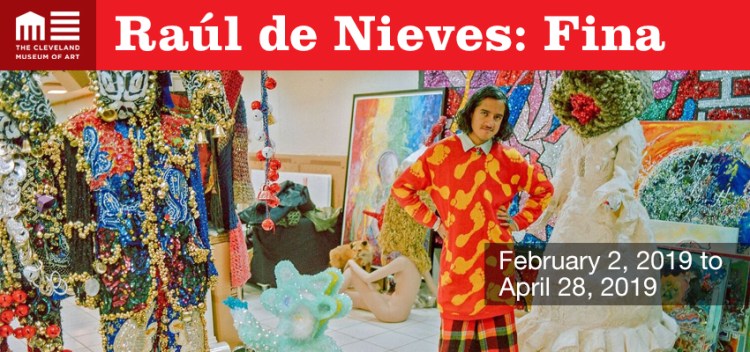
Raúl de Nieves: Fina, the first solo museum exhibition by Raúl de Nieves (b. 1983, Michoacán, Mexico), will feature new work in a site-specific installation developed for the Cleveland Museum of Art at the Transformer Station. Narrative facets of the installation will be informed by de Nieves’s experience of Mexican cultural traditions, considered through the lens of this moment in history. These will unfold in relation to the particular architecture of the Transformer Station. As a whole, the installation will be characterized by the artist’s ongoing interest in transforming humble materials into spectacular objects that alter the spaces around them.
De Nieves, who lives in New York, traces his artistic practice back to his childhood in Mexico: at school and alongside family members, he learned traditional Latin American sewing and beadwork that now permeate his art in multiple ways. At the age of nine de Nieves migrated to San Diego with his mother and two brothers. Later he moved to San Francisco and finally to New York, where his multimedia practice, including painting, sculpture, and performance, has taken shape. De Nieves has presented solo projects and performances at The Kitchen and the Watermill Center, New York (both 2017), and the Institute of Contemporary Art, Philadelphia (2016). He has participated in major contemporary art surveys, including Documenta 14 (2018), the 2017 Whitney Biennial, and Greater New York at MoMA/PS1 (2015). His work is part of the Swiss Institute for Contemporary Art’s inaugural exhibition in its new building that opened in New York in summer 2018.
This year’s Glendinning Lecture, an annual event in honour of the great Hispanist Nigel Glendinning, will celebrate the 200th anniversary of the Museo Nacional del Prado.
Dr Javier Barón will deliver a lecture on how Velázquez and El Greco influenced modern painting.
From its opening in 1819, the Prado offered artists a unique opportunity to study the oeuvre of Spanish Old Masters, especially Murillo, Velázquez and El Greco. This was, precisely, the chronological order in which these masters influenced foreign painters.
During the nineteenth century, Velázquez was the most appreciated Spanish master. The Prado owned the most extensive collection of this artist in the world. So, many painters, amongst them Wilkie, Courbet, Manet, Renoir, Sargent, Chase and others came to Madrid to see his masterworks. Velázquez’s approach to everyday life, as well as his large and loose brushstrokes, were relevant to naturalistic painters.
El Greco was especially appreciated after the first monographic exhibition of his work took place at the Prado in 1902. His influence was already important in the mainstream renewal of painting spearheaded by Pablo Picasso and cubism in Paris. At the same time, El Greco was the major reference for Central European Expressionism. American artists also appreciated the suggestiveness of his painting when seeking to lay the foundation of their own modernity.
Javier Barón is Doctor in History of Art by the University of Oviedo, where he was graduated with honours back in 1989. Before joining Prado Museum, he was a professor of Art History at the University of Oviedo (1991–2002). In 2003, Barón was appointed as Head of Nineteenth-century Painting Department at the Prado Museum, a position he held until 2014, when he became Senior Curator. He is correspondent member of the Spanish Royal Academy of History, the Spanish Royal Academy of Fine Arts and the Royal Academy of Fine Arts of San Telmo, in Málaga, as well as member of the Royal Institute of Asturian Studies, Chevalier des Arts et des Lettres, member of the Board of Trustees of the Sorolla Museum and Member of the Madrid City Council Board of Valuation of Works of Art.
Free and open to all, but please book a ticket here.
7th February 2019, 16:00 to 17:00, Room 146, Elvet Riverside 1, Durham University
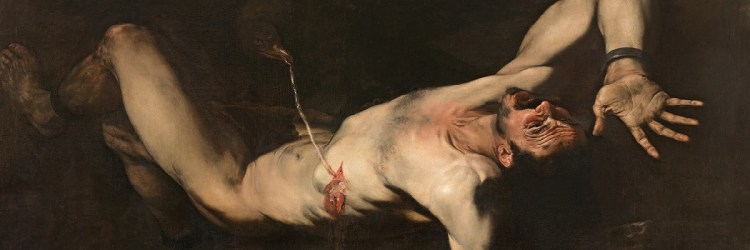
Paintings by the Spanish Baroque artist, Jusepe de Ribera (1591–1652), prompted a range of contradictory responses in the nineteenth century. Poets, travel writers, critics and artists reacted to his work, especially his striking depictions of violent subjects, at once with admiration and displeasure. In his epic poem Don Juan (1823), Lord Byron declares that ‘Spagnoletto tainted / His brush with all the blood of all the sainted’, and in 1845, Théophile Gautier published two poems on the artist, referring to Ribera as ‘le noir Valencian’, and ‘plus dur que Jupiter’. While Byron and Gautier are often quoted in the literature on the artist, scholars have been swift to dismiss these responses as ‘muddying the waters’ of Ribera’s œuvre, and thus his reception during the nineteenth century has, until recently, received scant scholarly attention.
Through a close, comparative study of Ribera’s paintings and Gautier’s poems, this lecture will explore nineteenth-century attitudes towards extreme imagery in the context of the revival of the Spanish School in France. It will provide a more contextualised and nuanced account of Ribera’s reception during the nineteenth century, and demonstrate that Gautier’s poetic responses are not, in fact, distorting, but revealing. The lecture will argue for the significance of these poems by suggesting that Gautier calls attention to the problematic relationship between the act of inflicting torture and the art of representing pain, a tension which is central to an understanding of Ribera’s violent imagery, and to the myth-making of Ribera as a ‘violent’ artist.
The photographs of Graciela Iturbide not only bear witness to Mexican society but express an intense personal and poetic lyricism about her native country. One of the most influential photographers active in Latin America today, Iturbide captures everyday life and its cultures, rituals, and religions, while also raising questions about paradoxes and social injustice in Mexican society. Her photographs tell a visual story of Mexico since the late 1970s—a country in constant transition, defined by the coexistence of the historical and modern as a result of the culture’s rich amalgamation of cultures. For Iturbide, photography is a way of life and a way of seeing and understanding Mexico and its beauty, challenges, and contradictions.
This is the first major East Coast presentation of Iturbide’s work, featuring approximately 125 photographs that span her five-decade-long career. Organised into nine sections, the exhibition opens with early photographs, followed by three series focused on three of Mexico’s many indigenous cultures: Juchitán captures the essential role of women in Zapotec culture; Los que viven en la arena (Those Who Live in the Sand) concentrates on the Seri people living in the Sonoran Desert; and La Mixteca documents elaborate goat-slaughtering rituals in Oaxaca, serving as critical commentary on the exploitation of workers. Thematic groupings highlight Iturbide’s explorations of various aspects of Mexican culture, including fiestas, death and mortality, and birds and their symbolism. Her more recent work is presented in two series related to Mexico’s cultural and artistic heritage, featuring plants—mainly cacti—in “intensive care” at the Oaxaca Ethnobotanical Gardens, as well as El baño de Frida (Frida’s Bathroom), a selection of photographs in Gallery 335 depicting personal belongings in Frida Kahlo’s bathroom at the Casa Azul that had been locked away for 50 years after the artist’s death.
Iturbide’s powerful and provocative photographs are anti-picturesque, anti-folkloric. Her work embodies her empathetic approach to photography and her deep connection with her subjects, asking questions through its capacity for imaginary associations. Drawn primarily from Iturbide’s own collection, Graciela Iturbide’s Mexico also includes the Museum’s recent acquisition of 37 works by the artist, as well as loans from museums and private collections throughout the US and Mexico. The exhibition is accompanied by an illustrated catalogue produced by MFA Publications.
Click here for more information on the exhibition, and here for the accompanying publication
The Prayerbook of Alfonso of Aragon and Manuscript Illumination in Early 15th-Century Valencia
Wednesday 20 February 2019 5:00 pm – 6:00 pm
Free and open to all
Research Forum Seminar Room, The Courtauld Institute of Art, Vernon Square, Penton Rise, King’s Cross, London, WC1X 9EW
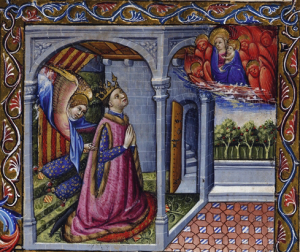
The Psalter-Book of Hours of Alfonso V the Magnanimous is one of the most important illuminated books commissioned by this Valencian monarch. This king used the book as an instrument of propaganda concerning his royal authority and piety, making this manuscript one of the most important records of the social history of medieval Valencia. A presentation of the miniatures will be accompanied by a brief introduction to Valencian manuscripts of the period, essential to understanding the specific characteristics of the complex manuscript studied here. The production process of the manuscript will also be analysed, and an attempt will be made to establish connections between this and other codices made in Valencia at the same date, trying to generate possible inflection points between these pieces and to define the artistic personalities who participated in this book of hours.
Dr. Nuria Ramón-Marqués is a lecturer in Art History at the Polytechnic University of Valencia. Her research focuses on the study of painting and illuminated manuscripts from the fourteenth and fifteenth centuries in the Crown of Aragon. Her doctoral thesis on the study of the Valencian medieval miniature, entitled The illumination of manuscripts in Valencia Gothic. From the beginning until the death of Alfonso V the Magnanimous (1290–1458) (2 vol. Universitat de València, 2005), made possible the reconstruction of the artistic personality of the Valencian miniaturist Domingo Crespí. Nuria is the author of several articles and books including The illumination of manuscripts in Gothic Valencia (1290–1458) (Valencia, 2007) that continues to have a significant scientific impact since it constitutes the most complete corpus of these works and a reference in the area of medieval painting and miniature.
Assistant Curator (ESCALA and University Art Collections), Library Services
Job Reference: REQ02285
Application Closing Date: 11/02/2019
Location: Colchester
Employment Type: Permanent, Part-time
Salary: £26,243 – £29,515 per annum, pro rata
This is an exciting opportunity to assist with the management of a major art collection and contribute to the development of academic and research support services at the University of Essex. Library Services – in which the post is based – includes three campus libraries, the largest being the iconic Albert Sloman Library at the Colchester campus, with over 1m printed items, extensive special collections and examples of work by leading 20th century artists such as Christopher Wood, Ben Nicholson, Alfred Wallis and Henri Gaudier-Brzeska.
In addition to promoting and conserving these artworks, the post holder will assist the recently appointed Curator with the operation of ESCALA, the University’s unique collection of Latin American art, with over 750 works dating largely from the 1960s to the present.
Duties of the Role
Based at ESCALA’s purpose-designed Teaching and Research space on the University’s Colchester campus, and working in the Albert Sloman Library as required, the post holder will work closely with the Curator in the management, care and promotion of ESCALA and the University’s other art collections; assisting with exhibitions, and planning and delivering Object Based Learning activities based on the collections and associated material.
Qualifications and Skills required
Educated to first degree level in art history or a relevant subject, ideally with a postgraduate qualification (or equivalent) in art history, gallery studies or a related subject, and knowledge of the art of Latin America, the post holder will possess excellent communication, presentation, IT and organisational and planning skills.
Experience of handling artworks, using social media for promotional purposes and working within a gallery or museum environment is essential for this post.
At the University of Essex internationalism is central to who we are and what we do. We are committed to being a cosmopolitan, internationally-oriented university that is welcoming to staff and students from all countries and a university where you can find the world in one place.
Please see the further detail link below for a full job description and person specification which outlines the full duties, skills, qualifications and experience needed for this role plus more information relating to the post. We recommend you read this information carefully before making an application. Applications should be made on-line, but if you would like advice or help in making an application, or need information in a different format, please telephone the Resourcing Team (01206 876559).
On 19 November 1819 Ferdinand VII of Spain inaugurated the Museo Real de Pinturas. Over the following two centuries, the new institution would turn into the Museo Nacional del Prado, one of the world’s most visited museums with an unparalleled collection of around 8,200 drawings, 7,600 paintings, 4,800 prints, and 1,000 sculptures.
The Museum will celebrate its anniversary with several exhibitions and events over the course of the year. Highlights of the programme are:
This exhibition opens the anniversary celebrations by offering a survey of the museum’s history that focuses on the dialogue between the Museum and society; heritage policies in Spain; the trends that have guided the growth of the museum’s collection and its transformation into a place that has allowed Spanish and foreign writers, intellectuals and artists to reflect on the country’s past and its collective identity.
Art at the court of Philip IV was an international language devoid of local boundaries. The work of Velázquez after 1623 is best understood in this international context. He was deeply influenced by paintings in the royal collections, especially works by Titian, Tintoretto and Rubens. One of his key experiences was the trip to Rome in 1629 where he encountered classical and Renaissance art and established contacts with his contemporaries in Italy. The exhibition underscores such internationalism through a selection of 61 paintings associated with Velázquez, the Spanish royal collections and the Spanish Golden Age. More than twenty of these works were painted by Italian, Flemish and French artists, including Titian, Rubens, Luca Giordano, Jan Brueghel, Anthonis Mor, Giovanni Lanfranco, Claude Lorrain, Salvator Rosa, Massimo Stanzione and Guido Reni. Spanish artists are represented through works by Ribera, Zurbarán, Murillo, Alonso Cano, Pereda, Maíno, Sánchez Coello, Mazo, Van der Hamen and others.
This exhibition focuses on Spanish drawing manuals of the 17th and 18th centuries, locating them in their international context. These rare and innovative manuals responded to changing trends in the theory and practice of art. While such learning aids were produced across Europe, this exhibition will highlight the unique features of Spanish examples through works by José de Ribera, Pedro de Villafranca y Malagón, José García Hidalgo, Friar Matías de Irala and José López Enguídanos.
This exhibition is the result of the research undertaken for the publication of a new catalogue raisonné of Goya’s drawings, a subject to which the Museo del Prado has always devoted particular attention and which is one of the keystones of its collection. The exhibition will bring together more than 100 drawings by Goya from the Prado’s own collections and from public and private ones around the world. It will be presented as an extensive chronological survey of the master’s oeuvre, ranging from the Italian Sketchbook to the Bordeaux Albums. It will also offer an up-to-date vision of the ideas that recurrently appear in Goya’s work, revealing the ongoing and long-lasting relevance of his thinking.
The exhibition will reveal the artistic personality of two of the most outstanding women artists in western art. Through a total of 60 works and for the first time, the Museo del Prado will jointly present the most important paintings by Sofonisba Anguissola (c. 1535–1625) and Lavinia Fontana (1552–1614). The two artists achieved recognition and fame among their contemporaries for and despite their status as female painters. Both were able to break away from the prevailing stereotypes assigned to women in relation to artistic practice and the deep-rooted scepticism regarding women’s creative and artistic abilities. In particular, Sofonisba Anguissola had close connections with the Spanish court as tutor to Queen Elizabeth of Valois and later official court painter to King Philip II.
This exhibition project will recreate the original aspect of Room 39, known as Their Majesties’ Retiring Room. First opened in 1828, it was intended as a portrait gallery of the Bourbon Dynasty. The images on display were accompanied by still lifes, floral compositions and landscapes and by other paintings that depict events from the reigns of Charles III and Ferdinand VII. This installation will recreate the hanging of the paintings at different heights and will include some of the furnishings made for this space, including Ferdinand VII’s toilet.
This exhibition on late 16th- and early 17th-century Dutch and Spanish painting is the result of an extensive and important research project on the part of the Museum arising from a collaborative agreement with the Rijksmuseum in Amsterdam, which will be lending a significant group of works. The exhibition will offer a reflection on the pictorial traditions represented by Spain and the Low Countries. While Dutch art-historical literature has considered these traditions as essentially different, this exhibition will aim to juxtapose the historical myths and artistic realities of the two countries and to reflect on the numerous traits that they share. In order to appreciate these parallels the exhibition will include major works by artists such as Velázquez, Rembrandt, Ribera, Frans Hals and Vermeer.
Permanent Displays and Other Projects
Prado 200, Museo Nacional del Prado and online, from 1 November 2019
Prado 200 is a new feature within the museum’s permanent display. This installation is presented as nine chronological sections which will present the museum’s history with an emphasis on its architecture, public image and its principal exhibitions and activities. Curated by Victor Cageao, it will include works of art and documentary material from the permanent collection and from the holdings of the Museum’s archive and library (paintings, sculptures, prints, photographs, documents, architectural models, plans, etc.), displayed in Rooms 100, 101 and 102 of the Villanueva Building. It will be accompanied by a specially designed online timeline providing access to graphic and technical documentation on the Museum’s history.
The video Memoria audiovisual del Museo del Prado present a selection of films and other television programmes filmed in the Museo del Prado, from 1907 to today. Voces del Prado. Una historia oralcollects the oral history of the museum through interviews with employees, from the 1940s to today.
As part of the project De gira por España, important works from the Prado collection will be on loan to a series of provincial museums, one for each of Spain’s autonomous regions or autonomous cities. Click here to find an interactive map of the loans.
And ARTES?
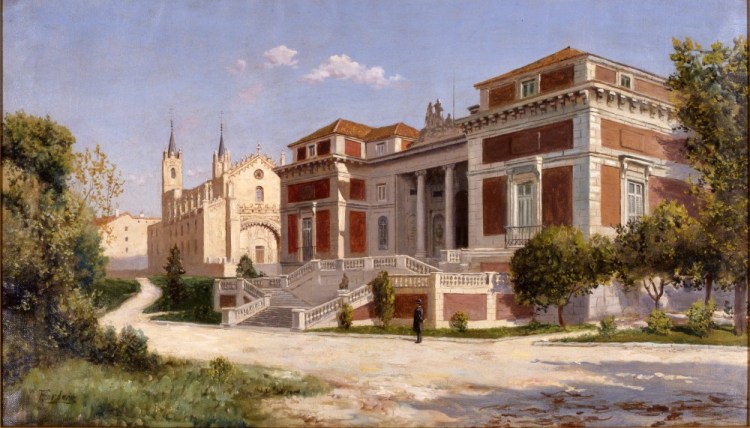
ARTES plans to join the party and organise events to celebrate the Prado’s birthday, for example in this year’s Glendinning lecture, by Javier Barón, Two Masters of the Prado: Velázquez, El Greco and Modern Painting. We have also changed our cover image to El Museo Del Prado, a painting by José Franco Cordero dated to c. 1890. The work, in the collection of the Madrid’s history museum, shows the Museum’s north façade before the construction of a new entrance designed by Francisco Jareño and completed around 1892. The church of San Jerónimo el Real is visible in the background. Click here for more information on this work.
José Franco Cordero, El Museo Del Prado, c. 1890, Museo de Historia, Madrid. Creative Commons – Reconocimiento-NoComercial 2.5 España (CC BY-NC 2.5)
Elizabeth Chant, report on a trip to Madrid, Simancas, and Seville, April-May 2018
NB: the deadline for applications for travel scholarships in 2019 is 31st January!
Thanks to the generosity of Coll & Cortés and ARTES, earlier this year I was able to visit Spain in order to conduct essential research for my doctoral thesis. My work explores the development of geographical understandings of Patagonia, initially in the Spanish Empire, and later in Argentina and Chile. I use a range of cultural media including literature, historical correspondence, and cartography, the latter being the focus of this trip. Spanish imperial maps of Patagonia tell a complex story of colonial violence, indigenous resistance, and contested sovereignty. They are central to the establishment and maintenance of Euro-Western Patagonian mythologies of barbarity and desolation. They also shed light on the origins of Argentina and Chile’s expansionist aims in the 19th century, another key consideration of my project.
Spain’s initial efforts to establish a settlement in Patagonia during the 1580s were gravely unsuccessful. A second large-scale attempt was fielded beginning in 1779 on the Atlantic coast of modern-day Argentina, and this event heralded a renewed cartographic interest in the region. I set out to consult the materials produced in the wake of said project during my time in Spain. Through this research, I wanted to amplify my cartographic corpus, and to better understand the pressing need for geographical information at this crucial juncture prior to Argentinean and Chilean independence.
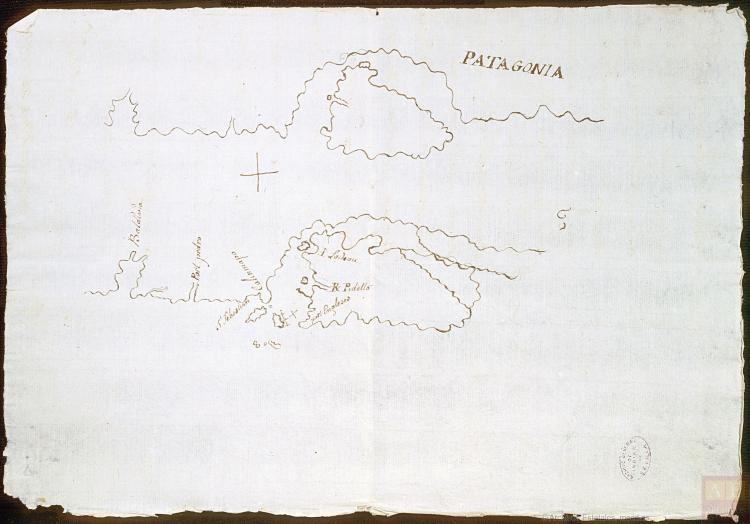
I began by visiting the Archive of the Museo Naval in Madrid. This was particularly useful for gathering primary cartographic materials. The highlight of my whole trip was finding eminent Spanish Pilot Alejo Berlinguero’s 1796 Descripción geográfica de las costas patagónicas… here. I was aware of Berlinguero’s watercolours painted during his voyage to Patagonia in the 1760s, but I did not know that he had produced a complete map of the region. It is without doubt one of the most important cartographic depictions of Patagonia to exist prior to Argentine and Chilean independence. Produced in the aftermath of Spain’s second colonisation project, it maps the region in considerable detail, and is telling of the urgent need for accurate information regarding the Patagonian interior. This map has become one of the focal pieces in the first chapter of my PhD, and I am extremely grateful to both Coll and Cortés and ARTES for enabling me to locate it.
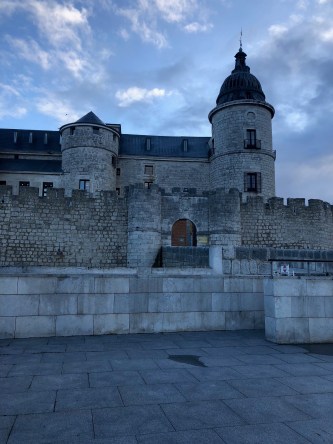
After Madrid, I went to the Archivo General de Simancas, Valladolid and then to the Archivo General de Indias, Seville. In these locations, I was looking for information regarding another important Spanish map of Patagonia, José Custodio de Sá y Faría’s 1786 Descripción geográfica de la costa patagónica…, an important companion piece to Berlinguero’s portrayal. Both of these archives house copies of said map. Consulting the corresponding documentation has been essential for understanding its context of production, and for comprehending the profound Spanish concerns regarding sovereignty in both Patagonia and the wider mar del Sur. I was able to read the accompanying letters that Sá y Faría sent to the then-Viceroy of Buenos Aires, the Marquis of Loreto, in which he argues for the continued maintenance of the colonisation project in spite of the considerable number of deaths and difficulties experienced. I was also able to locate the travelogue from Berlinguero’s voyage to Patagonia upon which his 1796 map was based. Further, in the Archivo de Indias I discovered perhaps the earliest Spanish map to use the toponym ‘Patagonia’ (1750), another significant find for my thesis.
The Coll and Cortés Travel Scholarship allowed me to encounter material that I would never have found had I been limited to working in the UK. I am currently working on an article comparing the Berlinguero and Sá y Faría maps, which will seek to highlight the importance of these until now overlooked pieces.
10:00 Inauguración. Jaime M. de los Santos. Consejero de Cultura, Turismo y Deporte. Comunidad de Madrid. Presentación. Miguel Luque. Decano de la Facultad.
MESA I. MUJERES PROTAGONISTAS DE LAS ARTES.
MODERA FÉLIX DÍAZ MORENO (UCM)
10:30 Plautilla Bricci: cronaca di un oblio. Consuelo Lollobrigida (Univ. of Arkansas – William J. Fulbright School of Arts and Sciences)
11:00 Pintoras flamencas en los siglos XVI y XVII: las sagas familiares y el talento. Ana Diéguez-Rodríguez (Instituto Moll. Centro de investigación en pintura flamenca Univ. de Burgos)
11:30 Pausa café
12:30 Vidas y afanes de las dos impresoras novohispanas del siglo XVIII: Rosa Teresa Poveda y Manuela de la Ascensión Cerezo. Marina Garone Gravier (Instituto de Investigaciones Bibliográficas, Univ. Nacional Autónoma de México)
13:00 Mujeres artistas en la Real Academia de Bellas Artes de San Carlos de Valencia. Mariángeles Pérez-Martín (Univ. de València)
13:30 Debate. Comida
MESA II. IDENTIDADES FEMENINAS, GENERADORAS DE ESPACIOS.
MODERAN CONCEPCIÓN LOPEZOSA APARICIO (UCM) Y SARA FUENTES LÁZARO (UNIV. A DISTANCIA DE MADRID)
16:00 De la casa al hogar. Aposentos femeninos en la Edad Moderna. Gloria Franco Rubio (UCM)
16:30 “Fare scena della casa”. Isabel de Farnesio y la arquitectura pintada en La Granja de San Ildefonso. Sara Fuentes Lázaro (Univ. a Distancia de Madrid)
17:00 Sociabilidad, ciudad y género en la crisis del Antiguo Régimen. Aproximaciones desde la cultura visual y material. Álvaro Molina (Univ. Nacional de Educación a Distancia)
17:30 “Mujeres en el límite”. Presencias femeninas en el Paseo del Prado de Madrid. Concepción Lopezosa Aparicio (UCM)
18:00 Debate
JUEVES, 21 DE FEBRERO
MESA III. LAS ARTES Y LA PRÁCTICA DEL PODER
MODERAN MAGDALENA DE LAPUERTA (UCM) Y MIGUEL HERMOSO CUESTA (UCM)
10:00 Il mecenatismo di Bona Sforza alla corte di Bari nella prima metà del ‘500. Mimma Pasculli (Univ. degli Studi di Bari Aldo Moro. Dpto. Lettere, Lingue e Arti)
10:30 Sofonisba Anguissola y la construcción de una imagen femenina para la familia Habsburgo. Jorge Sebastián Lozano (Univ. de València)
11:00 Patrimonio y encargos artísticos de Juana Cortés, II duquesa de Alcalá. Sergio Ramiro Ramírez (UCM)
11:30 Debate
12:00 Pausa café
12:30 La perla de la Monarquía hispana: Margarita de Austria y el retrato cortesano. Magdalena de Lapuerta Montoya (UCM)
13:00 Sor Ana Dorotea de Austria y la exaltación de las mujeres fuertes. Cipriano García-Hidalgo Villena (UCM)
13:30 María Isabel de Braganza y la música. Judith Ortega Rodríguez (ICCMU-UCM)
14:00 Debate. Comida
WORKSHOP (LUGAR: SALA DE JUNTAS). CUARTOS DE MUJERES. ESPACIOS DONDE VIVIR Y TRABAJAR EN EL SIGLO XVI
16:30 Presentación a cargo de Beatriz Blasco Esquivias (UCM). Intervienen: Elena Díez Jorge (Univ. de Granada), Ana Aranda Bernal (Univ. Pablo Olavide, Sevilla), María Núñez – González (Univ. de Sevilla)
18:00 Debate
VIERNES, 22 DE FEBRERO
MESA IV. EL ARTE EN SUS MANOS. LOS MUSEOS Y LA GESTIÓN DEL PATRIMONIO
MODERA JONATAN JAIR LÓPEZ MUÑOZ (UCM)
10:00 Las mujeres y la arqueología en Europa: de la aristocracia a las clases medias. Margarita Díaz-Andreu (ICREA y Univ. de Barcelona)
10:30 Mujeres y museos en Europa del Este. Laura Coltofean-Arizancu (Univ. de Barcelona)
11:00 Las profesionales de museos en España, una historia envuelta en silencios. Margarita Moreno Conde (Museo Arqueológico Nacional)
11:30 Debate. Pausa café
WORKSHOP
INVESTIGACIONES PREDOCTORALES
Presentación a cargo de María Ángeles Toajas Roger (UCM)
12:00 Aproximación al estudio de las mujeres en los talleres artísticos de la Villa de Madrid (1561–1700). Alba Gómez de Zamora Sanz (UCM)
12:20 La decoración del Cuarto de la Reina en el Alcázar Real de Madrid bajo Isabel de Borbón- Introducción y reflexiones. Audrey-Caroline Michielon (UCM / Univ. de Toulouse – Jean Jaurès )
12:40 El estudio de la moda femenina en la corte: Cuestiones metodológicas. María Redondo Solance (UCM)
13:00 Las mujeres y las artes en “la hora navarra del XVIII”. Sergio Rodero Jiménez (UCM)
13:20 Mujeres en las actas de la Real Academia de Bellas Artes de San Fernando. Daniel Lavín González (UCM)
13:40 Debate y conclusiones del Segundo Seminario. Comida
VISITA GUIADA: REAL MONASTERIO DE LA ENCARNACIÓN
16:30 Encuentro frente al Monasterio. Plaza de la Encarnación, 1 (28013 Madrid)
Practical information
Location: Salón de Grados y Sala de Juntas, Facultad de Geografía e Historia, Universidad Complutense de Madrid, February 20–22, 2019
Registration deadline: Feb 20, 2019
Scientific committee:
Antonio Bonet Correa, Rosario Camacho, Benito Navarrete, Mª Ángeles Pérez Samper, Javier Rivera Blanco.
Organisers:
Gloria Del Val, Sara Fuentes, Daniel Lavín, Jonatan Jair López, Sergio Ramiro, Sergio Rodero.
Supported by the Proyecto de Investigación I+D+i FEMENINO SINGULAR. Las mujeres y las artes en la Corte española de la Edad Moderna (reinas, nobles, artistas y empresarias) [HAR2015-65166-P MINECO/FEDER]
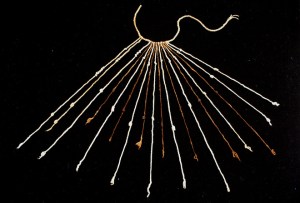
Khipu RN9027, from the Casa del Kipu deposit at Pachacamac; courtesy of Denise Pozzi-Escot, director, Pachacamac site museum; photograph by Rommel Angeles.
There has been much concern and criticism in the West over the absence of the voices of “peoples without history” in the writing of local, regional, and global histories. This concern has been especially profound insofar as it pertains to societies that did not have in the past, or that do not have today, their own traditions of written history. The Inkas of the Pre-Columbian Andes represent a striking case study in this regard, because, while Inka administrators had the use of an exceptionally complex and highly efficient instrument for record keeping, in the knotted-string khipu (or quipu, “knot”), we have not to date been able to draw historical information from these knotted records for writing a history of the Inka Empire. Gary Urton’s recently published book, Inka History in Knots: Reading Khipus as Primary Sources (Univ. of Texas Press, 2017), lays out a methodology for approaching khipu accounts as sources for writing Annales-style histories of the Inka state—i.e., histories based on administrative data, such as censuses, tribute records, storehouse accounts, etc. This symposium brings together eight Andean scholars to discuss and debate the question of whether or not, and if so how, we might draw on knotted cord accounts from the pre-Inka Wari, the Inka empire, and those from Andean subjects of the Spanish Colonial state in order to begin to understand how Andean peoples constructed representations of their own societies. The principal challenges will be, first, to identify the structures, physical features, organizational principles, and semiotic properties of cord accounts in these different periods in the Andean past, and second, to determine how we might draw on these constructions to begin to write histories of Andean societies based on Andean sources.
Programme:
9:30 am
Peter N. Miller
Bard Graduate Center Welcome
Gary Urton
Harvard University Introduction
9:50 am
Gary Urton
Harvard University Finding Time for History in the Inka Khipus
10:30 am
Jeffrey C. Splitstoser
George Washington University The Large Wari Khipu at Dumbarton Oaks
11:10 am Coffee Break
11:30 am
Jon Clindaniel
Harvard University Towards an Understanding of Non-numerical Inka Khipu Semiosis: Implications for the Interpretation of Inka History Using Primary Sources
12:10 pm
Bruce Mannheim
University of Michigan Three Commensuration Problems in Interpreting Khipus
12:50 pm Lunch Break
2 pm
Terence N. D’Altroy
Columbia University The Dynamic Formation of Imperial Knowledge
2:40 pm
Sabine Hyland
University of St Andrews “These Are Our Khipus!” The Ritual Khipu Boards of Casta, Peru
3:20 pm Coffee Break
3:40 pm
José Carlos de la Puente Luna
Texas State University Khipus as Legal Archives: Tribute, Justice, and Controlled Translation in Early Colonial Peru
4:20 pm
Frank Salomon
University of Wisconsin–Madison The Long Afterlives of Central-Peruvian Khipu Patrimonies

 Raúl de Nieves: Fina, the first solo museum exhibition by Raúl de Nieves (b. 1983, Michoacán, Mexico), will feature new work in a site-specific installation developed for the Cleveland Museum of Art at the Transformer Station. Narrative facets of the installation will be informed by de Nieves’s experience of Mexican cultural traditions, considered through the lens of this moment in history. These will unfold in relation to the particular architecture of the Transformer Station. As a whole, the installation will be characterized by the artist’s ongoing interest in transforming humble materials into spectacular objects that alter the spaces around them.
 This year’s Glendinning Lecture, an annual event in honour of the great Hispanist Nigel Glendinning, will celebrate the 200th anniversary of the Museo Nacional del Prado.
 7th February 2019, 16:00 to 17:00, Room 146, Elvet Riverside 1, Durham University

 This exhibition opens the anniversary celebrations by offering a survey of the museum’s history that focuses on the dialogue between the Museum and society; heritage policies in Spain; the trends that have guided the growth of the museum’s collection and its transformation into a place that has allowed Spanish and foreign writers, intellectuals and artists to reflect on the country’s past and its collective identity.
 Art at the court of Philip IV was an international language devoid of local boundaries. The work of Velázquez after 1623 is best understood in this international context. He was deeply influenced by paintings in the royal collections, especially works by Titian, Tintoretto and Rubens. One of his key experiences was the trip to Rome in 1629 where he encountered classical and Renaissance art and established contacts with his contemporaries in Italy. The exhibition underscores such internationalism through a selection of 61 paintings associated with Velázquez, the Spanish royal collections and the Spanish Golden Age. More than twenty of these works were painted by Italian, Flemish and French artists, including Titian, Rubens, Luca Giordano, Jan Brueghel, Anthonis Mor, Giovanni Lanfranco, Claude Lorrain, Salvator Rosa, Massimo Stanzione and Guido Reni. Spanish artists are represented through works by Ribera, Zurbarán, Murillo, Alonso Cano, Pereda, Maíno, Sánchez Coello, Mazo, Van der Hamen and others.
 This exhibition focuses on Spanish drawing manuals of the 17th and 18th centuries, locating them in their international context. These rare and innovative manuals responded to changing trends in the theory and practice of art. While such learning aids were produced across Europe, this exhibition will highlight the unique features of Spanish examples through works by José de Ribera, Pedro de Villafranca y Malagón, José García Hidalgo, Friar Matías de Irala and José López Enguídanos.
 This exhibition is the result of the research undertaken for the publication of a new catalogue raisonné of Goya’s drawings, a subject to which the Museo del Prado has always devoted particular attention and which is one of the keystones of its collection. The exhibition will bring together more than 100 drawings by Goya from the Prado’s own collections and from public and private ones around the world. It will be presented as an extensive chronological survey of the master’s oeuvre, ranging from the Italian Sketchbook to the Bordeaux Albums. It will also offer an up-to-date vision of the ideas that recurrently appear in Goya’s work, revealing the ongoing and long-lasting relevance of his thinking.
 The exhibition will reveal the artistic personality of two of the most outstanding women artists in western art. Through a total of 60 works and for the first time, the Museo del Prado will jointly present the most important paintings by Sofonisba Anguissola (c. 1535–1625) and Lavinia Fontana (1552–1614). The two artists achieved recognition and fame among their contemporaries for and despite their status as female painters. Both were able to break away from the prevailing stereotypes assigned to women in relation to artistic practice and the deep-rooted scepticism regarding women’s creative and artistic abilities. In particular, Sofonisba Anguissola had close connections with the Spanish court as tutor to Queen Elizabeth of Valois and later official court painter to King Philip II.
 This exhibition project will recreate the original aspect of Room 39, known as Their Majesties’ Retiring Room. First opened in 1828, it was intended as a portrait gallery of the Bourbon Dynasty. The images on display were accompanied by still lifes, floral compositions and landscapes and by other paintings that depict events from the reigns of Charles III and Ferdinand VII. This installation will recreate the hanging of the paintings at different heights and will include some of the furnishings made for this space, including Ferdinand VII’s toilet.
 This exhibition on late 16th- and early 17th-century Dutch and Spanish painting is the result of an extensive and important research project on the part of the Museum arising from a collaborative agreement with the Rijksmuseum in Amsterdam, which will be lending a significant group of works. The exhibition will offer a reflection on the pictorial traditions represented by Spain and the Low Countries. While Dutch art-historical literature has considered these traditions as essentially different, this exhibition will aim to juxtapose the historical myths and artistic realities of the two countries and to reflect on the numerous traits that they share. In order to appreciate these parallels the exhibition will include major works by artists such as Velázquez, Rembrandt, Ribera, Frans Hals and Vermeer.
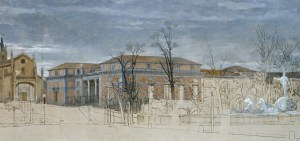 Prado 200 is a new feature within the museum’s permanent display. This installation is presented as nine chronological sections which will present the museum’s history with an emphasis on its architecture, public image and its principal exhibitions and activities. Curated by Victor Cageao, it will include works of art and documentary material from the permanent collection and from the holdings of the Museum’s archive and library (paintings, sculptures, prints, photographs, documents, architectural models, plans, etc.), displayed in Rooms 100, 101 and 102 of the Villanueva Building. It will be accompanied by a specially designed online timeline providing access to graphic and technical documentation on the Museum’s history.

 ARTES
ARTES 