
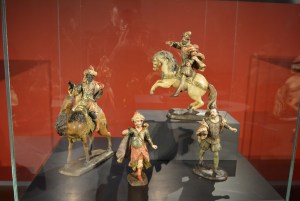
 Now on display at the Museo Nacional de Escultura in Valladolid the museum’s newly acquired group of 19 individual polychrome sculptures by the Seville-born Luisa Roldán (1652-1706), forming the unusual subject of the Cavalcade of the Kings. These small-scale cedar-wood painted and gilded figures were acquired in December 2017 after being export-stopped and are the first examples of La Roldana’s work to enter the Valladolid museum. Amongst the mixed-race cavalcade, which is presumed to have formed the cortege for a much larger, but now dismantled, group, there is a fourth king, the King of Tharsis, the mythical Hispanic region cited in the Bible. The group is believed to have been carved before the sculptress moved to the Madrid court in 1689. A video clip showing some of the figures can be viewed here.
Postgraduate Research Scholarship in Renaissance Studies at Birkbeck, U of London—Deadline 15 June 2018
| Qualification type: | PhD |
| Location: | London |
| Funding for: | UK Students, EU Students |
| Funding amount: | Full Home/EU fee waiver (currently £4,260) & annual stipend |
| Hours: | Full Time |
| Placed on: | 18th May 2018 |
| Closes: | 15th June 2018 |
Postgraduate Research Scholarship in Renaissance Studies 18-19
Birkbeck School of Arts will award one fully funded Birkbeck Postgraduate Research Scholarship in Renaissance Studies beginning in 2018-19.
We invite outstanding applicants working in one or more than one of the constituent disciplines of Renaissance Studies (ca. 1400-1670) in the School of Arts at Birkbeck. Applications are welcomed within the fields of History of Art; English Literature; Drama and Theatre Studies; Intellectual History; Early Modern French Studies; Iberian and Latin American Studies and Visual Culture. The scholarship is equally open to candidates wishing to work in interdisciplinary ways and to those located within one of the single disciplines.
Supervision in Renaissance Studies in the School of Arts is wide in scope. For a list of Renaissance Studies specialists, who can act as supervisors, please visit the academic staff pages on the School’s departmental websites.
Eligibility
Birkbeck Postgraduate Research Scholarships are open to Home/EU and International applicants applying for a full-time or part time M.Phil/PhD place within the School of Arts, starting in the 2018/19 academic year.
Funding
The Birkbeck Postgraduate Research Scholarship awards will include a full fee waiver capped at the value of the full-time Home/EU rate for M.Phil/PhD degrees (currently £4,260), in addition to an annual stipend set at Research Council rates (currently £16,777; pro rata in the case of a part-time award).
Duration of Awards
Scholarships will be tenable for up to three years (subject to satisfactory academic progress) for full-time students, and at an appropriate pro rata rate and extended duration for part-time students.
How to Apply – Application Process
To apply for an award please download the funding application form here.
Please note that you will also need to apply for a place on a relevant PhD programme:
M.Phil/PhD Comparative Literature
M.Phil/PhD English and Humanities
M.Phil/PhD German
M.Phil/PhD Iberian and Latin American Studies
Please consult the general guidance on applying online for an M.Phil/PhD place. You can find the School of Arts Guide for Applicants here. All prospective students are strongly advised to first make informal contact with a potential supervisor. For information about staff and the research environment at Birkbeck, please consult the School’s Departmental webpages.
Application Deadline: 6pm 15 June 2018.
Please be advised that all applicants wishing to be considered for funding may be required to attend an interview to discuss their proposal. Interviews will be held in w/c 18 and 25 June (if not before). Results will be announced in early July 2018.
The completed form should be emailed to SoAFA@bbk.ac.uk.
If you have any enquiries about this studentship and the scope of supervision within the School of Arts, please contact Dr Luisa Calè, Assistant Dean for Postgraduate Research (l.cale@bbk.ac.uk).
Workshop: Nuevos caminos del hispanismo, 16–17 October 2018, Casa de Velázquez, Madrid
 Click here for more information on a three-day residential workshop at the Casa Velázquez in Madrid. Intended for young researchers, the workshop will explore new currents in Hispanic studies. It is organised around a series of lectures by the following scholars:
Carlos MARTÍNEZ SHAW (Universidad Nacional de Educación a Distancia, Madrid / Real Academia de la Historia).
Alicia ALTED VIGIL (Universidad Nacional de Educación a Distancia, Madrid)
Louise BÉNAT-TACHOT (Université Paris – Sorbonne)
Fernando BOUZA ÁLVAREZ (Universidad Complutense de Madrid)
Serge GRUZINSKI (École des hautes études en sciences sociales, Paris)
Roberto MONDOLA (Università degli Studi l’Orientale di Napoli)
José Luis SÁNCHEZ NORIEGA (Universidad Complutense de Madrid)
Jesusa VEGA GONZÁLEZ (Universidad Autónoma de Madrid)
followed by extensive discussion in Spanish and French.
The deadline for enrolment is 12 July 2018 at 5pm. Applicants are required to fill an application form, which will be evaluated on the basis of academic record and language fluency. The 20 selected candidates will be notified after 20 July 2018. The workshop costs 50 euros inclusive of accommodation and lunch. African and Latin American applicants may be selected for a scholarship of 300 euros, intended as a contribution towards travel costs.
Featured Exhibition: Painted in Mexico, 1700–1790: Pinxit Mexici, Metropolitan Museum of Art, New York, until 22 July 2018

The vitality and inventiveness of artists in eighteenth-century New Spain (Mexico) is the focus of Pinxit Mexici, an exhibition which presents some 110 works of art (primarily paintings), many of which are unpublished and newly restored. The exhibition surveys the most important artists and stylistic developments of the period and highlights the emergence of new pictorial genres and subjects. It is the first major exhibition devoted to this neglected topic.
The exhibition is divided in thematic sections: Great Masters; Masters Storytellers and the Art of Expression; Noble Pursuits and the Academy; Paintings of the Land; The Power of Portraiture; The Allegorical World; Imagining the Sacred.
Click here to find out more.
Conference: Artistic Trade between Spain and its Viceroyalties from 1500 to 1800, King’s College, Cambridge, 22 June 2018

This is the first conference in the United Kingdom devoted to artistic trade between Spain and its viceroyalties. Referring to Cambridge’s Spanish and colonial art collections and with the indispensable support of the Nigel Glendinning studentship for Spanish studies, this conference brings together scholars specialized in the art from the Spanish Viceroyalties. The speakers will trace the artworks from their production, their movement with the help of agents and their collection and display at their destination. Such approach avoids setting an epicentre and periphery but establishes an equalitarian platform on the movement of art within the Spanish Empire.
8:30- 9:15 – Registration.
Introductory remarks:
9:15- 9:30 – Akemi Herráez Vossbrink (University of Cambridge)
Keynote speaker:
9:30- 10:00 – Luisa Elena Alcalá (Universidad Autónoma de Madrid)
Passageways of Art in the Atlantic world: Artists, Patrons and Agents.
- Workshops and Artists Producing Art for the Spanish Viceroyalties and Transitory Spaces.
Chaired by Akemi Herráez Vossbrink (University of Cambridge)
10:00- 10:30 – Holly Trusted (Victoria and Albert Museum), Shipwrecked Ivories: The Confluence of East and West.
10:30- 11:00 – Piers Baker Bates (The Open University), Traveling between the Viceroyalties: Artistic Translation in the Sixteenth-century Hispanic World.
11:00- 11:30 – Escardiel González Estevez (Universidad de Sevilla), Alonso Vázquez between Seville, Mexico and Manila (1603-1608): The Paradigm of a “Global Artist”.
11:30- 12:00- Questions.
12:00-13:30- Lunch break.
- The Role of Agents Commercializing Artworks between Spain and its Viceroyalties
Chaired by José Ramón Marcaida López (University of Saint Andrews)
13:30-14:00 – Sandra Van Ginhoven (Getty Research Institute, Research Associate), Spanish Transatlantic Agents and the Flemish Guilliam Forchondt in the Overseas Paintings Trade.
14:00- 14:30 – Corinna Gramatke (Technical University of Munich Chair of Conservation-Restoration), “The Portable Europe”: European Artworks for the Jesuit Province of Paraguay (1608-1767).
14:30-15:00 – Eduardo Lamas Delgado (Royal Institute for Cultural Heritage, Brussels), Madrilenian Painters and America: Artistic Production for Overseas Trade Networks and their possible Agents.
15:00- 16:00- Questions followed by a coffee break.
- Collecting and Display in Private, Civil and Religious Spaces in the Spanish Viceroyalties.
Chaired by Jean Michel Massing (University of Cambridge)
16:00-16:30 – Kathryn Santner (Leverhulme Trust Fellow, ILAS, London), Conventual Art Collections and Artistic Exchange in the Colonial Viceroyalties.
16:30-17:00 – Isabel Oleas Mogollón (University of Delaware), The Divine and the Self: Uses and Meanings of Mirrors in Quito’s Jesuit Church.
17:00-17:30 – Veronika Winkler (Ludwig-Maximilians-Universität, München), Witnessing the Saint’s Life: Patrons and Hagiographical Painting Cycles of Viceregal Peru.
17:30- 18:00- Final questions and closing remarks.
For further information please contact Akemi Herráez Vossbrink at alh64@cam.ac.uk.
To book your place, please click here
4-week course on intercultural contact and primary sources, October 2018, €60, CSIC, Madrid


4 months to go! ‘Ribera: Art of Violence’ opens 26 September 2018 at Dulwich Picture Gallery, London
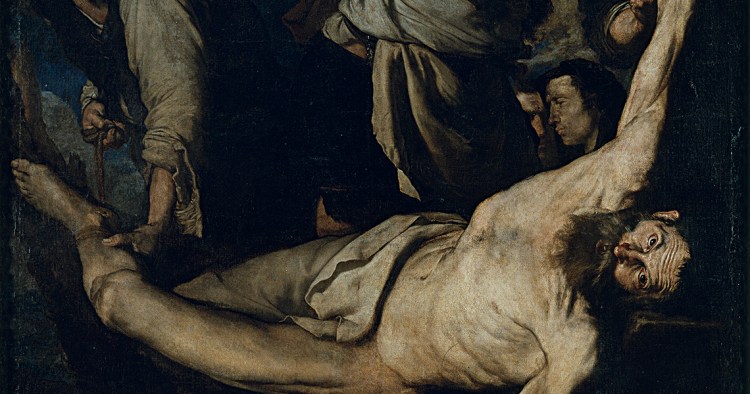 This autumn, Dulwich Picture Gallery will present the first exhibition in the UK dedicated to the Spanish Baroque painter, draughtsman and printmaker Jusepe de Ribera (1591–1652). Born in Játiva, Valencia, Ribera emigrated to Italy as a young artist. Proud of his Spanish heritage, he eventually settled in Naples, then a Spanish territory, but never again returned to Spain. A hybrid figure, Ribera had a significant influence on the art of both countries in the seventeenth century.
Introducing this artist to a UK audience, the exhibition will focus on some of Ribera’s most powerful images featuring saints and sinners, flaying and flogging. Ribera’s images of pain have often been described as shocking and even grotesque in their realism. In a common historiographical trope, the artist himself has been labelled as sadistic and violent. Challenging this long-standing interpretation, Ribera: Art of Violence will reveal the complex artistic, religious and cultural discourses underpinning the artist’s violent imagery in paint and on paper. This exploration will be anchored by a number of major loans from North American and European collections, with some works travelling to the UK for the first time.
A scholarly catalogue will accompany the exhibition, showcasing the new research which has informed the display.
Ribera: Art of Violence is co-curated by ARTES committee member Dr Edward Payne (Head Curator of Spanish Art, The Auckland Project), author of a PhD thesis on the theme of violence in Ribera’s art (2012) and contributor to the catalogue raisonné of Ribera’s drawings (2016), and Dr Xavier Bray (Director, The Wallace Collection), former Arturo and Holly Melosi Chief Curator at Dulwich Picture Gallery, and curator of the National Gallery’s exhibitions The Sacred Made Real: Spanish Painting and Sculpture 1600–1700 (2009) and Goya: The Portraits (2015).
Click here for a video presenting the exhibition, and here for a preview article in The Guardian.
ARTES AGM in Oxford, Thursday 14 June, 2018
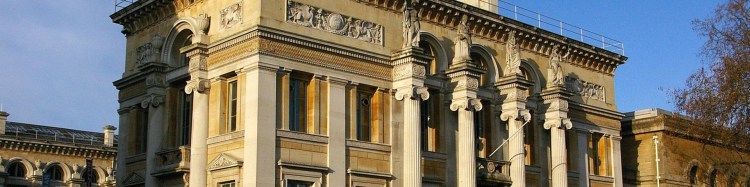
10:00 Campion Hall, Brewer St, Oxford OX1 1QS — http://www.campion.ox.ac.uk
Established in 1896, Campion Hall holds extensive collections, including in the areas of Iberian & Latin American art.
Visit Led by Professor Peter Davidson, Senior Research Fellow & Archivist
***Attendees are asked to arrive punctually, as late arrivals may be difficult to accommodate***
12:00 Taylor Institution
St. Giles’, Oxford, OX1 3NA — https://www.bodleian.ox.ac.uk/taylor & http://blogs.bodleian.ox.ac.uk/taylorian
Established through the legacy of architect Sir Robert Taylor (1714-1788), the ‘Taylorian’ is the University’s centre for the study of Modern European languages and literatures, other than English.
AGM and Prize Giving — Sandwich lunch provided
15:00 Magdalen College
High Street, Oxford, OX1 4 AU — http://www.magd.ox.ac.uk
Founded by William Waynflete in 1458, the College holds wide-ranging art collections. Visit Led by the Dean, the Revd Dr Jonathan Arnold: Chapel altarpiece, Christ Carrying the Cross (attrib. Valdés Leal/Seville School, 17thC; for in situ discussion)
Venues can accommodate limited numbers only, so book early to avoid disappointment. To book, please email artesiberia@gmail.com, stating
(1) Whether you will arrive in time for the Campion Hall visit
(2) Your membership status
Once your place has been confirmed please pay a small charge to cover costs: £7 for members, or £20 for non-members
- by credit or debit card (via the CAF website )
- by cheque made out to ARTES and sent to: 58 Manor Road, Woodstock, Oxon OX20 1XJ
- by Paypal – simply click the button below.

New Online Resource: Collection of the Museum für Islamische Kunst in Berlin
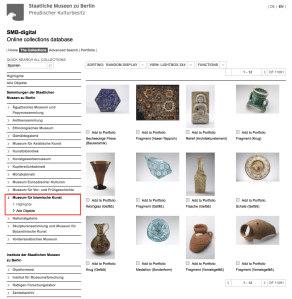 The Museum für Islamische Kunst in Berlin now provides access to more than 11.000 objects online on its website. This is a fundamental milestone in the accessibility of the museum collection and would not have been possible without the generosity of Yousef Jameel, Hon. LHD, a private supporter of the arts, education, and research.
Between 2012 and 2017 a special project team of art historians, archaeologists, photographers and conservators helped permanent museum staff to record, document and photograph large parts of the museum’s collection. They compiled important information about the objects including their dating, provenance, materials, and techniques.
After the successful conclusion of the project last year, a huge selection of object information is now available online, which also includes photographs of entire works and details. The selection includes most of the museum’s famous carpets, three hundred examples of its little-published textiles, and representative artworks from the ceramic, glass and metalwork and the ivory collection.
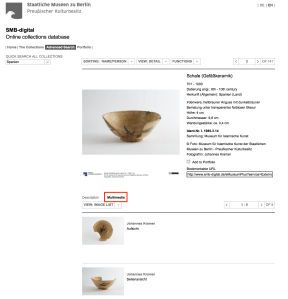 To see the museum’s collection, follow this link and select ‘Museum für Islamische Kunst’ from the museum list on the left. You can also click here for a selection of highlights from the museum, here for the whole collection, and here for objects connected to Spain. Clicking on Advanced Search will enables visitors to search according to date, material, object/term and geographical reference. Once you have selected an object of interest, don’t forget to click on ‘Multimedia’ below the object’s lead image to visualise a portfolio of photographs of different views and details.
Opens today: Dibujos de Luis Paret (1746-1799) at the Biblioteca Nacional de España, Madrid
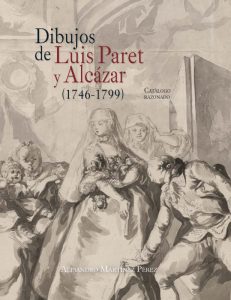 Luis Paret y Alcázar (Madrid, 1746‒1799) has been hailed as a ‘spontaneous and joyful’ painter who allowed himself to be ‘overly’ influenced by French art. Labelled as the ‘Spanish Watteau’ and the most genuine representative of Rococo painting in the
country, he has long been considered the second most important painter of his day after Goya.
However, these considerations are a direct consequence of a historiographical discourse more concerned with contrasting the two artists than with attributing Paret’s heterodoxy (he was a pupil of La Traverse and court painter to the Infante Don Luis) to his eventful life, his artistic interests and his background.
The above factors provide a backdrop to Dibujos de Luis Paret (1746-1799). Open until 16 September, the exhibition is curated by Alejandro Martínez Pérez, a historian well versed in the Paret’s life and career who sets out to clarify the historiographical lacunae by examining the artist’s main instrument – his drawings – reconstructing his personal library and analysing his relationships with his patrons.
The show – featuring a total of 188 pieces including drawings (84), paintings, prints, books and manuscripts – has been made possible by the collaboration and loans of important private collections and institutions, both Spanish and foreign, such as the Museo Nacional del Prado, the National Gallery of Art in Washington, the Real Academia
de Bellas Artes de San Fernando, the Rijksmuseum, the Real Academia Española, the Fundación Lázaro Galdiano and the Museo Nacional de Artes Decorativas.
Organised by the BNE and the CEEH, the exhibition is accompanied by a catalogue raisonné of Luis Paret’s drawings, which is set to become a reference work for studies on the artist. Published by CEEH, the catalogue can be purchased here. Until 15 June, our readers can benefit from a 10% discount.
 ARTES
ARTES 