

The exhibition Sorolla y la moda closes on 27 May at the Museo Sorolla in Madrid.
Curated by Eloy Martínez de la Pera, it investigates the connections between Sorolla’s painting and fashion between 1890 and the 1920s.
Three important new acquisitions are temporarily on display at the Prado Museum in Madrid:
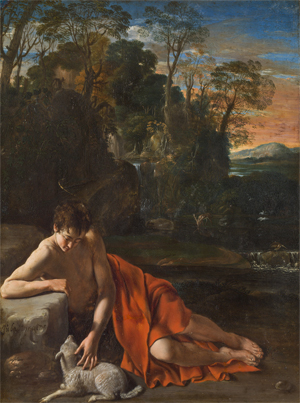
Saint John the Baptist in a Landscape, an oil on copper by Juan Bautista Maíno (1581–1649), strongly influenced by the artist’s Roman period.
The copper plate for a print portraying an auto da fé in Madrid’s Plaza Mayor, engraved by in 1680 by Flemish artist Gregorio Fosman, one of the outstanding printmakers of the seventeenth century. The print is related to Francisco Rizi’s famous painting of the same subject, also in the Prado.

Luis Paret’s A celestina [procuress] and the lovers, a work of 1784, inspired by the famous play La Celestina by Francisco de Rojas (1499), which foreshadows the satire of interpersonal relationships characteristic of Goya’s Caprichos 

This is the first conference in the United Kingdom devoted to artistic trade between Spain and its viceroyalties. Referring to Cambridge’s Spanish and colonial art collections and with the indispensable support of the Nigel Glendinning studentship for Spanish studies, this conference brings together scholars specialized in the art from the Spanish Viceroyalties. The speakers will trace the artworks from their production, their movement with the help of agents and their collection and display at their destination. Such approach avoids setting an epicentre and periphery but establishes an equalitarian platform on the movement of art within the Spanish Empire.
8:30- 9:15 – Registration.
Introductory remarks:
9:15- 9:30 – Akemi Herráez Vossbrink (University of Cambridge)
Keynote speaker:
9:30- 10:00 – Luisa Elena Alcalá (Universidad Autónoma de Madrid)
Passageways of Art in the Atlantic world: Artists, Patrons and Agents.
Chaired by Akemi Herráez Vossbrink (University of Cambridge)
10:00- 10:30 – Holly Trusted (Victoria and Albert Museum), Shipwrecked Ivories: The Confluence of East and West.
10:30- 11:00 – Piers Baker Bates (The Open University), Traveling between the Viceroyalties: Artistic Translation in the Sixteenth-century Hispanic World.
11:00- 11:30 – Escardiel González Estevez (Universidad de Sevilla), Alonso Vázquez between Seville, Mexico and Manila (1603-1608): The Paradigm of a “Global Artist”.
11:30- 12:00- Questions.
12:00-13:30- Lunch break.
Chaired by José Ramón Marcaida López (University of Saint Andrews)
13:30-14:00 – Sandra Van Ginhoven (Getty Research Institute, Research Associate), Spanish Transatlantic Agents and the Flemish Guilliam Forchondt in the Overseas Paintings Trade.
14:00- 14:30 – Corinna Gramatke (Technical University of Munich Chair of Conservation-Restoration), “The Portable Europe”: European Artworks for the Jesuit Province of Paraguay (1608-1767).
14:30-15:00 – Eduardo Lamas Delgado (Royal Institute for Cultural Heritage, Brussels), Madrilenian Painters and America: Artistic Production for Overseas Trade Networks and their possible Agents.
15:00- 16:00- Questions followed by a coffee break.
Chaired by Jean Michel Massing (University of Cambridge)
16:00-16:30 – Kathryn Santner (Leverhulme Trust Fellow, ILAS, London), Conventual Art Collections and Artistic Exchange in the Colonial Viceroyalties.
16:30-17:00 – Isabel Oleas Mogollón (University of Delaware), The Divine and the Self: Uses and Meanings of Mirrors in Quito’s Jesuit Church.
17:00-17:30 – Veronika Winkler (Ludwig-Maximilians-Universität, München), Witnessing the Saint’s Life: Patrons and Hagiographical Painting Cycles of Viceregal Peru.
17:30- 18:00- Final questions and closing remarks.
For further information please contact Akemi Herráez Vossbrink at alh64@cam.ac.uk.
To book your place, please click here
 Coordinators: Ana Cabrera and Lesley Miller
This conference explores collecting practices, attitudes to and perceptions of Spanish decorative arts in Britain and Spain from the 19thcentury onwards, and how these attitudes influenced the development of museums and museum collections in both countries. The case studies aredrawnfrom the British and Spanish museum collections.
The conference is organisedin joint sessions dealing with the same subject from British and then Spanish perspectives. The first day considers the collecting of particular media while the second day focuses on the dissemination, display and conservation of these collections. The conference includes poster sessions during the coffee breaks.
Click here to buy tickets
Programme
Friday, 8thJune 2008: Collecting Spanish Decorative Arts
10.00 Registration and collecting of conference packs; displaying of posters
10.20 Introduction
Ana Cabrera, V&A
10:30 Collecting, Display & Dissemination: The Changing Face of the Decorative Arts Collection at South Kensington, 1852-1873
Susanna Avery-Quash, National Gallery, London
Lustreware and Furniture
Chair: Holly Trusted, V&A
11.00 Collecting Spanish Lustreware at the Victoria and Albert Museum
Mariam Rosser-Owen, Asian Department, V&A
11:30 A Survey and History of the Collecting of Spanish Decorative Arts: Lustreware
Jaume Coll, Museo Nacional de Cerámica, Valencia
12.00-12.30. COFFEE BREAK
12:30 Collecting Spanish Furniture, Woodwork and Leatherwork, 1850-1950
Nick Humphrey, Furniture, Textiles and Fashion department, V&A
13:00 Collecting Spanish Furniture in Madrid, 1880-1920
Sofía Rodríguez, Museo Nacional de Artes Decorativas, Madrid
13.30-14.30 LUNCH
Textiles and Fashion
Chair: Sonnet Stanfill, V&A
14:30 Following the Thread: Collecting Spanish Textiles at the Victoria and Albert Museum
Ana Cabrera, Marie S.-Curie Fellow, V&A
15:30 Textile Collecting in Catalonia
Silvia Carbonell, Centre de Documentació i Museu Tèxtil, Terrasa
16:00 Fashion and Spain at the Victoria and Albert Museum
Oriole Cullen, Furniture, Textiles and Fashion Department, V&A
16:30 From Dress to Fashion: The Collection of The Museo del Traje
Helena López del Hierro, Museo del Traje, Madrid
16.30-17.00 TEA BREAK
Sculpture and Plaster Casts
Chair: Edward Payne, Auckland Castle Project
17.00 A Vogue for St Francis
Xavier Bray, Wallace Collection, London
17:30 Spanish Monuments Displayed at South Kensington: Raising the Profile of Spanish Art through Plaster Casts
Holly Trusted, Sculpture, Metalwork, Ceramics and Glass Department, V&A
18:00 Electrical Treasuries: The Decorative Arts Collection from Antiquity at the Museo Nacional de Reproducciones, 1881-1915
María Bolaños, Museo Nacional de Escultura, Valladolid
18.30-19.00 DISCUSSION
Saturday, 9thJune 2008: Collecting Spanish decorative arts continued
Silver
Chair: Antonia Boström, V&A
10:15 The Scholar, the Scoundrel and the Skater: How the V&A Collections of Hispanic Silver were formed
Kirstin Kennedy, Sculpture, Metalwork, Ceramics and Glass Department, V&A
10:45 Collecting Spanish Silver
Jesús Rivas, Universidad de Murcia
11.15-11.45COFFEE BREAK
Displaying, Interpreting and Conserving Spanish Decorative Arts
Chair: Christopher Wilk, V&A
11.45 Displaying Decorative Arts in Britain and Spain. A Comparative Analysis
Isabel Rodríguez, Museo Nacional de Artes Decorativas, Madrid
12.15 Spain in the Europe 1600-1815 Galleries at the V&A
Lesley Miller, Furniture, Textiles and Fashion Department, V&A
12.45 The20th-century Galleries at the V&A
Corinna Gardner and Johanna Agerman Ross, Design, Architecture and Digital Department, V&A
13.15-14.15LUNCH
Displaying, Interpreting and conserving Spanish decorative arts
Chair: Joanna Norman, V&A
14.15 The Conservationof the Cast Courts. New Discoveries from Spanish Casts
Victor Borges, Conservation Department, V&A
14:45 Collecting in Action: Building a Spanish Gallery in Bishop Auckland
Edward Payne, The Auckland Project
15.15 Closing remarks
Joanna Norman, Head of the Victoria and Albert Research Institute (VARI)
Miguel González Suela, Directorate of the State Museum, Spanish Ministry of Education, Culture and Sports

Paper proposals are being accepted for “Iberian (In)tolerance: Minorities, Cultural Exchanges, and Social Exclusion in the Middle Ages and Early Modern Era,” an LAHP Funded Postgraduate Students-led Conference to be held at Senate House, Bedford Room 37, University College, London.
Keynotes speakers include Prof. Trevor Dadson (Queen Mary University) and Prof. Alexander Samson (UCL)
Submission deadline: 20 June 2018
During the Middle Ages and the Renaissance, minorities in the Iberian peninsula experienced both peaceful coexistence and, at times, violent intolerance. But despite restrictions, persecutions, and forced conversions, extensive cultural production and exchange among Jews, Christians and Muslims defined the life in towns and cities across the centuries, particularly in Al-Andalus. In this context of religious (in)tolerance, the question of limpieza de sangre (blood purity) played an important role in preventing newly converted Christians from occupying high social positions. Recent approaches have highlighted how the question of limpieza de sangre was not only a matter of anti-Judaism or hostility towards Jews and Moors, but was also driven by personal enmity, ambition, and political interest. Also relevant are a series of political decisions concerning minorities, such as conversos or moriscos, which appeared in the two first decades of the seventeenth century and deeply affected the social climate of the time. This is reflected in literary works from the period, when a number of prominent pieces dealt directly with the issues raised by the political reforms. While some of the decisions are very well studied, such as the expulsion of the moriscos in 1609 and 1610, others such as the issue of the Pardons, in which the both Duke of Lerma and the Count-Duke of Olivares were involved, are less well known. It is clear that these circumstances affected the lives of many authors, their poetic trajectories and determined their voices and their works.
We invite proposals for papers in English (15-20 minutes) that explore the relationships among Jews, Christians and Muslims in the Iberian Peninsula from the Middle Ages to the 17th century and how these relationships changed over time, as represented in literary works that mirrored and were influenced by the particular socio-political dynamics of the period.
Possible topics include, but are not limited to:
• Literature and minorities: Conversos, New Christians, Marranos, Moriscos.
• Literature and tolerance, convivencia
, cultural exchanges.
• Literature and legality: statutes of limpieza de sangre (blood purity), blood libel, Pardons of 1609 and 1627, Duke of Lerma, Duke of Olivares.
• Literature beyond the Iberian Peninsula, Spanish identity in France, the Netherlands, Portugal, etc.
Candidates will be notified by the 15th of July 2018.
If you have any questions please do not hesitate to contact us here: iberianintolerance@gmail.com.
Organisers:
• Roser López Cruz (King’s College London)
• Virginia Ghelarducci (School of Advanced Study)
Symposium: ‘Collecting Murillo in Britain and Ireland,’ The Wallace Collection, London, 14 May 2018

‘Oh wonderful Spain. Think of this romantic land covered in Moorish ruins and full of Murillos’
Benjamin Disraeli’s 1830 letter attests to the prominence of Bartolomé Esteban Murillo in the minds British travellers and collectors. In celebration of the 400thanniversary of Murillo’s birth, the Wallace Collection, in collaboration with the Centro de Estudios Europa Hispánica, will be exploring this further by hosting an international one-day symposium on 14th May 2018 entitled ‘Collecting Murillo in Britain and Ireland’.
Speakers include Thierry Morel, Veronique Gerard Powell, Xanthe Brooke, Hugh Brigstocke, Isabelle Kent, Xavier Bray, Claudia Hopkins, Thomas Bean, Hilary Macarney and Philip McEvansoneya. We are delighted to have this group of acclaimed scholars coming together to discuss new research surrounding the collecting of Murillo in Britain and Ireland.The seminars delivered will form the basis of a new volume on the subject to be published by CEEH.
Click here to buy a ticket to the symposium
Programme
09:30 – Registration
09:50 – Welcome
Session 1) Early Displays of Works by Murillo in Britain
10:00 – Sir Robert Walpole’s Spanish Pictures. Thierry Morel (Director and Curator at Large, Hermitage Museum Foundation)
10:30 – From Lord Godolphin to John Blackwood and Lawrence Dundas: the first British purchasers of Murillo. Véronique Gerard Powell (Honorary Senior Lecturer, Sorbonne University)
11:00 – tea and coffee break
Session 2) British Collectors in Seville and Madrid
11:30 – Collecting Murillo in Seville: the case of Julian Benjamin Williams (d.1866) and Frank Hall Standish (1799-1840). Xanthe Brooke (Curator of Continental European Art, Walker Art Gallery)
12:00 – William Eden: the discovery of Murillo with his friends in Spain. Travel and collecting. Hugh Brigstocke (independent scholar)
12:30 – The curious case of General Meade (1775 – 1849): his collection in Madrid and its dissemination. Isabelle Kent (Enriqueta Harris Frankfort Curatorial Assistant, The Wallace Collection)
13:00 – Break for lunch (not included)
14:00 – William Buchanan and James Irvine: In-situ talk in the Great Gallery. Xavier Bray (Director, The Wallace Collection) and Isabelle Kent
Session 3) Artists and Scholars travellers to Spain
14:30 – ‘All softness’ – Murillo through British artists’ eyes. Claudia Hopkins (Lecturer, University of Edinburgh)
15:00 – Hand-Book for Travellers in Spain and Richard Ford. Thomas Bean (private researcher)
15:30 – Accessing Murillo: Stirling Maxwell’s contribution to scholarship, collecting and taste in Britain. Hilary Macartney (Lecturer, University of Glasgow)
Session 4) Other Major Collectors
16:00 – Collecting and displaying Murillo in Ireland. Philip McEvansoneya (Lecturer, Trinity College Dublin)
16:30 – Close
Curator-Led Visit for ARTES Members: MURILLO: THE SELF-PORTRAITS, led by Letizia Treves, at the National Gallery, London, 15th May 2018 at 10:00 A.M.
Members must book by emailing artesiberia@gmail.com
ARTES Symposium: Murillo in Perspective, The Courtauld Institute of Art, London, 15 May 2018
13:00 – 14:30 13:00 – 14:30 Registration and opportunity to visit the drawings by Murillo and other Spanish masters in the Courtauld Prints and Drawings Study Room (Please note: directions to the Study Room and information on the visit will be provided upon registration)
14:30 Welcome
14:35 – 15:05 Manuela Mena Marqués, Senior Curator of 18th Century Painting and Goya, Museo Nacional del Prado, Madrid: “Murillo the Draughtsman”
15:05 – 15:35 Xanthe Brooke, Curator of Continental European Art, Walker Art Gallery, Liverpool: “Murillo’s Virgin and Child in Glory: The Afterlife of a Great Baroque Altarpiece”
15:35 – 16:05 Benito Navarrete Prieto, Professor, History of Art at the University of Alcala and Director of the Department of History and Philosophy: “Empathy and Prestige: The Real Reasons for Collecting Murillo’s Work in the Seville of his Patrons”
16:05 – 16:35 Tea
16:35 – 17:05 Laura Alba Carcelén, Conservation Scientist, Museo Nacional del Prado, Madrid’: “At Murillo’s Workshop: Pictorial Materials and Procedures”
17:05 – 17:35 Mairi Macdonald, Birkbeck College, University of London: “Murillo and Depictions of Poverty”
17:35 – 17:55 Discussion and close
18:00 – 19:00 Drinks and tapas
19:30 Invitation to attend a free concert of Spanish Renaissance and Baroque music organised by the Instituto Cervantes in Kings College Chapel (next door to the Courtauld). Please visit this link to book tickets.
For tickets to the conference, please click here
General public £16
Students £11
10:00 Campion Hall, Brewer St, Oxford OX1 1QS — http://www.campion.ox.ac.uk
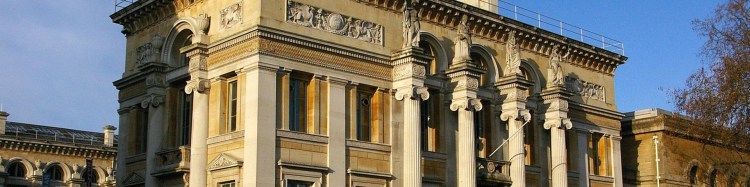
Established in 1896, Campion Hall holds extensive collections, including in the areas of Iberian & Latin American art.
Visit Led by Professor Peter Davidson, Senior Research Fellow & Archivist
***Attendees are asked to arrive punctually, as late arrivals may be difficult to accommodate***
12:00 Taylor Institution
St. Giles’, Oxford, OX1 3NA — https://www.bodleian.ox.ac.uk/taylor & http://blogs.bodleian.ox.ac.uk/taylorian
Established through the legacy of architect Sir Robert Taylor (1714-1788), the ‘Taylorian’ is the University’s centre for the study of Modern European languages and literatures, other than English.
AGM and Prize Giving — Sandwich lunch provided
15:00 Magdalen College
High Street, Oxford, OX1 4 AU — http://www.magd.ox.ac.uk
Founded by William Waynflete in 1458, the College holds wide-ranging art collections. Visit Led by the Dean, the Revd Dr Jonathan Arnold: Chapel altarpiece, Christ Carrying the Cross (attrib. Valdés Leal/Seville School, 17thC; for in situ discussion)
Venues can accommodate limited numbers only, so book early to avoid disappointment. To book, please email artesiberia@gmail.com, stating
(1) Whether you will arrive in time for the Campion Hall visit
(2) Your membership status
Once your place has been confirmed please pay a small charge to cover costs: £7 for members, or £20 for non-members

‘Oh wonderful Spain. Think of this romantic land covered in Moorish ruins and full of Murillos’
Benjamin Disraeli’s 1830 letter attests to the prominence of Bartolomé Esteban Murillo in the minds British travellers and collectors. In celebration of the 400thanniversary of Murillo’s birth, the Wallace Collection, in collaboration with the Centro de Estudios Europa Hispánica, will be exploring this further by hosting an international one-day symposium on 14th May 2018 entitled ‘Collecting Murillo in Britain and Ireland’.
Speakers include Thierry Morel, Veronique Gerard Powell, Xanthe Brooke, Hugh Brigstocke, Isabelle Kent, Xavier Bray, Claudia Hopkins, Thomas Bean, Hilary Macarney and Philip McEvansoneya. We are delighted to have this group of acclaimed scholars coming together to discuss new research surrounding the collecting of Murillo in Britain and Ireland.The seminars delivered will form the basis of a new volume on the subject to be published by CEEH.
Click here to buy a ticket to the symposium
Programme
09:30 – Registration
09:50 – Welcome
Session 1) Early Displays of Works by Murillo in Britain
10:00 – Sir Robert Walpole’s Spanish Pictures. Thierry Morel (Director and Curator at Large, Hermitage Museum Foundation)
10:30 – From Lord Godolphin to John Blackwood and Lawrence Dundas: the first British purchasers of Murillo. Véronique Gerard Powell (Honorary Senior Lecturer, Sorbonne University)
11:00 – tea and coffee break
Session 2) British Collectors in Seville and Madrid
11:30 – Collecting Murillo in Seville: the case of Julian Benjamin Williams (d.1866) and Frank Hall Standish (1799-1840). Xanthe Brooke (Curator of Continental European Art, Walker Art Gallery)
12:00 – William Eden: the discovery of Murillo with his friends in Spain. Travel and collecting. Hugh Brigstocke (independent scholar)
12:30 – The curious case of General Meade (1775 – 1849): his collection in Madrid and its dissemination. Isabelle Kent (Enriqueta Harris Frankfort Curatorial Assistant, The Wallace Collection)
13:00 – Break for lunch (not included)
14:00 – William Buchanan and James Irvine: In-situ talk in the Great Gallery. Xavier Bray (Director, The Wallace Collection) and Isabelle Kent
Session 3) Artists and Scholars travellers to Spain
14:30 – ‘All softness’ – Murillo through British artists’ eyes. Claudia Hopkins (Lecturer, University of Edinburgh)
15:00 – Hand-Book for Travellers in Spain and Richard Ford. Thomas Bean (private researcher)
15:30 – Accessing Murillo: Stirling Maxwell’s contribution to scholarship, collecting and taste in Britain. Hilary Macartney (Lecturer, University of Glasgow)
Session 4) Other Major Collectors
16:00 – Collecting and displaying Murillo in Ireland. Philip McEvansoneya (Lecturer, Trinity College Dublin)
16:30 – Close

13:00 – 14:30 13:00 – 14:30 Registration and opportunity to visit the drawings by Murillo and other Spanish masters in the Courtauld Prints and Drawings Study Room (Please note: directions to the Study Room and information on the visit will be provided upon registration)
14:30 Welcome
14:35 – 15:05 Manuela Mena Marqués, Senior Curator of 18th Century Painting and Goya, Museo Nacional del Prado, Madrid: “Murillo the Draughtsman”
15:05 – 15:35 Xanthe Brooke, Curator of Continental European Art, Walker Art Gallery, Liverpool: “Murillo’s Virgin and Child in Glory: The Afterlife of a Great Baroque Altarpiece”
15:35 – 16:05 Benito Navarrete Prieto, Professor, History of Art at the University of Alcala and Director of the Department of History and Philosophy: “Empathy and Prestige: The Real Reasons for Collecting Murillo’s Work in the Seville of his Patrons”
16:05 – 16:35 Tea
16:35 – 17:05 Laura Alba Carcelén, Conservation Scientist, Museo Nacional del Prado, Madrid’: “At Murillo´s Workshop: Pictorial Materials and Procedures”
17:05 – 17:35 Mairi Macdonald, Birkbeck College, University of London: “Murillo and Depictions of Poverty”
17:35 – 17:55 Discussion and close
18:00 – 19:00 Drinks and tapas
19:30 Invitation to attend a free concert of Spanish Renaissance and Baroque music organised by the Instituto Cervantes in Kings College Chapel (next door to the Courtauld). Please visit this link to book tickets.
For tickets to the conference, please click here
General public £16
Students £11
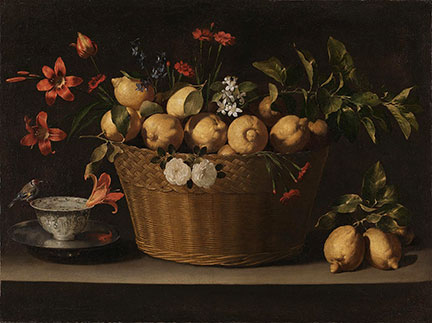 The National Gallery, London, has recently acquired Still Life with Lemons, Lilies, Carnations, Roses and a Lemon Blossom in a Wicker Basket, the first work by Juan de Zurbarán to enter a public collection in the UK. On display at the Gallery since 25 April 2018, the work was painted in about 1643–49 by the son of leading Golden Age artist Francisco de Zurbarán. Long overshadowed by his father, Juan was a skilled still life painter documented in Seville between 1620 and 1649. Works by his hand are extremely rare as his career was cut short at 29 by the plague which halved the city’s population.
 ARTES
ARTES 