

Featured Exhibition: The Auckland Project at Sotheby’s: Paintings from the Spanish Gallery, Sotheby’s New York
Open until 11 February
1334 York Avenue, New York, NY 10021

This exhibition features a selection of outstanding Spanish Old Master paintings by such artists as Juan de Juanes, Juan Bautista Maíno, Juan van der Hamen, Francisco Bayeu and others. Acquired by The Auckland Project through Sotheby’s, these works will feature in the collection of the Spanish Gallery in Bishop Auckland, North East England, due to open in 2019. The Gallery forms part of an inspiring initiative to create a world-class visitor destination and revitalise this former industrial town through employment, training and educational opportunities.
The exhibition catalogue is available online at this link.
Job: Lecturer/senior lecturer in art history c. 1400-1800

| Salary: | Competitive salary |
| Closing Date: | Wednesday 21 February 2018 |
| Interview Date: | See advert |
| Reference: | 189 |
The Courtauld Institute of Art is the UK’s leading institution for teaching and research in Art History and the conservation of paintings; it is also home to one of the finest small art museums in the world. The Art History department has an outstanding research and teaching record from Late Antiquity to the Contemporary with an increasingly global outlook, and embraces its diversity of theoretical approaches and methodologies.
The Courtauld wishes to appoint a full-time Lecturer/Senior Lecturer in Art History, to begin on 1 September 2018. The successful candidate will complement the existing teaching strengths of the Department and will have a research focus in any region or period from c.1400-1800. We seek an art historian who situates their research in a wider, global context, and who shares a ‘decentred’ approach that avoids focus on only a single part of the world. An ideal candidate would be able to teach across at least one other field in a way directed by concepts of exchange and interaction, and to build bridges with other areas of art historical investigation. The candidate is expected to be able to situate their work in the theoretical and historiographical debates in their specialised research area and also engage with current issues in global Art History.
The appointee will research and publish to the highest quality and will actively pursue and apply for appropriate research grants; will provide inspiring teaching at both undergraduate and postgraduate levels; and will play an active role in the life and administration of The Courtauld.
PAY: Grade 6 (£36,644 to £41,958) or Grade 7 (£43,117 to £49,461), depending on experience
DEADLINE FOR APPLICATIONS: 21 February 2018, 23:59 GMT
INTERVIEW DATE: Interviews will be held in the week of 19 March 2018
Art historian, philanthropist and ARTES member William Jordan has died at 77
After obtaining a Ph.D. from the Institute of Fine Arts in New York, he helped Mr. Algur Meadows form a new collection of Spanish paintings for Southern Methodist University. Later on, he was curator at the Dallas Museum of Art, Kimbell Art Museum and, eventually, a trustee of the Nasher Sculpture Center and the DMA.

(Joe Laird /Staff Photographer)
Jordan was known for his unerring eye and outstanding ability to identify potential acquisitions and new masterpieces. Perhaps his crowning achievement was the discovery and subsequent personal gift to the Prado Museum in Madrid of the Portrait of Philip III by the greatest Spanish painter of the Golden Age, Diego Velázquez. Jordan donated the work (estimated at $6 million) to the Prado on Dec. 17, 2016 and was consequently made a trustee of the most significant museum of Spanish art in the world.
Lecture: Felipe Pereda, ‘Images’ Oblivious Memory: Funerary Laments from Ancient Greece to El Greco’. Courtauld Institute of Art, London, 4pm, Thursday 25th January, 2018
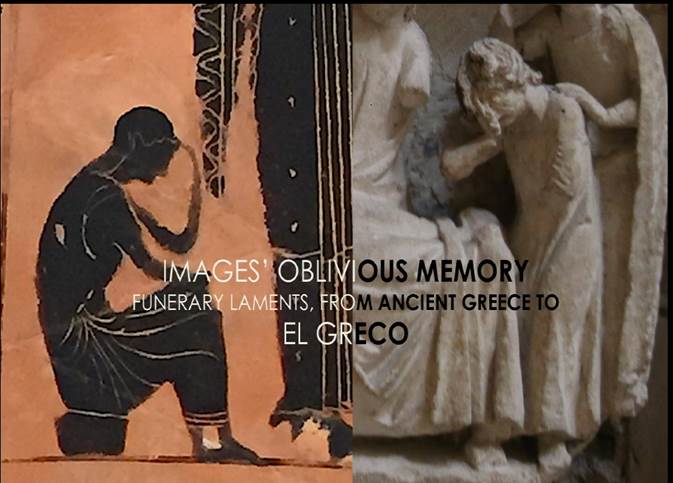
Felipe Pereda (Harvard), will give the inaugural lecture for the 2018-19 Coll & Cortes Medieval Spain Seminar Series at 4pm on Thursday 25th January in the Kenneth Clark Lecture Theatre of the Courtauld Institute of Art, London.
An old narrative tradition going back to Ancient Egypt but documented across the Mediterranean – from the Middle East to Greece — shows women attending funerals performing theatrical, but also highly ritualized gestures that express unbearable pain. This visual trope corresponds to a practice that was surveyed and prosecuted in this part of the world well before the arrival of Christianity. The practice continued in Iberia throughout the Middle Ages, producing from the 12th century onwards an extraordinary tradition of painting and monumental sculpture. This lecture will explore the persistence, survival and repression of this practice and discuss the contribution of the visual arts to the production of cultural memory.
Felipe Pereda is Fernando Zóbel de Ayala Professor of Spanish Art at Harvard University. Born in Madrid, he studied at the Universidad Complutense, and the Autónoma University where he received his PhD (1995) and taught until 2011. In more recent years, he has also taught at the Instituto de Investigaciones Estéticas (Universidad Autónoma de México), and Johns Hopkins University (2011-15). He has worked on Spanish late medieval and early modern art, art theory, image theory and history of architecture.
His books include, La arquitectura elocuente (1999), El atlas del Rey Planeta (3rd. ed. 2003), and Images of Discord. Poetics and Politics of the Sacred Image in 15th century Spain (Spanish ed. 2007; English translation, Harvey Miller, forthcoming). He has recently published on artists such as Luis de Morales, Ribera, or Zurbarán.
Casa Vicens, a home designed by Gaudí, now open to the public in Barcelona
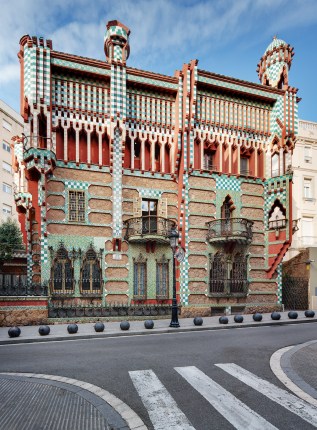
The first home designed by Catalan architect Antoni Gaudí has recently opened to the public. Built between 1883 and 1885 as a summer house for the Vicens family, it is a masterpiece of riotous colour in an eclectic neo-moorish style. After over a century of transformations at the hands of various different owners, the World Heritage Site has been returned to its original disposition, while an addition constructed in 1925 has been transformed into a museum. Located in the Gràcia district and surrounded by a verdant garden, the house is open everyday, from 10 am to 8 pm.
Carrer de les Carolines, 20, 08012 Barcelona, Spain
Open daily from 10 am to 8 pm except 25 December, 1 and 6 January
News: Meadows Museum acquires last painting by Spanish master Mariano Fortuny y Marsal

Oil on canvas, 27 x 51 ¼ in. (68.6 x 130.2 cm). Meadows Museum, SMU, Dallas.
The Southern Methodist University’s Website announced today that The Meadows Museum has acquired Beach at Portici, the last painting of famed Spanish artist Mariano Fortuny y Marsal (1838-1874).
This large-scale, unfinished work depicts the carefree atmosphere of a bbeautiful summer day at the beach, demonstrating Fortuny’s hallmark ability to capture light in paint.
Fortuny was an especially popular artist with 19th-century American collectors and audiences, as revealed by the American provenance of this work. Indeed, it was featured prominently in the American Pavilion’s “Loan Collection of Foreign Masterpieces Owned in the United States” at the 1893 World’s Columbian Exposition in Chicago, one of the most important international exhibitions of the 19th century.
Beach at Portici will be on view at the Meadows Museum beginning January 19, 2018. From June 24 through September 23, it will be the subject of a focused exhibition, At the Beach: Mariano Fortuny y Marsal and William Merritt Chase.
Extended: Murillo: The Self-Portraits now on until February 11, 2018

Until February 11, the Frick Collection in New York is celebrating Bartolomé Esteban Murillo, one of the outstanding painters of the Spanish Golden Age, who will turn 400 years old on 31 December. Well known for his religious paintings and his extraordinary depictions of street urchins, he was also an ingenious painter of portraits. This genre remains, however, the least studied aspect of his work. Inspired by the self-portraits in their holdings, New York’s Frick Collection and London’s National Gallery have co-organized a show which will move to London from February 28 through May 21, 2018.
As widely reported by the media, including the Guardian, an exceptional self-portrait by Murillo just discovered at Penrhyn Castle in Wales has been added to the show on account of its exceptionality.
Click here for more information on the show.
News: 200 works of contemporary Latin American art donated to six museums

ARTES Coll & Cortés Travel Scholarship report: Sylvia Alvares-Correa (PhD Candidate, University of Oxford)

The Annunciation
1512-1520
Oil on oak panel
Museu de Arte Sacra do Funchal, inv. MASF35
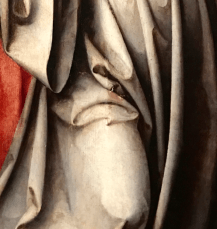
The generous award funds provided by ARTES Coll&Cortes allowed me to travel to Lisbon to investigate the transmission of Flemish art, designs, and techniques to Portugal in the late medieval period, on which my PhD research is based. The trip fortuitously overlapped with the exhibition ‘The Islands of White Gold, Art Commissions in Madeira: 15th and 16th Centuries’ at the Museu Nacional De Arte Antiga as well as the ‘Medieval Europe in Motion—The Middle Ages, A Global Context?’ conference hosted at the Calouste Gulbenkian Foundation. Both introduced me to works of art and research with which I had not been familiar and underlined the complexity and ambiguity involved in defining artistic transmission.

Triptych of the Descent from the Cross
Oil on oak panel
Museu Nacional de Arte Antiga, Inv. 1285 Pint
The fluid movement of artists and designs between north and south during this period means that just because something looks Flemish doesn’t necessarily mean it is; unfortunately, ‘style’ is often the determinant factor in classifying the origin of artworks in museums as well as in literature. Production methods can help elucidate if not by who at least where an artwork was made. To this end, the research trip sponsored by ARTES Coll & Cortes allowed me to collect data on the different joinery methods used in 15th and 16th century panel painting. Specifically, I sought out works joined by perpendicular dowels. Internal dowels, the predominate joinery method found in the north, in some cases dictated by guild regulations, are less likely to disrupt the surface of the painting; perpendicular dowels, however, tend to protrude slightly to the surface over time and can often be discerned with the naked eye. Current research proposes that the latter joinery method was predominant exclusively in Portugal (though famously employed by Hugo van der Goes as well).

My preliminary investigations, however, yielded evidence that perpendicular dowels were utilized not only Portuguese panel paintings, but also in panels believed to be imported from Flanders. While it is too early to draw conclusions, the diversity of joinery methods observed suggest that either perpendicular dowels were not as uncommon to northern production as has been supposed or that certain works in Portuguese collections which have been classified as ‘Flemish’ were perhaps produced locally. I’m looking forward to delving in further!
 ARTES
ARTES 