 This international workshop aims to contribute to the visibilization of enslaved and free peoples of Afro-Hispanic descent, by exploring their representation in the visual and literary regimes of early modern Spain and the New World, and to generate critical insights into the articulation of slave subjectivities.
This gathering, supported by CILAVS, the Centre of Iberian and Latin American Visual Studies at Birkbeck, University of London is organised by the Transatlantic Afro-Hispanic Study Group, that emerged from the international conference Border Subjects/ Global Hispanisms (Birkbeck, November 2017). The latter was the outcome of the institutional collaboration between the Department of Cultures and Languages at Birkbeck and the Department of Hispanic Languages and Literatures at the University of Pittsburgh. This collaboration has already produced our first publication entitled, Post/Colonialism and the Pursuit of Freedom in the Black Atlantic (Routledge, 2018, ed. J. Branche), the result of an international conference held at the University of Pittsburgh in 2015.
To attend the workshop, please register here.
PROGRAMME
14:30pm-16:00
Jerome Branche (University of Pittsburgh, USA), Love and Affec(ta)tion: Re/Viewing Francisco de Quevedo’s ‘Boda de negros’
Francisco de Quevedo’s ‘Boda de negros,’ (in)famous for its conceptista artistry as much as for its anti-immigrant and anti-black virulence, acquires an important historico-existential dimension when considered in the broader context of (Hispano)-Christian religious symbology of the seventeenth century. My paper proposes that the poem’s central trope of marital consummation, the performance of coitus by the black groom, simultaneously speaks to and reveals important additional registers of both sexual and racial dominance. On the one hand, the aromantic and bloody implications of bridal penetration sans affection figure as an early discursive projection of black brutality in Hispanic and western artistic discourse, as also do the poem’s references to cannibalism. On the other, the image of the nail (es/clavo), which he punningly deploys to also identify Tomé, the groom, partakes of the symbology of humiliation, servitude, and death (by crucifixion), that characterize Catholic traditions of mysticism, saintliness and self-negation. My paper proposes that a reflection on the image of the S and the nail deployed here by the poet, ubiquitous in the popular and religious iconography of the time, beyond the symbolism of Christian devotion/abjection, also speaks volumes in relation to the enslaved, incoming Africans, and to the material and epistemic violence visited and potentially visited on their bodies under the aegis of conquest and enslavement.
Baltasar Fra-Molinero (Bates College, Maine, USA), Black Women and the Inquisition: Race, Gender, Healing, and Power
More than two hundred women of African descent were prosecuted by the Inquisition of the Canary Islands between 1505 and 1834. Most cases involved accusations of witchcraft, or its lesser charge, sorcery. The accusations involved healing practices that the religious authorities considered unorthodox. The accusers could be priests as well as lay people who, in some cases, were coerced to testify against these women on the basis of their social reputation as healers outside the legal and professional channels. These women competed against the male practitioners of faculty medicine as well as against curanderosand saludadores, men and women who were authorized to use a mixture of empirical healing knowledge with religious prayers to obtain cures or remedies to the health of individuals or entire groups. This presentation explores the tensions created when Black women in the Canary Islands practiced medicine and magic healing while negotiating their social exclusion due to their gender and race. The reputation some of these Black women gained broke boundaries of religious and social prohibition. The Inquisition moved against many of these Black women on charges both of heresy—use of religious objects and words without authorization—and professional impropriety—practicing medicine without proper faculty—a crime that clearly fell outside the jurisdiction of the Holy Office.
Helen Melling (Institute of Latin American Studies, University of London, U.K.), Contested Visions of Black Wet Nurses in 18th & 19th Century Lima
Portraits of infants alongside their black wet nurses and nannies were incorporated into the family albums of the wealthiest Peruvian and European immigrant families in Lima from the 1860s, coinciding with the immediate post-abolition period in Peru. Although the creole elite’s preference in employing wet nurses of African-descent is examined and contested in late 18th century discourses, their presence in Peruvian visual culture does not arise until the advent of photography, producing the first images to make visible a practice that dates from Peru’s colonial and slaveholding past. The duplicity of these portraits resides in the dissonance between the marginal or supposedly ‘invisible’ presence of the wet nurse, and their centrality in the formation of an elite identity. This tension ruptures the fantasy of masterly ownership and creole ‘whiteness’, with the wet nurse constituting a deeply ambivalent symbol of the socio-racial pedigree of the elite.
16:15-16:30 Break
16.30-18.15
Carmen Fracchia (Birkbeck, University of London, U.K.), The Colour of Freedom in Hapsburg Spain (16th-17th Centuries)
This paper addresses the ways in which visual artists articulate and problematize the hegemonic associations of the appearance of (a) blackness as the social condition of slavery and the appearance of (b) whiteness as the social condition of freedom in the visual form. It will also focus on the hegemonic idea of ‘whiteness’ as the exclusive referent of the concept of humanity and on ‘blackness’ as the referent of Afro-Hispanic counter-culture as articulated in anonymous poems written individually and collectively by enslaved and liberated Afro-Hispanic people in the Spanish black confraternities.
José Miguel López García (University Autónoma of Madrid, Spain), In Pursuit of Freedom: Emancipated, Coartados, and Marrooned in Madrid (1701-1820)
During the Bourbon Dynasty, slaves in Madrid could obtain their freedom through letters of emancipation, deeds of ransom (coartación), or by running away. This paper, based on the analysis of 344 documents from the beginning of the eighteenth century to the early 19th century, considers the different degrees and routes to freedom that slaves could aspire to in a European capital city.
Luis Méndez Rodriguez (University of Seville, Spain), Narratives and Fictions Around Slavery: Towards A New Artistic Imaginary
This work analyzes the elements which defined artistic narratives and which allowed the spread of a visual culture of transatlantic slavery through the Hispanic world from the beginning of the seventeenth century. The Baroque created a set of archetypal images of Afro-Hispanic people, based eitheron their integration into, or their social exclusion from Hispanic societies. In this way, many groups congregated into ethnicbrotherhoods where they found a space to protect themselves from external threats, based on solidarity which allowed their visible participation in the public space. This paper also analyzes a set of images which formed an iconography of slavery. In the artistic context, some slaves not only achieved their freedom but also developed a profession and a certain social recognition. Their presence is studied in the development of a first artistic historiography based on documentary evidence, which also reveals how a fictional discourse of Afro-Hispanic lives was generated in the centuries that followed.

 This post is full-time and fixed term (1 September 2018 – 31 August 2019).

 On 14 June 2018 ARTES held its AGM and prize-giving ceremony in Oxford. It was a day packed with special visits to rarely-seen collections of Spanish art in the city. The day started at Campion Hall, a Jesuit private hall which hosts a fascinating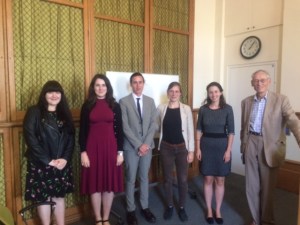

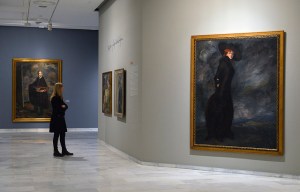 Zuloaga. Character and Emotion (until 26 August 2018)
 Sorolla and Spirituality (until 2 September 2018)
 Open until 4 November 2018, this exhibition presents an extraordinary collection of personal artefacts and clothing belonging to the iconic Mexican artist Frida Kahlo. Locked away for 50 years after her death, this collection has never before been exhibited outside Mexico. Click
  Running until 7th October 2018, this large-scale special exhibition at
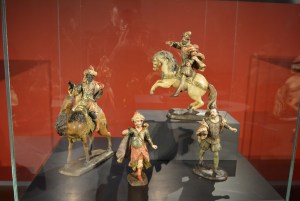 Now on display at the Museo Nacional de Escultura in Valladolid the museum’s newly acquired group of 19 individual polychrome sculptures by the Seville-born Luisa Roldán (1652-1706), forming the unusual subject of the Cavalcade of the Kings. These small-scale cedar-wood painted and gilded figures were acquired in December 2017 after being export-stopped and are the first examples of La Roldana’s work to enter the Valladolid museum. Amongst the mixed-race cavalcade, which is presumed to have formed the cortege for a much larger, but now dismantled, group, there is a fourth king, the King of Tharsis, the mythical Hispanic region cited in the Bible. The group is believed to have been carved before the sculptress moved to the Madrid court in 1689. A video clip showing some of the figures can be viewed
  ARTES
ARTES 